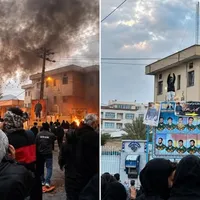
Iran’s judiciary chief Gholamhossein Mohseni Ejei on Monday ordered rapid prosecution and punishment for anyone found cooperating with Israel, warning that wartime conditions require immediate legal action.
“If anyone is found to have collaborated with the Zionist regime, they must be swiftly tried and punished without delay,” Ejei said during a high-level judicial meeting in Tehran.
He warned that those attempting to exploit the current situation to destabilize the country—whether through physical or psychological means—would face “the most severe penalties under the law.”


Iran’s Foreign Ministry spokesman Esmaeil Baghaei said Monday that Israel’s attacks on residential areas and nuclear sites were carried out with US support, and dismissed any talk of nuclear negotiations as “meaningless” under current conditions.
“Israel, with the support of the United States, attacked us,” Baghaei said during a press conference, accusing both countries of violating international norms and threatening regional peace.
Baghaei also rejected what he described as “ambiguous statements calling for Iran’s restraint,” saying they amount to hypocrisy.

Israel is using mobile phone tracking technology to carry out assassinations inside Iran, including of nuclear scientists in the latest strikes, the IRGC-affiliated Fars News Agency reported Monday.
"Israel uses mobile tracking to assassinate individuals in Iran. It previously killed Ismail Haniyeh the same way in Tehran,” the outlet said.
Fars added that even turning off mobile phones at meeting locations or residences can still reveal individuals’ whereabouts, and recommended using secure, anti-tracking phones.
The report follows a call by a Tehran lawmaker urging military and government officials to collect their own and their associates' mobile phones to prevent tracking.
Iranian missiles hit multiple Israeli cities early Monday, killing at least eight people and wounding over 100, according to Israeli army radio.
The latest casualties bring Israel’s death toll to 21 since Friday, as Iran continues retaliatory strikes following Israeli attacks on its nuclear and missile infrastructure.
The escalation has raised alarm among leaders attending this week’s G7 summit, amid fears that the conflict could expand into a broader regional war.
Israel’s recent strikes on Iran’s nuclear facilities may have seriously damaged the underground Natanz enrichment site, according to a report by The Wall Street Journal citing Israeli and international officials.
An Israeli official told the paper there are early indications that the underground portion of the Natanz facility may have imploded, though further assessments are still needed. The International Atomic Energy Agency (IAEA) said the sudden loss of power at Natanz could have destroyed some of the site’s 14,000 centrifuges, which are highly sensitive and can be damaged if not shut down properly.
The fate of Iran’s enriched uranium stockpiles — stored at Natanz, Isfahan, and Fordow — remains unclear. Israeli officials said Tehran had recently signaled it might disperse those supplies, adding urgency to the timing of the strikes.
Iran on Monday executed Esmaeil Fekri, accused of spying for Israel’s Mossad, after the Supreme Court upheld his death sentence, state media said.
Authorities said Fekri passed classified information to Israeli agents.
The execution is the third in recent weeks related to allegations of espionage on behalf of Israel.
In April, Mohsen Langarneshin, a cybersecurity expert, was executed in Ghezelhesar prison. Rights groups and activists have said his conviction was based on forced confessions and flawed legal proceedings.
Earlier this year, Norway-based rights group Iran Human Rights (IHR) warned that Fekri was transferred from Ward 4 of Evin Prison to Ghezelhesar Prison on 15 February alongside Langarneshin, raising concerns of their imminent execution as hangings of prisoners held in Evin are often carried out in Ghezelhesar.