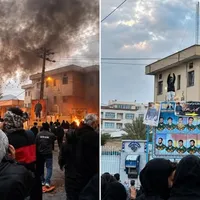
East Azarbaijan’s crisis management office confirmed Sunday that air defenses were activated over Tabriz and Sahand, responding to what officials called “Israeli aggression.”
No explosions have been reported, but defense systems were engaged throughout the morning, Noor News reported.
The office said the death toll in Tabriz has risen to 34.
An Iranian cleric and the imam of a Mosque in Tehran’s Shahrak-e Chamran, was killed in Israeli strikes during Friday’s attack, Iranian media reported Sunday.
His wife and their three children also were killed.
Further Iranian missile attacks on Israel are expected in the coming days, IDF Spokesman Brig. Gen. Effie Defrin said Sunday, as Israeli airstrikes on Tehran continued around the clock.
“Challenging days are ahead. There will be more launches and impacts in the coming days,” Defrin told reporters at a press conference.
He said Israeli jets were still targeting Iranian positions, especially in and around the capital.
“Even at this hour, we are striking dozens of targets in Tehran,” Defrin said. “We are deepening the damage to [Tehran’s] nuclear program and military capabilities, to disrupt and reduce the risk to the home front.”

Iran International audience reported explosions and smoke around Azimieh, near Karaj, following an Israeli strike.
Another message said drones were targeting air defense systems atop the surrounding mountains.
After the Israeli military warned of large-scale attacks on Tehran, reports emerged of blasts in various neighborhoods of the capital, including Shahrak-e Gharb, Saadatabad, Punak, Ekbatan, and Chitgar.
Residents across Tehran and Karaj described hearing multiple explosions and seeing air defense fire in the skies.
Users in numerous Iranian cities told Iran international that they are experiencing significant internet disruptions.
Multiple witnesses said that accessing social media platforms like Instagram and messaging services such as WhatsApp has become extremely difficult.
Internet slowdowns and partial blackouts have made it hard for citizens to share updates, coordinate aid, and stay informed about unfolding events.
The interruptions mirror previous tactics during times of crisis, raising concerns about restricted access to independent reporting and emergency communication during wartime conditions.
Iran could force a ceasefire by launching 2,000 missiles, especially hypersonic ones, in coming nights, lawmaker Ahmad Bakhshayesh Ardestani said.
“If Iran can fire 2,000 missiles—especially hypersonic ones—over the next one or two nights, rest assured that the whole world, including France, Germany, and even Britain, will come and demand a ceasefire,” he said.