Israel’s surprise airstrikes on across Iran—confirmed to have killed several senior officials—have triggered a wave of intense reactions from Iranians, experts and politicians ranging from celebration to alarm over the risk of war.
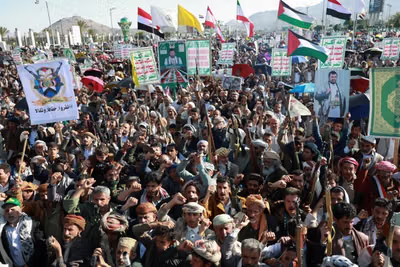
Among those killed was Revolutionary Guards chief Hossein Salami, prompting jubilation from many in the Iranian diaspora. Kaveh Shahrooz, a Canadian human rights lawyer and activist, posted on X:
“His hands dripped with the blood of 176 people aboard flight #PS752. May this be true. May there be a hell for him to burn in,” referring to an airliner shot down by the military unit in Tehran in 2020.
Actress and human rights activist Nazanin Boniadi warned that ordinary Iranians—already caught between an authoritatian government and years of economic pressure—now face the added threat of war.
"There was a 3rd path: strangle the regime, empower the people," Boniadi wrote, "Few committed to it. Now, innocent Iranians—who yearn for freedom—are caught b/w foreign firepower & domestic tyranny."
Former Obama adviser Ben Rhodes also weighed in, calling the strikes senseless and warning of a cycle of violence that could derail any remaining path to diplomacy.
Iran analyst and author Arash Azizi pointed out that a new round of nuclear talks was just days away, arguing that the decision to launch a strike now undermines diplomatic efforts and could plunge the region into broader conflict.
“Even if we take Netanyahu at face value here, Iran was months away from developing a nuclear weapon ... there was a round of diplomatic talks scheduled in THREE DAYS.... what justifies an attack before that?”, Azizi wrote on X.
Democratic Senator John Fetterman responded bluntly to reports of General Hossein Salami’s death, posting “thank u, next” on X after confirmation of the IRGC commander’s killing in the Israeli strikes.
A senior Israeli official told Iran International that leaders' homes and not civilians were targeted in airstrikes in Tehran, as Iranian state media announced the death of the Revolutionary Guards chief Hossein Salami.
"Homes of senior military and political officials were targeted in Israeli airstrikes in Tehran," a senior Israeli political official told Iran International, speaking on condition of anonymity.
"Civilians are not the intended targets," the official added.
Iran International was the first media outlet to publish official confirmation of the Israeli attack on Iran and its targets.
State news outlet IRNA reported that Hossein Salami, the head of Iran's Islamic Revolutionary Guard Corps, along with another top commander and two senior nuclear officials were killed.
Ali Shamkhani, an advisor to Supreme Leader Ali Khamenei, was seriously wounded during an attack on his residence and has been transferred to a hospital in Tehran in critical condition, Nour News, a media outlet close to the Supreme National Security Council reported.
Khamenei is alive and being briefed on the situation following Israel's attack on Iran, Reuters reported citing a security source.
US President Donald Trump on Thursday said he did not want Israel to attack its arch-foe Iran while there was still hope for a nuclear deal with Washington but warned a 'massive conflict' in the region was possible.
Speaking at White House press conference, Trump said an Israeli attack on Iran was possible but that he hoped for a negotiated solution to the nuclear impasse.
Responding to reporter's question, Trump said, "Well I don't want to say imminent, but it looks like it's something that could very well happen."
"I'd love to avoid a conflict. Iran's going to have to ... give us some things that they're not willing to give us right now," Trump said. Tehran and Washington remain at loggerheads over whether Iran can keep enriching uranium on its own soil.
Trump added the two sides are "fairly close to a pretty good agreement," but struck an ambivalent note about the impact of a potential Israeli strike.
"As long as I think there is an agreement, I don't want them (Israel) going in, because I think that would blow it. Might help it actually, but it also could blow it."
Israel is weighing a potential attack on Iran within days, ABC News reported on Thursday citing three sources familiar with the situation.
The network cited the sources as saying they were unaware of any specific US role but added it was possible the United States could share intelligence or support logistics.
A sixth round of US-Iran nuclear talks is due to convene in the Omani capital Muscat on Sunday, in what could be a decisive moment for the war-weary region.
Trump on Thursday cited the possibility of a potential "massive conflict" in the region for drawing down US personnel from the Middle East, a day after US officials said the embassy in Baghdad would be partially evacuated.
"There's a chance of massive conflict. We have a lot of American people in this area, and I said we've got to tell them to get out, because something could happen soon," Trump said. "I don't want to be the one that didn't give any warning and missiles are flying into their buildings."
"He's going to drag us into a war"
Iranian rhetoric had ratcheted up on Wednesday as Defense Minister Aziz Nassirzadeh said Tehran would strike American bases in the region if nuclear negotiations fail and conflict breaks out.
"Some officials on the other side threaten conflict if negotiations don't come to fruition. If a conflict is imposed on us... all US bases are within our reach and we will boldly target them in host countries," Nassirzadeh said during a press conference.
Iranian officials also bristled at a resolution passed against it at the International Atomic Energy Agency (IAEA) on Thursday finding Tehran non-compliant with proliferation obligations.
The move put the Islamic Republic further at odds with the United Nations nuclear watchdog which inspects its nuclear facilities and would be a key player in any deal.
Meanwhile a prominent Democratic lawmaker urged the US Defense Secretary not to allow Israel to embroil the United States in a conflict and unsuccessfully sought to extract a pledge from Pete Hegseth not to strike Iran unless attacked.
"Will you commit to us not bombing (Iran) ... unless we're directly hit?" California representative Ro Khanna asked at a House hearing on Thursday.
"Would you agree ... that Netanyahu is itching for a fight? If Netanyahu uses American missiles to hit Iran, he's going to drag us into a war there," Khanna added.
The remarks were a rare public intervention by a Democratic lawmaker on Trump's Iran policy.
Hegseth said Trump sought peace but understood what he called the Iranian threat.
"The President has been earnestly and completely committed to a peace process. He's given Iran every opportunity, those talks are ongoing, but he also fully recognizes the threat that Iran poses."
Iranian state media began releasing images of what it said were documents related to Israel's nuclear program obtained by Tehran and said they demonstrated collusion between the United Nations nuclear agency and arch-foe Israel.
"The first set of documents obtained from the Israeli regime shows that Grossi, the Secretary General of the International Atomic Energy Agency, had full cooperation and close coordination with this regime and fully implemented its orders," the Tasneem news agency wrote on X.
The outlet, which is affiliated with Iran's Revolutionary Guards, included images of email exchanges in Hebrew and and what appeared to be a printed letter from Meirav Zafary-Odiz, Israel's ambassador to the IAEA, to its now chief Raphael Grossi.
Dated 2016, the alleged letter requests a meeting.
Other documents appeared to be email exchanges between Zafary-Odiz and an Israeli academic using an University of Washington email address and focused on panel discussions on nuclear topics.
Iran's intelligence ministry said last week it had obtained a trove of sensitive material from Israel, including documents it says are related to the Jewish state's nuclear and strategic facilities.
Israeli security experts cast doubt on the assertion, saying it was likely part of a state attempt to sway opinion as US-Iran nuclear talks enter a critical phase.
Amir Rashidi, director of cyber security and digital rights of the Iran-focused human rights NGO the Miaan Group, said the documents released on Thursday appeared dubious.
"There are several red flags that raise questions about the authenticity and origin of these materials," he wrote in a post on LinkedIn.
Their presentation as screenshots impairs verification through metadata and timestamps, pages are numbered in Persian-Arabic script and Iranian hackers' past compromising of academic accounts makes the university email address suspect, Rashidi said.
Iranian President Masoud Pezeshkian on Thursday criticized a resolution passed by the UN nuclear watchdog’s board of governors against Tehran’s nuclear activities, saying that Iran will continue its uranium enrichment and remain defiant in the face of Western pressure.
"Today, the United Kingdom, France, and Germany passed a resolution against Iran. I truly do not understand how we are supposed to cooperate with a world that keeps provoking us and refuses to let the people of this nation stand on their own and live independently," Pezeshkian said during a meeting with teachers, academics, and cultural figures in the western province of Ilam.
The remarks came a few hours after the International Atomic Energy Agency’s (IAEA) board adopted a non-compliance resolution criticizing Iran for lack of cooperation with inspectors and its ongoing expansion of nuclear activities, which Western powers say could pose proliferation risks.
Reaffirming Tehran’s nuclear posture, Pezeshkian said, “We will continue on our path. We will carry on with enrichment and we will not back down from the current course. This is a national right, and we will not compromise.”
"We will build this country with our youth. Even if they destroy our facilities with bombs, the knowledge and capability remain in our minds, and we will rebuild everything no matter what they do.”
Iran maintains that its nuclear program is solely for peaceful purposes, but its rapid expansion of enrichment activities and restrictions on international oversight have raised alarms in Washington and European capitals.
The resolution by the IAEA’s policy-making 35-nation board declaring Iran in breach of its non-proliferation obligations marked the first in almost 20 years, raising the prospect of reporting it to the UN Security Council.
The decision follows years of escalating tensions between Iran and the Vienna-based agency, particularly after the United States withdrew from the 2015 nuclear deal in 2018 under President Donald Trump, prompting the gradual collapse of the accord.
In response to the censure, an IAEA official said Iran had notified the agency of its intention of countermeasures such as establishing a new uranium enrichment facility.
Following the announcement, Israel’s Foreign Ministry condemned Iran’s move, accusing Tehran of undermining the global Non-Proliferation Treaty (NPT) and posing a serious threat to regional and international security.
Iran remains a signatory to the NPT, while Israel is not. Israel is widely believed to possess the Middle East’s only nuclear arsenal.
Withdrawal from the NPT is now under consideration at the Iranian parliament, the spokesman for the National Security and Foreign Policy Committee said after the resolution was passed.
Earlier in the day, a senior Israeli told Iran International that Israel is ready to launch a military strike on Iran if the next round of nuclear talks between Tehran and Washington, set for Sunday in Oman, fails to yield results.
The killing of 24-year-old Elahe Hosseinnejad by a driver from a ride-hailing app has deeply jarred Iranian women who say they live in daily fear on buses, in taxis and on the streets.
Hosseinnejad, a nail technician from Eslamshahr south of Tehran, vanished on her way home late last month, and her body was found days later riddled with stab wounds.
Police later arrested the man driving her, whose account of the murder varied from an altercation over payment to his alleged gendered slur that she had been "shameless", according to Iranian media citing police.
Voice messages and texts sent to Iran International's submissions line point to a deep well of shared trauma and anger in the male-dominated theocracy.
“I was nearly abducted in broad daylight,” one woman said. “I ran into a stranger’s house because I had no other way to escape. And this wasn’t even a remote place—this was a residential street.”
Dozens of accounts tell similar stories. One woman said her Snapp ride-hailing driver changed course three times, laughing when she protested. Another described how a man posing as a Tapsi driver sexually assaulted her on a highway outside Isfahan.
Snapp and Tapsi are Iran’s two leading app-based ride services modeled on Uber.
“These stories have always existed,” another woman said. “What Elahe’s death has done is rip the veil off.”
Hosseinnejad’s body was released under heavy security and buried without a public funeral.
Systemic fear and silence
In the messages submitted to Iran International, women described persistent sexual harassment in taxis, parks, workplaces and schools.
Some said they were assaulted while taking rides, others while walking to university or boarding a bus.
One woman described sitting quietly in a shared car when the driver suddenly pulled over and exposed himself. “I kicked the door open and ran,” she wrote. “But for weeks, he called me from different numbers, threatening to find me.”
“I went to file a complaint, and they asked if I had a witness,” another woman wrote. “I said if I had one, I wouldn’t be in this situation. They told me to drop it if I cared about my reputation.”
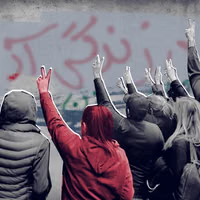
Two young women walk along a sidewalk while being closely watched and harassed by some men.
Several others shared versions of the same response: authorities demanding impossible evidence, mocking victims or advising them to stay quiet.
“The law is not on our side,” said another woman. “If something happens to you, they treat you like the criminal.”
Ride-hailing platforms in focus
Snapp and Tapsi, Iran’s dominant ride-hailing apps, came under renewed scrutiny following Hosseinnejad’s death.
Many contributors noted that both apps have faced growing criticism for weak driver vetting and limited response to complaints.
“I was 18, and the driver kept making crude comments,” one woman wrote. “When I reported him to Snapp, they told me they’d investigate. Nothing happened. He kept calling me from different phones.”
In several cases, riders said drivers had pressured them to adjust their clothing or implied they could be dropped off mid-trip to avoid fines under Iran’s hijab regulations.
“I wore my scarf just to avoid trouble,” wrote one student. “But the way they looked at me … it was like they were waiting for an opportunity.”
The cost of inequality
Women who contacted Iran International repeatedly returned to one point: gender-based inequality under the law.
“I don’t want revenge,” one woman said of Hosseinnejad’s accused killer. “I want justice. But how can there be justice when our lives are worth half as much under the law?”
Under Iranian law, murder is punishable by death, but when a man kills a woman, the victim’s family must first pay half the standard blood money—set annually by judicial authorities—to the killer’s family before an execution can take place. Activists say this devalues women’s lives and deters families from pursuing justice.
Elahe Hosseinnejad’s story has ignited anger—but also a grim sense of recognition. “She did everything right,” one woman said. “She worked, cared for her family, shared her beliefs—but still, she ended up dead."