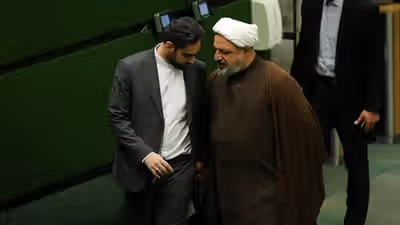
A member of Iran’s parliament said negotiations with the United States have so far produced the most benefit for Tehran, despite widespread skepticism about their purpose.
“Based on principles we’ve set for ourselves, we entered negotiations—and they’ve brought us the most gains to date,” said Salar Velayatmadar, a member of the national security committee.
Velayatmadar dismissed calls to suspend uranium enrichment, saying, “Halting enrichment is a fantasy of our enemies. Their predecessors took that dream to the grave, and so will they.”


Drivers in at least 105 cities across Iran took part in the fourth consecutive day of a nationwide strike demanding better working conditions, the Union of Truckers and Drivers’ Associations said in a statement on Sunday.
“Today marked the fourth day of a strike that, with your dignity and perseverance, has become a historic moment for the transport sector,” the union said. “Drivers in 105 cities across Iran responded to this call for justice, showing that the voice of the driver can no longer be silenced.”
Launched on May 22 in the southern port city of Bandar Abbas, the coordinated protest has since spread widely across the country, with truckers pledging to hold out for a full week or longer if their demands remain unmet.
Drivers are demanding better working conditions, higher freight rates, and relief from high insurance costs and fuel restrictions.
Footage received by Iran International on Sunday showed strikes continuing in cities across the provinces of South Khorasan, Ardabil, Bushehr, Sistan and Baluchestan, Gilan, Fars, Isfahan, Qazvin, West Azarbaijan, Yazd, and Razavi Khorasan.
Videos show parked freight trucks, drivers refusing cargo, and protest actions such as horn-blaring. The strike has disrupted traffic on key highways and industrial zones.
Former MP Ali Motahari called for a unified national voice on Iran’s nuclear program, warning against projecting discord abroad.
“The world must hear a single voice from our country,” he said, urging resilience whether or not an agreement with the US is reached.
Motahari defended domestic uranium enrichment, saying no deal is possible without it.
“The US only cares about Israel’s security,” he said, adding this stance hinders not just Iran’s progress, but that of the entire region.

President Donald Trump said over the weekend that US negotiators held “very good” discussions with an Iranian delegation, pointing to serious progress in efforts to limit Tehran’s nuclear activities and reduce the risk of military confrontation.
“Very importantly, we had some very good talks with Iran yesterday and today, and let's see what happens. But I think we could have some good news on the Iran front,” Trump said Sunday at Morristown airport in New Jersey, before returning to Washington.
The talks took place in Rome between US special envoy Steve Witkoff and Iranian officials. While Trump gave no specifics, he struck a notably optimistic tone. “We've had some real progress, serious progress,” he said. “I don’t know if I’ll be telling you anything good or bad over the next two days, but I have a feeling I might be telling you something good.”
When asked if another round of talks would follow soon, Trump responded, “Very soon. I can’t tell you what’s going to happen tomorrow. I can tell you the Iran talks have been going very well. I'd love that to happen because I'd love to see no bombs dropped and a lot of people dead.”
Senior officials from the UK, France, and Germany (the E3) have warned the Trump administration that Iran is deliberately dragging out nuclear talks to evade the reimposition of UN sanctions, the Jerusalem Post reported citing multiple sources.
"The Europeans told the United States that there must be a clear timeline for the negotiations; otherwise, the Iranians will deliberately stall to create a US-Europe confrontation in an effort to block the use of the sanctions snapback mechanism," the report quoted the sources as saying.
Britain, France and Germany - as signatories to a mostly lapsed 2015 nuclear deal with Iran - have until October to trigger United Nations sanctions on Tehran if they deem it non-compliant.
Iran's Foreign Minister Abbas Araghchi said Tehran is reviewing proposals and solutions put forward by Oman in the ongoing negotiations between Iran and the United States.
“The Omani side presented solutions in recent talks to remove obstacles, which are currently under review,” Araghchi said speaking to reporters on Sunday.
He did not elaborate on the contents of the proposal.
Oman has been mediating between Tehran and Washington, as talks remain stalled particularly because of disagreement over Iran’s uranium enrichment.
Oman’s foreign ministry on Sunday said that Iranian President Masoud Pezeshkian will travel to Muscat on Tuesday.