Iran says reviewing Omani proposal aimed at breaking deadlock in US talks
Iran's Foreign Minister Abbas Araghchi said Tehran is reviewing proposals and solutions put forward by Oman in the ongoing negotiations between Iran and the United States.
“The Omani side presented solutions in recent talks to remove obstacles, which are currently under review,” Araghchi said speaking to reporters on Sunday.
He did not elaborate on the contents of the proposal.
Oman has been mediating between Tehran and Washington, as talks remain stalled particularly because of disagreement over Iran’s uranium enrichment.
Oman’s foreign ministry on Sunday said that Iranian President Masoud Pezeshkian will travel to Muscat on Tuesday.
A nationwide truck drivers’ strike in Iran entered its fourth day on Sunday, with protests spreading to dozens of cities and major highways despite a police crackdown and arrests.
The Union of Iranian Truckers and Heavy Vehicle Drivers said in a statement on Sunday that police used pepper spray on protesting drivers and arrested several of them.
Launched on May 22 in the southern port city of Bandar Abbas, the coordinated protest has since spread widely across the country, with truckers pledging to hold out for a full week or longer if their demands remain unmet.
Drivers are demanding better working conditions, higher freight rates, and relief from high insurance costs and fuel restrictions.
On Sunday, drivers in the southeastern cities of Jiroft and Sirjan, the western cities of Shabab in Ilam province and Asadabad in Hamadan province, and several locations in Tehran province, including Pakdasht, joined the strike.
Videos show parked freight trucks, drivers refusing cargo, and protest actions such as horn-blaring. The strike has disrupted traffic on key highways and industrial zones.
Footage received by Iran International on Sunday showed strikes continuing in cities across the provinces of South Khorasan, Ardabil, Bushehr, Sistan and Baluchestan, Gilan, Fars, Isfahan, Qazvin, West Azarbaijan, Yazd, and Razavi Khorasan.
Government response
Despite state media efforts to portray freight operations as normal, the scale of the strike has prompted responses from senior officials.
Parliament speaker Mohammad Bagher Ghalibaf on Sunday called truckers a “key link in the production and supply chain” and urged the government to act quickly. He cited high costs of vehicles and spare parts, insurance burdens, and unfair freight distribution.
Mehdi Khezri, deputy head of the Road Maintenance and Transportation Organization, said base fuel quotas would remain unchanged and that the issue was under review.
He added that meetings were being held with the Social Security Organization and the interior ministry, and that a cabinet-level proposal to reduce insurance costs was under discussion.
Khezri acknowledged that a 45% rise in insurance premiums earlier this year had triggered discontent.
Mohammad Mohammadi, deputy head of the Social Security Organization, said the government continues to pay 50% of the 27% insurance contribution for truckers and that this had not changed.
The IRGC-affiliated Fars News Agency called reports of steep insurance hikes “rumors.”
Previous truckers' strikes
Iran’s truck drivers have staged several large-scale strikes in the past.
In 2018, drivers across dozens of cities stopped work for several weeks over low freight rates, high insurance costs, and access to parts, leading to arrests and government warnings.
In 2022, truckers again walked off the job in solidarity with nationwide protests following the death of Mahsa Amini, who died in police custody over an alleged hijab violation.
Tehran university students hold a rally outside the Atomic Energy Organization of Iran, 25 May 2025.
A group of students from various Tehran universities held a state-sponsored rally outside the Atomic Energy Organization of Iran to express support for the country's nuclear program including its right to enrich uranium, Iran's official news agencies reported on Sunday.
The students aimed to affirm Iran's right to uranium enrichment amid ongoing nuclear negotiations with the United States, the reports said.
The students chanted slogans including "Nuclear energy is our absolute right," "Death to America," and "Death to Israel," and carried placards with messages like "Enrichment means our right to build the future."
Videos from the rally show they also held a placard that read "Zero enrichment=we do not want a deal," referring to the US demand that Tehran will not be allowed to enrich uranium at any level.
University students supporting the Islamic Republic held similar gatherings in recent days outside various nuclear sites across the country.
French Minister Jean-Noel Barrot leaves following the weekly cabinet meeting at the Elysee Palace in Paris, France, November 22, 2023.
Iran's Foreign Ministry on Sunday summoned the French embassy's chargé d'affaires to protest the remarks made by France's foreign minister in reaction to Iranian dissident filmmaker Jafar Panahi's win at the Cannes Film Festival.
"In a symbolic act of resistance against the Iranian regime's oppression, Jafar Panahi wins a Palme d'Or, reigniting hope for freedom fighters around the world," French Foreign Minister Jean-Noël Barrot said on Saturday in a French post on his X account.
On Sunday, the Iranian Foreign Ministry's Director General for Western Europe Mohammad Tanhaei summoned the French envoy to convey Tehran’s strong protest against Barrot's statements.
"Tanhaei condemned his comments as a blatant interference in Iran’s internal affairs and labeled them as irresponsible and provocative," a Foreign Ministry statement said.
He also demanded an official explanation from the French Foreign Ministry.
Tanhaei criticized Paris for what he called the politicization of a cultural event, accusing the French government of misusing its role as host of a cinematic occasion to advance political agendas against Iran.
Iran's Foreign Minister Abbas Araghchi also called on French officials to "spare Iranians the lectures" on human rights.
"There have been many transgressions making a mockery of France's "human rights activism". But perhaps nothing has made the hypocrisy as stark as the French approach to the Israeli regime and its war crimes. Spare us Iranians the lectures. You have no moral authority whatsoever," he said in a post on X.
The French foreign minister's comments came after Panahi used his speech at the Cannes to call for unity among Iranians worldwide in their struggle for freedom at home.
Panahi, who has faced imprisonment and a nearly 15-year travel ban for his outspoken criticism of the Islamic Republic, received a standing ovation as Cate Blanchett presented the award.
In his acceptance speech, he urged unity among Iranians striving for democracy: "Let's set aside our differences. The important thing now is the freedom of our country, so that no one would dare to tell us what to wear or what film to make."
Panahi's remarks have earned him widespread praise from political, civic and cultural figures around the world.
Iran’s Foreign Minister Abbas Araghchi said uranium enrichment is among the country's fundamental rights and that negotiations with the United States will only conclude once those rights are secured.
“The outcome of these negotiations will only be clear once the rights of the Iranian people are secured. Among these rights is enrichment, and our position on it is completely clear,” Araghchi said in remarks to state broadcaster IRIB on Sunday after briefing parliament’s national security committee.
Araghchi said that Iran welcomes the idea of a regional enrichment center but insists enrichment within Iran must continue. “We welcome the establishment of a regional enrichment center, but enrichment in Iran must continue,” Araghchi said.
He described media reports suggesting that talks could continue into the summer as speculation. “All of these are speculation. We are not in a hurry, and we are also not causing delays. Every hour that sanctions are lifted sooner, we will not hesitate — but not at the cost of the rights of the Iranian people.”
Iran will respond forcefully if Western powers move to restore UN sanctions, a parliamentary spokesman said after a closed-door briefing.
Ebrahim Rezaei, speaking for the National Security and Foreign Policy Committee, quoted Foreign Minister Abbas Araghchi as saying, “If the snapback mechanism is activated, our reaction will be harsh.”
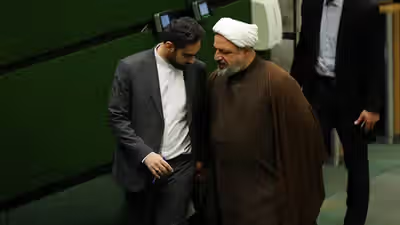
Araghchi, who led the recent round of talks with the US, said Tehran remains committed to diplomacy but will not negotiate under threat. He insisted uranium enrichment must continue inside Iran.
Several lawmakers criticized the talks as unproductive and said sanctions relief remains out of reach.