Foreign ministry spokesman Esmail Baghaei said Tehran is prepared to engage in dialogue with European parties but noted that the timing and location still need to be finalized.
“We are ready for talks with Europe, but the time and place must be decided,” he said Monday.
“We invite European countries to adopt a constructive approach.”
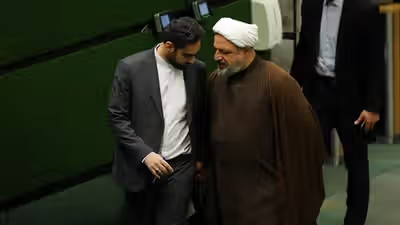
Iran’s foreign ministry spokesman said many recent reports about the nuclear talks are part of a coordinated effort by Israel to derail diplomacy.
“Much of the disinformation is coming from sources linked to the Zionist regime, aimed deliberately at undermining the negotiations,” Esmail Baghaei said Monday.
He also confirmed that a deputy to IAEA Director General Rafael Grossi will visit Tehran this week for meetings with officials from Iran’s Atomic Energy Organization. Baghaei added that Iran expects the agency’s upcoming report to be “carried out free from political pressure.”
Iran’s foreign ministry dismissed reports that US envoy Steve Witkoff abruptly left the recent nuclear talks, calling the issue unworthy of serious attention. “This isn’t something worth spending time on—it’s part of media theatrics,” spokesman Esmail Baghaei said Monday.
He added that the schedule was clear from the start. “It was known when the talks would begin and when they would end. It’s natural that each side has other commitments,” he said.
Baghaei explained that Iran concluded its part of the meeting as planned and held a 20-minute follow-up with Oman’s foreign minister on the next steps.
Iran’s foreign ministry rejected that Tehran is deliberately prolonging negotiations with the United States.
“The Islamic Republic has never sought to waste time in talks with America,” spokesman Esmail Baghaei said during a press briefing on Monday.
“We entered the negotiation process seriously and with the intent of reaching a fair understanding,” he added.

A commander in Iran’s Revolutionary Guard said Donald Trump’s respectful language toward Supreme Leader Ali Khamenei reflects a US acknowledgment of Iran’s strength.
“Trump insulted regional countries during his Middle East visit, and he humiliates China and Europe—but he writes polite letters to our leader. This shows they have correctly grasped our power,” said Ramezan Sharif, former IRGC spokesman and head of the War Documentation Center.
Sharif added that while Israel might miscalculate, “America has felt our power up close,” framing the US president’s tone as evidence of Iran’s regional deterrence.

A member of Iran’s parliament said negotiations with the United States have so far produced the most benefit for Tehran, despite widespread skepticism about their purpose.
“Based on principles we’ve set for ourselves, we entered negotiations—and they’ve brought us the most gains to date,” said Salar Velayatmadar, a member of the national security committee.
Velayatmadar dismissed calls to suspend uranium enrichment, saying, “Halting enrichment is a fantasy of our enemies. Their predecessors took that dream to the grave, and so will they.”