Iran’s Foreign Minister Abbas Araghchi said uranium enrichment is among the country's fundamental rights and that negotiations with the United States will only conclude once those rights are secured.
“The outcome of these negotiations will only be clear once the rights of the Iranian people are secured. Among these rights is enrichment, and our position on it is completely clear,” Araghchi said in remarks to state broadcaster IRIB on Sunday after briefing parliament’s national security committee.
Araghchi said that Iran welcomes the idea of a regional enrichment center but insists enrichment within Iran must continue. “We welcome the establishment of a regional enrichment center, but enrichment in Iran must continue,” Araghchi said.
He described media reports suggesting that talks could continue into the summer as speculation. “All of these are speculation. We are not in a hurry, and we are also not causing delays. Every hour that sanctions are lifted sooner, we will not hesitate — but not at the cost of the rights of the Iranian people.”
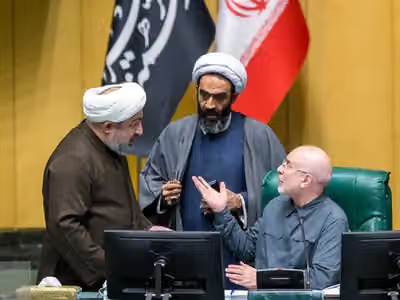
Iran will respond forcefully if Western powers move to restore UN sanctions, a parliamentary spokesman said after a closed-door briefing.
Ebrahim Rezaei, speaking for the National Security and Foreign Policy Committee, quoted Foreign Minister Abbas Araghchi as saying, “If the snapback mechanism is activated, our reaction will be harsh.”
Araghchi, who led the recent round of talks with the US, said Tehran remains committed to diplomacy but will not negotiate under threat. He insisted uranium enrichment must continue inside Iran.
Several lawmakers criticized the talks as unproductive and said sanctions relief remains out of reach.

Iran’s foreign ministry said no date or venue has been set for the next round of nuclear negotiations, dismissing media reports as speculation.
“The timing and location of the next talks have not been determined,” spokesman Baghai said in response to a question from IRNA.

A prominent political figure in Tehran warned against walking away from nuclear negotiations, saying abandoning diplomacy would only benefit those profiting from sanctions.
“Iran must not leave the negotiating table. Those who flip it over are the ones who do not speak the language of diplomacy,” said Javad Emam in an interview with Etemad newspaper.
He called for transparency in the talks and argued that sanctions have fueled corruption and hardship for ordinary Iranians.
“Sanctions have filled the pockets of hardliners and profiteers, while bringing poverty, inflation, and rent-seeking to the people,” he added.

A member of Iran’s parliament warned the US not to challenge Tehran’s nuclear program, calling them red lines that are non-negotiable.
“Americans know that enrichment and preserving the Islamic Republic’s defensive power are not up for discussion,” said Manouchehr Mottaki.
“By crossing these forbidden lines, they harm themselves and do us a favor.”
Speaking in parliament on Sunday, Mottaki also said that the resistance axis would soon bring down US-made F-35s as part of its evolving air defense strategy.


Iranian dissident filmmaker Jafar Panahi received the Palme d’Or at the 78th Cannes Film Festival for his film It Was Just an Accident, earning widespread praise from political, civic and cultural figures around the world.
The award for his film It Was Just an Accident, hailed as a milestone for Iranian cinema and a symbolic victory for freedom of expression, also sparked harsh criticism from pro-government media in Iran.
Panahi, a former political prisoner banned from travel and filmmaking for over a decade, received a standing ovation at the award ceremony.
The Palme d'Or was presented by acclaimed actress Cate Blanchett on Saturday night. In his acceptance speech, Panahi struck a unifying tone, calling on Iranians inside and outside the country to "set aside our differences" and work collectively toward democracy, dignity and human rights.
“Let no one tell us what to wear, what to do or what films to make,” he said, drawing repeated applause from the audience.
The moment was described by French Foreign Minister Jean-Noël Barrot as a "symbolic act of resistance" against repression. “Jafar Panahi’s Palme d’Or revives hope for freedom fighters around the world,” Barrot wrote on X.
A national and global moment
The win drew emotional reactions from across Iranian political and artistic figures at home and abroad.
Nobel Peace Laureate Narges Mohammadi, writing from inside Iran, described Panahi as a “brave and distinguished director” whose recognition was the result of years of relentless effort to deepen human and civil values through art.
Prince Reza Pahlavi, the exiled heir to Iran’s former monarchy, congratulated Panahi and called the award a “great honor for Iran.” He expressed hope that Iranian filmmakers could one day work “without censorship or restriction” in their homeland.
Iranian activist Hamed Esmaeilion called Panahi a “true hero,” praising his resilience in the face of censorship and repression. “His courage inspires all who fight for justice and freedom,” he said.
Political prisoner Mehdi Mahmoudian, speaking from Tehran’s Evin Prison, said the award was “not just a cinematic honor, but a victory of truth over censorship.”
Iranian-British actress Nazanin Boniadi also praised Panahi’s speech, calling him a “unifying voice” at a time when Iranians are searching for solidarity and vision.
The wave of celebration was echoed by 135 civil, political, and cultural activists, who issued a joint statement lauding Panahi as a symbol of artistic integrity and human rights advocacy.
The statement said that Panahi had joined a rare class of filmmakers alongside legends like Michelangelo Antonioni and Robert Altman—to win all three major European film prizes: the Golden Bear (Berlin), Golden Lion (Venice), and now the Palme d’Or (Cannes).

Film made in defiance
It Was Just an Accident, a political thriller, was shot clandestinely in Iran without government authorization and in open defiance of mandatory hijab laws.
The film’s production and Panahi’s public defiance of censorship laws have drawn admiration from international film communities and rights groups.
The Cannes jury also awarded Panahi the Festival’s Citizenship Prize, recognizing his broader contributions to freedom of expression.
An increasing number of Iranian filmmakers are defying the country's strict ideological censorship by making movies without seeking the Culture Ministry's permission for screening abroad.
Last year, prominent Iranian filmmaker Asghar Farhadi said he will not produce any films in Iran until the ban on showing women without headscarves is lifted, as people demand.
Official backlash in Tehran
Inside Iran, however, the award was met with either silence or anger from state-linked outlets.
The conservative daily Farhikhtegan, affiliated with Islamic Azad University, dismissed the honor with the headline: “Palme d’Or Turns to Rust”.
The editorial accused European film festivals of orientalist bias and suggested that Panahi’s acclaim was driven by political motives rather than artistic merit.
The Student News Agency (SNN) went further, branding Panahi a “middleman” and “Iran-seller.” It called the ceremony a “political show” orchestrated by “PR marketers.”
Despite the criticism, Panahi’s victory has reignited conversations around freedom of expression, artistic resistance, and national unity among Iranians worldwide.
As he left the stage in Cannes, Panahi expressed a simple hope: “I dream of an Iran where artists are not silenced, where truth has no borders, and where no one lives in fear for telling a story.”