Reformist figure urges continued talks, says sanctions enrich hardliners
A prominent political figure in Tehran warned against walking away from nuclear negotiations, saying abandoning diplomacy would only benefit those profiting from sanctions.
“Iran must not leave the negotiating table. Those who flip it over are the ones who do not speak the language of diplomacy,” said Javad Emam in an interview with Etemad newspaper.
He called for transparency in the talks and argued that sanctions have fueled corruption and hardship for ordinary Iranians.
“Sanctions have filled the pockets of hardliners and profiteers, while bringing poverty, inflation, and rent-seeking to the people,” he added.
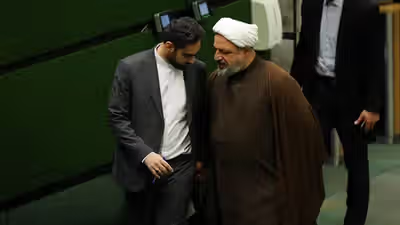
A member of Iran’s parliament warned the US not to challenge Tehran’s nuclear program, calling them red lines that are non-negotiable.
“Americans know that enrichment and preserving the Islamic Republic’s defensive power are not up for discussion,” said Manouchehr Mottaki.
“By crossing these forbidden lines, they harm themselves and do us a favor.”
Speaking in parliament on Sunday, Mottaki also said that the resistance axis would soon bring down US-made F-35s as part of its evolving air defense strategy.
Director Jafar Panahi, Palme d'Or award winner for the film "Un simple accident" (It Was Just an Accident), poses with award next to a team of the film, Juliette Binoche, Jury President of the 78th Cannes Film Festival, Cate Blanchett and Master of ceremony Laurent Lafitte , during the closing ceremony of the 78th Cannes Film Festival in Cannes, France, May 24, 2025.
Iranian dissident filmmaker Jafar Panahi received the Palme d’Or at the 78th Cannes Film Festival for his film It Was Just an Accident, earning widespread praise from political, civic and cultural figures around the world.
The award for his film It Was Just an Accident, hailed as a milestone for Iranian cinema and a symbolic victory for freedom of expression, also sparked harsh criticism from pro-government media in Iran.
Panahi, a former political prisoner banned from travel and filmmaking for over a decade, received a standing ovation at the award ceremony.
The Palme d'Or was presented by acclaimed actress Cate Blanchett on Saturday night. In his acceptance speech, Panahi struck a unifying tone, calling on Iranians inside and outside the country to "set aside our differences" and work collectively toward democracy, dignity and human rights.
“Let no one tell us what to wear, what to do or what films to make,” he said, drawing repeated applause from the audience.
The moment was described by French Foreign Minister Jean-Noël Barrot as a "symbolic act of resistance" against repression. “Jafar Panahi’s Palme d’Or revives hope for freedom fighters around the world,” Barrot wrote on X.
A national and global moment
The win drew emotional reactions from across Iranian political and artistic figures at home and abroad.
Nobel Peace Laureate Narges Mohammadi, writing from inside Iran, described Panahi as a “brave and distinguished director” whose recognition was the result of years of relentless effort to deepen human and civil values through art.
Prince Reza Pahlavi, the exiled heir to Iran’s former monarchy, congratulated Panahi and called the award a “great honor for Iran.” He expressed hope that Iranian filmmakers could one day work “without censorship or restriction” in their homeland.
Iranian activist Hamed Esmaeilion called Panahi a “true hero,” praising his resilience in the face of censorship and repression. “His courage inspires all who fight for justice and freedom,” he said.
Political prisoner Mehdi Mahmoudian, speaking from Tehran’s Evin Prison, said the award was “not just a cinematic honor, but a victory of truth over censorship.”
Iranian-British actress Nazanin Boniadi also praised Panahi’s speech, calling him a “unifying voice” at a time when Iranians are searching for solidarity and vision.
The wave of celebration was echoed by 135 civil, political, and cultural activists, who issued a joint statement lauding Panahi as a symbol of artistic integrity and human rights advocacy.
The statement said that Panahi had joined a rare class of filmmakers alongside legends like Michelangelo Antonioni and Robert Altman—to win all three major European film prizes: the Golden Bear (Berlin), Golden Lion (Venice), and now the Palme d’Or (Cannes).
Director Jafar Panahi, Palme d'Or award winner for the film "Un simple accident" (It Was Just an Accident), poses during a photocall after the closing ceremony of the 78th Cannes Film Festival in Cannes, France, May 24, 2025.
Film made in defiance
It Was Just an Accident, a political thriller, was shot clandestinely in Iran without government authorization and in open defiance of mandatory hijab laws.
The film’s production and Panahi’s public defiance of censorship laws have drawn admiration from international film communities and rights groups.
The Cannes jury also awarded Panahi the Festival’s Citizenship Prize, recognizing his broader contributions to freedom of expression.
An increasing number of Iranian filmmakers are defying the country's strict ideological censorship by making movies without seeking the Culture Ministry's permission for screening abroad.
Last year, prominent Iranian filmmaker Asghar Farhadi said he will not produce any films in Iran until the ban on showing women without headscarves is lifted, as people demand.
Official backlash in Tehran
Inside Iran, however, the award was met with either silence or anger from state-linked outlets.
The conservative daily Farhikhtegan, affiliated with Islamic Azad University, dismissed the honor with the headline: “Palme d’Or Turns to Rust”.
The editorial accused European film festivals of orientalist bias and suggested that Panahi’s acclaim was driven by political motives rather than artistic merit.
The Student News Agency (SNN) went further, branding Panahi a “middleman” and “Iran-seller.” It called the ceremony a “political show” orchestrated by “PR marketers.”
Despite the criticism, Panahi’s victory has reignited conversations around freedom of expression, artistic resistance, and national unity among Iranians worldwide.
As he left the stage in Cannes, Panahi expressed a simple hope: “I dream of an Iran where artists are not silenced, where truth has no borders, and where no one lives in fear for telling a story.”
A Marine Corps F-35B lands aboard the HMS Prince of Wales in 2023
The United Kingdom’s Carrier Strike Group (CSG), led by HMS Prince of Wales, has entered the Red Sea as part of Operation Highmast, the country’s most extensive naval deployment in recent years, according to the UK Defense Journal.
The task group, which transited the Suez Canal early Saturday morning, includes warships from several NATO allies: Canada’s HMCS Ville de Québec, Norway’s HNoMS Roald Amundsen and logistics vessel Maud, and Spain’s ESPS Méndez Núñez. HMS Richmond is expected to join the group shortly.
The eight-month operation aims to strengthen defense ties and project the UK’s presence across the Indo-Pacific. Activities will include joint exercises, regional port visits, and security patrols in coordination with the United States, Australia, and Japan, according to the UK Ministry of Defense (MoD).
"This deployment demonstrates our commitment to upholding regional stability and ensuring maritime freedom," the MoD said in a statement.
The carrier group integrates UK F-35B stealth jets, Merlin helicopters, unmanned systems, and allied platforms in a range of training and operational missions, including anti-submarine warfare and integrated air defense.
Royal Air Force (RAF) assets provided overwatch during the transit. Two Poseidon MRA1 maritime patrol aircraft were observed operating over the Sinai Peninsula Saturday morning.
In preparation for the transit, the RAF also reinforced its forward base at Akrotiri, Cyprus, deploying four Voyager aerial refueling aircraft from RAF Brize Norton earlier in May.
The deployment comes at a time of heightened tension in the Red Sea region. Despite a recent ceasefire agreement between the United States and Yemen's Houthi rebels, the UK is not a signatory.
The move follows the departure of the US aircraft carrier USS Harry S. Truman from the Red Sea, leaving the area temporarily without a US carrier presence. While the USS Carl Vinson remains in the wider region, British officials acknowledge the vulnerability of the UK-led group as it operates near conflict zones.
Last month, the UK participated in a joint airstrike with US forces against a Houthi military facility in Yemen, targeting infrastructure used to manufacture drones implicated in attacks on commercial shipping.
The Houthis accuse the British of aiding Israel in the war in Gaza, supplying weapons, spare parts and intelligence.
There has been no formal announcement of the manoeuvre from the British military.
Iran International has put a request for comment to the Royal Navy.
The most recent round of nuclear talks between Tehran and Washington achieved nothing new and was simply an effort to avoid announcing a collapse, said the former head of Iran’s parliamentary national security committee.
“The only thing that came out was that the Omanis offered an alternative plan to prevent failure, though its details are still unclear,” Heshmatollah Falahatpisheh said.
He added that the apparent proposal may involve suspending Iran’s nuclear program in exchange for partial sanctions relief, but deep divisions remain.
“Enrichment is a matter of national pride for Iran, and the US demands come at a heavy cost,” he added.
Iran’s top army ground commander said any act of aggression against the country would trigger an immediate response.
“We are finger on the trigger and ready to respond decisively and regretfully to any threat, at any scale,” said Brigadier General Kioumars Heydari on Sunday.