Iran’s top army ground commander said any act of aggression against the country would trigger an immediate response.
“We are finger on the trigger and ready to respond decisively and regretfully to any threat, at any scale,” said Brigadier General Kioumars Heydari on Sunday.

A lawmaker in Iran told parliament the Supreme National Security Council has issued instructions telling parliamentarians what they can and cannot say about negotiations with the United States.
“A letter came recently via the Council’s secretariat emphasizing what representatives should not say,” said Meysam Zohourian, MP for Mashhad.
The letter was being enforced through the foreign ministry, Zohourian said, adding that it outlines talking points that lawmakers are expected to follow.
Zohourian called on the parliament’s presidium to formally address the directive. Iran International previously reported on a similar order sent to media instructing outlets to avoid commentary on the talks.

The chief of Iran’s Revolutionary Guard said the country is locked in a full-scale confrontation with what he called a “satanic global coalition of hostile powers,” but added that the Islamic Republic remains calm while its enemies grow increasingly anxious.
Hossein Salami said Iran sees its adversaries’ forces, hears their threats, and feels their pressure, yet refuses to submit.
“We are facing a complex and powerful formation of small and large enemies, but we do not accept humiliation and do not believe in submission,” he said, describing Israel in particular as “trapped in permanent fear.”


Iran is engaged in a “full-scale war” on political, economic, and military fronts, but the country remains calm and stable internally, the commander of Iran’s Islamic Revolutionary Guard Corps (IRGC) said on Sunday.
Major General Hossein Salami, speaking at a ceremony honoring veterans of the Iran-Iraq war in West Azarbaijan province, said that although Iran faces what he described as a “powerful global coalition” of enemies, it continues to function normally at home.
“We are in a full war, but nothing appears warlike. The arenas of battle are active, but the country is at peace,” Salami said in remarks broadcast by state media.
“You see the enemy’s deployment, hear their rhetoric, and feel their political pressure. But the mystery lies in how this nation stands firm and dignified under such heavy pressure.
“All parts of the system are operating normally, while we are in a full-scale war. There is no anxiety among the people—this is exceptional and unprecedented,” he said.
Also on Sunday, commander of Iran’s Army Ground Forces said Iran’s army is fully prepared to respond to any threat “at any level and scale.”
“Our hands are truly on the trigger, and our eyes are wide open,” said Brigadier General Kioumars Heidari, according to state-affiliated ISNA news agency. “We are monitoring threats carefully and are ready to act on the command of the Supreme Leader.”
The comments come after a CNN report last week quoted US intelligence officials who said Israel was preparing to strike Iran's nuclear facilities if ongoing indirect US-Iran nuclear talks collapse.
Before the talks began, US President Donald Trump had already warned Iran that if a new deal was not reached within a set time, the US would bomb Iran.
Speaking to reporters, Heidari said the armed forces — including the regular army and particularly its ground forces — are positioned to retaliate swiftly and decisively against any hostile action.
“If any threat is carried out, rest assured that its origin will be wiped out in a fraction of a moment,” he said. “The people should have confidence that we will confront any threat, from any source, at any scale.”
Last week, Iran’s top military commander announced a major increase in the country’s air defense capabilities, including a fivefold rise in detection and tracking systems.
Last October, Israel carried out a major strike on Iranian targets, destroying large sections of the country’s air defense infrastructure. The attack followed two massive airstrikes from Tehran on Israel. Reports in Fox News and the Wall Street Journal said all of Iran’s S-300s were taken out of action.
“The country’s air defense readiness—especially in detection, identification, and elimination of aerial threats—has advanced significantly compared to last year,” Major General Mohammad Bagheri, the chief of staff of Iran’s armed forces, told the IRGC's Tasnim News Agency.

Iran's Parliament Speaker Mohammad-Bagher Ghalibaf said on Sunday that the Supreme National Security Council (SNSC) has instructed the legislature not to enforce a contentious law mandating stricter hijab regulations.
“Although I had no intention of publicly declaring this in such explicit terms, the SNSC has formally written to the Parliament, directing us not to promulgate the hijab and chastity law for now," Ghalibaf told lawmakers.
His remarks came in response to a demand from hardline MP Mohammad-Taghi Naghdali, who urged the Speaker to forward the bill for executive enforcement.
The legislation—officially titled The Law to Support the Family by Promoting Chastity and Hijab—was passed by Parliament in December 2023 but has remained unenforced amid internal disagreements and widespread public opposition at home and abroad. The United Nations said the proposal amounted to "gender apartheid".
Ghalibaf emphasized that, under Article 176 of Iran’s Constitution, the SNSC has overriding authority on matters of national security.
“When the Council issues a directive of this nature, the Speaker has no legal authority to proceed with enforcement,” he said.
Behind-the-scenes power struggles
The decision underscores an intensifying struggle between Iran’s ultra-conservative factions, who demand immediate enforcement, and state institutions seeking to avoid further social unrest.
In recent months, hardliners and religious vigilante groups have mounted increasing pressure on authorities to enforce the law, even staging sit-ins outside Parliament that were eventually broken up by police.
Mohammad-Mannan Raisi, a firebrand MP closely aligned with the ultraconservative Paydari (Steadfastness) Front, recently accused the SNSC of betraying the Islamic Republic’s core supporters by halting enforcement of what he called “God’s commandments.”
The SNSC’s September 2024 decision to quietly shelve the law followed a wave of public backlash, echoing the protests that erupted in 2022 after the death of 22-year-old Mahsa Amini in morality police custody. The unrest marked one of the most significant challenges to the Islamic Republic in decades.
Surveillance without legislation
While the law itself remains suspended, authorities have pursued enforcement by other means.
Since late March, women in Tehran, Shiraz, and Isfahan have reported receiving text-message warnings for alleged hijab violations detected via surveillance footage.
Activists and digital rights experts say the messages are powered by AI-enabled facial recognition systems, cross-referenced with government ID databases and mobile phone data.
Critics have condemned the approach as unconstitutional and ethically fraught.
“Does the Headquarters for the Promotion of Virtue and Prevention of Vice even have legal access to people’s personal data?” asked Abdollah Ramezanzadeh, a former government spokesman and law professor, in a popular post on X.
In March, the UN's Fact Finding Mission on Iran said, "surveillance online was a critical tool for State repression," including against those rejecting the mandatory hijab.
"This enforcement increasingly relies on technology, surveillance and even State-sponsored vigilantism," the investigators said, with methods including dedicated apps to report violators and the monitoring of social media.
Despite government denials, the crackdown has continued.
In April, Iran’s police signed a cooperation agreement with the Education Ministry allowing enforcement measures in schools, sparking backlash from teachers’ unions who warned of “militarizing education.”
The standoff over hijab enforcement highlights deeper political dilemmas which continue to challenge Iran’s clerical leadership.
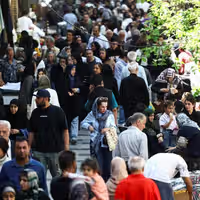
Public defiance continues to rise. Across major cities, women are increasingly seen without headscarves in public spaces, often posting videos online in acts of civil disobedience.
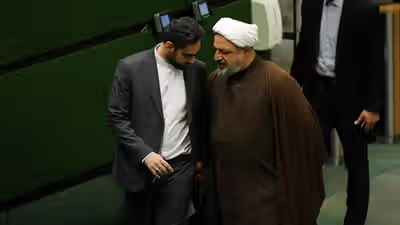
Iran could produce a nuclear weapon if it chose to, a former top official said, but insisted no such directive has yet been given.
“We are capable of building a nuclear weapon, but no official order has been issued so far,” said Fereydoon Abbasi, former head of Iran’s Atomic Energy Organization.
If Tehran were to pursue the bomb, he added, strikes on Iranian nuclear infrastructure would be ineffective. “Our power lies in our scientists, not facilities.”