Iran's Supreme National Security Council issued a directive on Tuesday banning domestic media from translating or republishing foreign reports on the country’s negotiations with the United States or offering any analysis on the talks.
The SNSC directive, a copy of which was obtained by Iran International, warned that failure to comply would be considered an act of threatening national interests and security.
It instructed media outlets and editors to only rely on official statements from the Iranian Foreign Ministry—namely, the foreign minister and the ministry’s spokesperson—for any coverage related to the ongoing talks.


US Secretary of State Marco Rubio gave an expansive view of negotiations with Iran on Tuesday, telling a Senate Committee that the United States rules out Iranian enrichment and could maintain missile and terrorism related sanctions after any deal.
Iranian enrichment
"Once you know how to enrich at any level, all you need is time to be able to enrich at a higher level. And they've already proven the ability to enrich at a higher level. In fact, they have and are doing so now," Rubio said on Tuesday.
"They claim that enrichment is a matter of national pride. It is our view that they want enrichment as a deterrent, they believe that it makes them a threshold nuclear power, and as a result, becomes untouchable," Rubio told the Senate Foreign Relations Committee. "That is the crux of the situation we're facing right now."
"Our hope is that we can encourage them to show them a path towards prosperity and peace that allow them to develop their economy, that allow them, if they want, to have a civil nuclear energy program like other countries around the world have - without enrichment."
Terrorism, missile sanctions
"Obviously we're aware of their sponsorship of terrorism in the region, including the Houthis and Hezbollah and other groups such as these, the militias in Iraq and their efforts to get back into Syria. Right now, the focus at this point of (the talks) has been their enrichment capability and their insistence on enrichment capability," Rubio said.
"Ultimately, I would say that if in fact we have sanctions that are related to the sponsorship of terrorism and a violation of weapons conventions and the like, their long-range munitions—those sanctions will remain. If those aren't part of the deal, then the sanctions will remain as a result of that," he added.
"The focus of the conversations over the last few weeks with (US special envoy) Witkoff and the Iranians has been on this enrichment matter, which is by far sort of the core and most critical matter."
Maximum pressure
"The administration sanctioned 72 entities, 14 individuals, 74 vessels, as well as 18 additional entities, including two Chinese-based oil terminals, 13 vessels," Rubio said.
"I think the maximum pressure campaign is working. We're already seeing a reduction in Iran's ability to fund destabilizing operations across the region ... we're going to continue with sanctions until there's a deal," he told the Senate Foreign Relations Committee.
"The administration’s maximum pressure campaign has secured the release of the last living American hostage held by Hamas, a pledge by the Houthis to abandon attacks on American ships and forced Iran to beg for talks with the United States," Rubio said earlier in the day in prepared remarks submitted to the committee.
European sanctions
"There's a separate set of sanctions out there, which are the snapback provisions that the E3 in Europe have," Rubio said, referring to Britain, France and Germany - the European signatories to a lapsed 2015 nuclear deal with Iran.
"That's on another clock, completely different from ours ... Now, maybe we'll do a deal with Iran and they'll be satisfied with it and not impose their sanctions," he added.
"They are moving forward on their process, independent from ours."
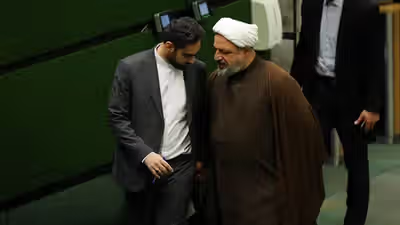

British-Iranian woman Nasrin Roshan was released from Tehran's notorious Evin Prison on Tuesday, 550 days after being arrested for participating in protest gatherings abroad, Iran International has learned.
Roshan was arrested by security forces at Imam Khomeini International Airport on November 19, 2023, while attempting to legally travel from Tehran to her country of residence, the United Kingdom.
She was then taken to a solitary cell in the Intelligence Ministry's detention center known as Ward 209 of Evin Prison. Section 209 of Evin Prison, reportedly the most dreadful ward of the detention facility, is one of three prison sections that are controlled by Iran’s intelligence ministry.
Sara Tabrizian, a former political prisoner who died mysteriously after being released from prison, was arrested with her. She had been summoned to the Intelligence Ministry just one day before her death.
On January 1, 2024, after about a month and a half of torture and interrogation, Roshan was transferred to the women's ward of Evin Prison, where she remained until her release.
Roshan was later tried by Judge Iman Afshari, head of Branch 26 of the Tehran Revolutionary Court, and sentenced to four years in prison on charges of "assembly and collusion" and eight months in prison on charges of "propaganda against the system."
Under Article 134 of the Islamic Penal Code, the four-year sentence was the maximum applicable punishment, which was later reduced to three years in prison.
A source familiar with her case told Iran International that her participation in Woman Life Freedom rallies outside Iran was one of the grounds cited by the court in issuing her sentence.
It is not Roshan’s first time inside the Islamic Republic’s prisons. Roshan, born in 1963, was imprisoned in Iran from September 1981 to September 1985, between the ages of 18 and 22.
She spent the first two months of her detention in the 1980s under interrogation and torture in Evin Prison, and the rest of her sentence in Qazal Hesar Prison in Karaj.
Iran has been accused of wrongfully detaining at least a dozen foreign and dual nationals on trumped up charges, effectively as hostages to extract concessions from Western governments. Most of them are held on spurious spying charges.

Dissident Iranian composer Mehdi Rajabian has become the first Iranian to win a Telly Award for his work on Mercedes-Benz's promotional teasers, after years of imprisonment for his underground musical activities and outspoken advocacy for artistic freedom.
The Telly Awards, established in 1979, honor excellence in video and television across all screens.
Rajabian whose compositions have been featured in several Mercedes-Benz promotional materials, was recognized at the 46th edition of the awards.
His music was featured in teasers for the Mercedes-Benz 300 SLR, the brand's most expensive model, and for Earth Day campaigns.
"The award has previously been given to the creators of teaser music for BMW, Toyota, Meta, Adidas, Apple, and Netflix, as well as to producers of content from The Washington Post, Al Jazeera, Fox News, NBC, Bloomberg, Warner Bros., and others," Rajabian said on his Instagram, dedicating the prize to his fans.

The Iranian artist was honored in 2023 with the United Nations' Minority Artist Award, which recognized his efforts to highlight issues of discrimination and human rights through his art.
"Happiness is a collective event, and unfortunately, no one is happy here [Iran]. The situation has changed completely after the recent protests. No award can be a criterion for determining an artist's artistic value, but it can certainly be a platform for the voice of human rights and artistic freedom,” said Rajabian in a statement on his UN award.
He previously faced imprisonment in Iran for his musical activities, enduring solitary confinement and a hunger strike.
Rajabian was arrested in 2013 for releasing underground music and was charged with “propaganda against the government”. He was put in solitary confinement for three months and then released on bail.
He was again arrested in 2015 for his album The History of Iran Narrated by Setar, a lute-like instrument used in traditional Persian music.
In Tehran’s notorious Evin prison, Rajabian began a 40-day hunger strike that led to his release on parole in 2017.
Rajabian was arrested again in 2020 for his album Middle Eastern but did not spend time in jail and was released on bail. He was accused of “encouraging prostitution” because females were singing in the album.

"Once you know how to enrich at any level, all you need is time to be able to enrich at a higher level. And they've already proven the ability to enrich at a higher level. In fact, they have and are doing so now," US Secretary of State Marco Rubio said on Tuesday.
"They claim that enrichment is a matter of national pride. It is our view that they want enrichment as a deterrent, they believe that it makes them a threshold nuclear power, and as a result, becomes untouchable," Rubio told a Senate committee. "That is the crux of the situation we're facing right now."
"Our hope is that we can encourage them to show them a path towards prosperity and peace that allow them to develop their economy, that allow them, if they want, to have a civil nuclear energy program like other countries around the world have - without enrichment."
US Secretary of State Marco Rubio told the Senate Foreign Relations Committee on Tuesday that Iran has been forced to "beg for talks" with the United States as a result of the Trump administration’s pressure campaign.
"In the Middle East, the administration’s maximum pressure campaign has secured the release of the last living American hostage held by Hamas, a pledge by the Houthis to abandon attacks on American ships, and forced Iran to beg for talks with the United States," Rubio said in prepared remarks submitted to the committee.