Iran’s nuclear chief said that the country’s nuclear industry will not be subject to any form of negotiation or compromise, describing it as a pillar of national power.
“The nuclear industry is a point of wealth and strength for the Iranian nation and is not subject to bargaining or negotiation,” Mohammad Eslami said on Tuesday.
US President Donald Trump’s tour of Saudi Arabia, the UAE, and Qatar reflects Washington’s recalibrated strategy in the Middle East, prioritizing economic diplomacy over security, according to an analysis by Nour News, a media outlet affiliated with Iran’s Supreme National Security Council.
The absence of Israel from Trump’s itinerary, despite the ongoing war in Gaza, is interpreted as a tactical move to avoid inflaming tensions while quietly pursuing economic deals and regional realignment, read thearticle.
The report suggests Trump aims to defuse regional anger over US support for Israel without publicly confronting America’s traditional ally.
According to Nour News, Trump’s primary goal is to secure large-scale investments from Persian Gulf nations—highlighting pledges of $600 billion from Saudi Arabia and $1.4 trillion over ten years from the UAE—as part of his economic diplomacy. Security and human rights, the outlet said, are lower on the agenda.
Despite Trump's push, the report points to skepticism in US media, including NPR, which described Trump’s ambitions—ending the Gaza war, curbing Iran’s nuclear program, and pushing Saudi Arabia to join the Abraham Accords—as “unlikely” given current regional dynamics.
The analysis also suggests Trump is seeking to rebuild America’s global image, using Persian Gulf partnerships to project stability and contain China’s growing influence in the region.
US Secretary of State Marco Rubio, President Donald Trump, Saudi Crown Prince Mohammed Bin Salman and Mohammed bin Abdulrahman bin Abdulaziz, Deputy Governor of Riyadh Region, meet in Riyadh, Saudi Arabia, May 13, 2025.
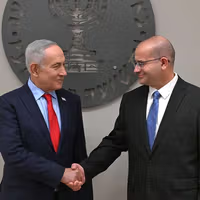
Iran’s nuclear chief Mohammad Eslami (right) and President Masoud Pezeshkian visiting a nuclear expo in Tehran (April 2025)
Iran’s nuclear chief said that the country’s nuclear industry will not be subject to any form of negotiation or compromise, describing it as a pillar of national power.
“The nuclear industry is a point of wealth and strength for the Iranian nation and is not subject to bargaining or negotiation,” Mohammad Eslami said speaking at an event in Karaj, near Tehran, on Tuesday.
“We have paid a heavy price to achieve nuclear knowledge, and nuclear technology is the key to progress in all fields of science and engineering,” he added.
Eslami’s remarks come as Iran and the United States concluded a fourth round of indirect nuclear negotiations in Oman on Sunday.
US President Donald Trump has said that the goal of the negotiations is to achieve "full dismantlement" of Tehran's nuclear program.
Tensions have mounted in recent days following comments by US envoy Steven Witkoff, who told Breitbart News last week that Washington's red line remains “no enrichment,” effectively calling for the dismantling of Iran’s nuclear infrastructure in Natanz, Fordow, and Isfahan.
Earlier on Tuesday, a senior Iranian lawmaker said Tehran will not give up uranium enrichment under any potential agreement with the United States, stressing that enrichment levels of up to 20% — or at least 5% — will be maintained on Iranian soil.
Ahmad Bakhshayesh Ardestani, a member of the Iranian parliament’s National Security and Foreign Policy Committee, told local media that the outlook for ongoing negotiations with Washington is positive, but insisted Iran will not concede to US demands.
“America ultimately has to accept our conditions,” he said.
Iran’s Deputy Foreign Minister Majid Takht-Ravanchi on Tuesday said that no specific details have been agreed regarding possible limits on uranium enrichment, after the latest round of talks in Muscat.
Iran has accelerated its enrichment activities since 2019, exceeding limits set under the 2015 nuclear deal, which the US exited unilaterally in 2018.
The UN nuclear watchdog has confirmed Iran’s enrichment of uranium to levels approaching weapons-grade, a move Tehran says is reversible if sanctions are lifted and credible guarantees are provided.
Iranian Foreign Minister Abbas Araghchi on Sunday said that Iran may consider temporary limits on enrichment “in terms of scope, level, and quantity” as a confidence-building measure, but also emphasized that the principle of enrichment itself is non-negotiable.
Amid the standoff, some Iranian commentators are reviving a long-standing proposal to break the impasse by forming a regional nuclear consortium that would include Iran, Arab states and the United States.
In February, the UN nuclear watchdog found that Iran's stockpile of near-weapons-grade uranium had risen to levels that, in principle, could be further enriched to produce enough material for six nuclear bombs.
A senior Iranian lawmaker said Tehran will not give up uranium enrichment under any potential agreement with the United States, stressing that enrichment levels of up to 20% — or at least 5% — will be maintained on Iranian soil.
Ahmad Bakhshayesh Ardestani, a member of the Iranian parliament’s National Security and Foreign Policy Committee, told local media that the outlook for ongoing negotiations with Washington is positive, but insisted Iran will not concede to US demands.
“America ultimately has to accept our conditions,” he said, adding that while US officials speak of “either deal or war,” their preference is clearly for an agreement, not conflict.
Ardestani accused the US of a “double game,” continuing sanctions and threats of war even while engaging in talks.
“They wrongly assume we are negotiating out of fear of war. We are confident the USwon’t attack,” he said.
The lawmaker also emphasized the need for binding guarantees from Washington to ensure any new agreement is upheld. “We need to be certain they won’t walk away from a future deal like they did with the JCPOA,” he said.
Ardestani suggested that US investment in Iran’s industrial sectors, particularly electricity, could act as a practical safeguard. “If American companies are involved on the ground, the cost of leaving the deal will rise for them.”
An Iranian lawmaker on Tuesday warned against allowing nuclear talks with the United States to dominate national policy, saying Iran should not be held hostage to the “ridiculous” statements of US President Donald Trump.
“It was never intended for indirect talks with the US to become the main issue and leave the country waiting on Trump’s ridiculous statements,” said Qasem Ravanbakhsh, a member of parliament from Qom, in a speech during a public session, according to ISNA.
Ravanbakhsh said the late President Ebrahim Raisi viewed negotiations only as a secondary tool and prioritized building ties with regional and independent powers. He urged the current administration to follow the same path and focus on domestic economic reforms instead of chasing foreign approval.
A senior Iranian official said on Tuesday that no specific details have been agreed regarding possible limits on uranium enrichment, following remarks by Iran’s foreign minister after the latest round of talks in Muscat.
“We have not entered into specifics on the level or scale of enrichment,” Deputy Foreign Minister Majid Takht-Ravanchi told Tasnim news agency. “What was stated was only a general framework.”
Iranian Foreign Minister Abbas Araghchi had said on Sunday that Iran may consider temporary limits on enrichment “in terms of scope, level, and quantity” as a confidence-building measure, but also emphasized that the principle of enrichment itself is non-negotiable.
Majid Takht-Ravanchi
Takht-Ravanchi added that any such measures would be conditional on reciprocal steps, including sanctions relief. “These are not unilateral actions,” he said. “They are part of mutual confidence-building to demonstrate the peaceful nature of our nuclear program.”
He also rejected speculation about a 25-year limit, calling such reports “unconfirmed and inaccurate.”