• العربية
  • فارسی
Brand
  • Iran Insight
  • Politics
  • Economy
  • Analysis
  • Special Report
  • Opinion
  • Podcast
  • Iran Insight
  • Politics
  • Economy
  • Analysis
  • Special Report
  • Opinion
  • Podcast
  • Theme
  • Language
    • العربية
    • فارسی
  • Iran Insight
  • Politics
  • Economy
  • Analysis
  • Special Report
  • Opinion
  • Podcast
All rights reserved for Volant Media UK Limited
volant media logo
ANALYSIS

Trump’s Persian Gulf tour marks strategic shift from security to economy – Nour News

May 13, 2025, 11:23 GMT+1

US President Donald Trump’s tour of Saudi Arabia, the UAE, and Qatar reflects Washington’s recalibrated strategy in the Middle East, prioritizing economic diplomacy over security, according to an analysis by Nour News, a media outlet affiliated with Iran’s Supreme National Security Council.

The absence of Israel from Trump’s itinerary, despite the ongoing war in Gaza, is interpreted as a tactical move to avoid inflaming tensions while quietly pursuing economic deals and regional realignment, read thearticle.

The report suggests Trump aims to defuse regional anger over US support for Israel without publicly confronting America’s traditional ally.

According to Nour News, Trump’s primary goal is to secure large-scale investments from Persian Gulf nations—highlighting pledges of $600 billion from Saudi Arabia and $1.4 trillion over ten years from the UAE—as part of his economic diplomacy. Security and human rights, the outlet said, are lower on the agenda.

Despite Trump's push, the report points to skepticism in US media, including NPR, which described Trump’s ambitions—ending the Gaza war, curbing Iran’s nuclear program, and pushing Saudi Arabia to join the Abraham Accords—as “unlikely” given current regional dynamics.

The analysis also suggests Trump is seeking to rebuild America’s global image, using Persian Gulf partnerships to project stability and contain China’s growing influence in the region.

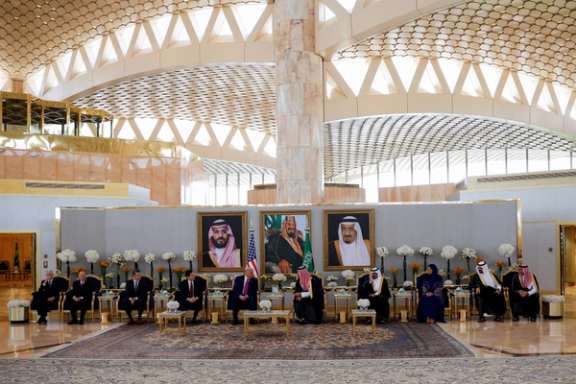
US Secretary of State Marco Rubio, President Donald Trump, Saudi Crown Prince Mohammed Bin Salman and Mohammed bin Abdulrahman bin Abdulaziz, Deputy Governor of Riyadh Region, meet in Riyadh, Saudi Arabia, May 13, 2025.
100%
US Secretary of State Marco Rubio, President Donald Trump, Saudi Crown Prince Mohammed Bin Salman and Mohammed bin Abdulrahman bin Abdulaziz, Deputy Governor of Riyadh Region, meet in Riyadh, Saudi Arabia, May 13, 2025.

Most Viewed

Ideology may be fading in Iran, but not in Kashmir's ‘Mini Iran'
1
INSIGHT

Ideology may be fading in Iran, but not in Kashmir's ‘Mini Iran'

2
INSIGHT

Hardliners push Hormuz ‘red line’ as US blockade tests Iran’s leverage

3
VOICES FROM IRAN

Hope and anger in Iran as fragile ceasefire persists

4

Iran International says it won’t be silenced after London arson attack

5

US sanctions oil network tied to Iranian tycoon Shamkhani

Banner
Banner

Spotlight

  • Hardliners push Hormuz ‘red line’ as US blockade tests Iran’s leverage
    INSIGHT

    Hardliners push Hormuz ‘red line’ as US blockade tests Iran’s leverage

  • Ideology may be fading in Iran, but not in Kashmir's ‘Mini Iran'
    INSIGHT

    Ideology may be fading in Iran, but not in Kashmir's ‘Mini Iran'

  • War damage amounts to $3,000 per Iranian, with blockade set to add to losses
    INSIGHT

    War damage amounts to $3,000 per Iranian, with blockade set to add to losses

  • Why the $100 billion Hormuz toll revenue is a myth
    ANALYSIS

    Why the $100 billion Hormuz toll revenue is a myth

  • US blockade targets Iran oil boom amid regional disruption
    ANALYSIS

    US blockade targets Iran oil boom amid regional disruption

  • Iran's digital economy battered by prolonged blackout
    INSIGHT

    Iran's digital economy battered by prolonged blackout

•
•
•

More Stories

Iran's indirect approach to US talks is a weak point - Shargh daily

May 13, 2025, 08:45 GMT+1

Iran's insistence on indirect negotiations with the United States remains a weakness given the sensitive circumstances surrounding the nuclear talks, reformist Shargh daily wrote on Tuesday.

The newspaper acknowledged that an agreement could potentially be reached through text exchanges, but argued this approach is disproportionate to the high stakes of the discussions.

Given Iran's insistence on maintaining domestic enrichment, the newspaper expressed concern that the talks might not achieve progress under such conditions.

Much ado about nothing: Iran's gas deal with Russia faces long odds

May 12, 2025, 17:59 GMT+1
•
Dalga Khatinoglu

A gas deal inked last month between Moscow and Tehran to transfer vast Russian volumes by pipeline via Azerbaijan faces the same logistical and financial obstacles that have sunk decades of energy deals between them before.

During a visit to Moscow Iran’s Oil Minister announced that Russia has agreed to export 55 billion cubic meters (bcm) of gas annually to Iran, claiming that this would turn Iran into a regional gas hub.

Mohsen Paknejad said on April 25 that various routes were considered and it was finally agreed that the gas would be delivered via land through the Republic of Azerbaijan, with Russia’s gas handed over to Iran in Astara.

While the Mozdok–Baku pipeline can transfer Russian gas to Azerbaijan, and the Baku–Astara pipeline can transport it to Iran, the combined daily capacity of these pipelines is only about six million cubic meters per day (mcm/d).

By contrast, Iran faces a gas shortfall of approximately 150 mcm/d during warmer months—rising to double that amount in colder seasons.

This means that the proposed Russian gas deliveries to Iran would not even cover a small portion of the country’s gas deficit—let alone turn Iran into a regional gas hub.

Paknejad has described this as the “first phase” of the gas deal, implying that new pipelines will be required to realize the full annual export volume of 55 bcm, which equals around 150 mcm/d.

The key issue here is that Gazprom, Russia’s state-run gas company meant to supply the gashas suffered massive losses of $18 billion over the past two years after losing its European markets following Russia's full-scale invasion of Ukraine.

Gazprom lacks the funds to complete an even more politically desirable “Power of Siberia 2” pipeline to China designed for the same annual capacity of 55 bcm.

Building a new pipeline connected to Russia’s main gas transmission network to deliver gas to Iran would require a stretch of at least 1,000 kilometers, demanding more than $10 billion in investment. If the pipeline were to cross the Caspian Sea, the cost could exceed $20 billion.

Another crucial point is that to become a regional gas hub, Iran must receive large volumes of gas from Russia and sell it to neighboring countries.

But Turkey already receives Russian gas directly via two pipelines, and most of Iran’s other northern and southern neighbors are gas producers or exporters themselves. Iran’s only potential customers would be Iraq, Pakistan, and Afghanistan.

Iraq plans to eliminate its need for gas imports within the next few years. Pakistan, despite a gas deal with Iran signed in 2009, has not built the pipeline due to sanctions.

Under the current contract, Iran would export only 7.5 bcm annually to Pakistan—raising questions about what Iran plans to do with the rest of the gas received from Russia.

Iran suffers from a gas deficit of 150 mcm/d in summer and 300 mcm/d in winter, and it could use Russian gas to meet its domestic needs.

However, 55 bcm of gas is worth around $15 billion, and Iran simply doesn’t have the money to pay for such a massive volume of gas. Even if it did, the government would need to provide enormous subsidies for its domestic use, given that gas prices in Iran’s domestic market are extremely low.

To illustrate, the Iranian government plans to sell 240 bcm of gas to the domestic market this year, earning only about 3,300 trillion rials in revenue—which, at the current exchange rate, amounts to less than $4 billion.

More Hollow Claims of New Oil Deals

Iran’s oil minister also announced that $4 billion in oil contracts have been signed with Russian companies.

Over the past two decades, Russian firms have signed more than a hundred contracts and memoranda of understanding (MoUs) with Iran, but almost none of the projects have ever gotten off the ground.

Paknejad provided few details, merely stating that “four contracts worth $4 billion have been signed with Russian companies for the development of seven oil fields.”

However, three years ago, Mohsen Khojastehmehr, then-CEO of the National Iranian Oil Company, made a similar announcement, saying that “contracts with Russian companies for the development of seven oil fields, worth $4 billion, have entered the operational phase.”

This strongly suggests that the contract Paknejad is referring to had already been signed years earlier—yet no action has been taken by the Russian side, contrary to Khojastehmehr’s assertions.

Back then, Iran and Gazprom had also signed 40 oil and gas memoranda of understanding, none of which led to any contracts or actual projects.

At the time, Iranian oil officials under President Ebrahim Raisi described the MoUs as being worth “$40 billion”, calling them “the largest deal in the history of the country’s oil and gas sector.”

Unlike formal contracts, MoUs do not carry any binding legal obligations, nor do they typically have a defined financial value—they are merely frameworks for studies and future negotiations aimed at signing actual contracts.

Analyst outlines three possible outcomes for US talks

May 12, 2025, 14:48 GMT+1

A senior Iranian international relations expert has outlined three possible scenarios for the outcome of ongoing diplomatic efforts between Iran and the United States, warning that talks remain clouded by mutual distrust and external interference.

In an op-ed published by Farhikhtegan newspaper, Alireza Mousapour, a professor at Tehran’s Shahid Beheshti University, said the negotiations could end in either failure, a temporary agreement, or an amended version of the 2015 nuclear deal.

The first scenario involves a collapse of talks, which Mousapour said could stem from excessive demands by the US, such as calls for dismantling Iran’s nuclear fuel cycle or pressure from Israel. Such a breakdown, he warned, could significantly increase the risk of military confrontation between Tehran and Washington.

The second scenario, deemed the most likely, envisions a short-term agreement similar to the 2015 framework. This interim deal could lay the groundwork for a broader accord, possibly involving what the writer called a “less for less” approach where Iran seeks reciprocal, verifiable steps from the US

The third scenario involves an amended Joint Comprehensive Plan of Action (JCPOA), with new provisions attached via a United Nations Security Council resolution. This would preserve the original deal's structure while integrating updated commitments.

Iran, US likely reaching compromise on uranium enrichment, analyst says

May 11, 2025, 20:58 GMT+1

"Despite ongoing challenges and disputes in the current negotiations between Tehran and Washington, both sides appear to be making mutual concessions in pursuit of a deal," Iranian political analyst Alireza Namvar Haghighi told Iran International.

"Ultimately, because both sides are aiming for an agreement, they would meet each other halfway," Namvar Haghighi said.

He suggested that the United States may have agreed to accept Iran’s uranium enrichment—either in a frozen state or at a limited level—while, in return, Iran is prepared to accept stricter verification measures.

According to Namvar Haghighi, this compromise could serve as the basis for a potential agreement between the two sides.

Delays in nuclear talks deepen economic strain, Iran’s business daily warns

May 11, 2025, 10:11 GMT+1

Delays in ongoing nuclear negotiations are inflicting damage on Iran’s economy, wrote Iran's Donya-e-Eqtesad newspaper warning that the country's "imbalance-ridden economy is facing a severe liquidity crunch, with depreciation outpacing capital formation, leaving industries parched for investment."

Inflation continues to surge, with rising input costs failing to attract new domestic or foreign capital, the paper noted. Without fresh investment, it added, Iran’s GDP will remain stagnant.

The paper’s “Economists’ Club” section argued that policymakers must pair negotiation planning with domestic reforms, adding that economic security and a stable business environment are key to drawing investment.

An Iranian newspaper with a cover photo of US President Donald Trump and US Middle East envoy Steve Witkoff, is seen in Tehran, Iran, May 11, 2025.
100%
An Iranian newspaper with a cover photo of US President Donald Trump and US Middle East envoy Steve Witkoff, is seen in Tehran, Iran, May 11, 2025.