Iran’s stance unchanged in ongoing talks, says security chief
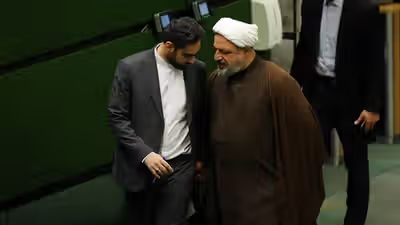
Negotiations remain reasonable only under equal conditions without coercion, said Ali Akbar Ahmadian, secretary of Iran’s Supreme National Security Council on Thursday.
“As negotiations under coercion and unreasonable threats are neither rational nor honorable, talks conducted under equal conditions and without pressure will be rational and honorable.”
“What has changed in the talks is the situation, not the Islamic Republic’s positions,” he said.
Ahmadian added that Iran’s red lines in the negotiations were completely clear.
Secretary of Iran’s Supreme National Security Council Ali Akbar Ahmadian
Iran’s hardline daily Kayhan issued a response to reports that US President Donald Trump may rename the Persian Gulf the “Arabian Gulf” during his upcoming Middle East visit.
In an editorial, the paper said Trump “laughs from the grave of his father, who ran a brothel,” for daring to propose such a change. The editorial called for renaming the United States “Redland,” invoking Native American history and accusing the country of being founded through “piracy and genocide.”
The Associated Press reported Trump is expected to address the naming dispute during visits to Saudi Arabia, the UAE and Qatar. Iran’s Foreign Ministry condemned the move as “politically motivated and historically inaccurate.”
Kayhan mocked the decision as a new low for Washington. “Are there no sane people in the West to restrain this madman?” the editorial asked.
Iranian Foreign Minister Abbas Araghchi and his Indian counterpart Subrahmanyam Jaishankar, May 8, 2025..
Iranian Foreign Minister Abbas Araghchi called for restraint between India and Pakistan during his visit to New Delhi on Thursday as tensions continue to rise following last month’s deadly attack on tourists in Indian-administered Kashmir.
“We hope that India and Pakistan will prevent the escalation of tension in the region,” Araghchi said, according to Iranian state media. “Our region needs peace, especially to expand economic cooperation between regional countries, and we hope this will happen.”
The visit, planned before the attack, is focused on co-chairing the Iran-India Joint Commission meeting with Indian External Affairs Minister S. Jaishankar.
India is a key trading partner for Iran, in spite of global sanctions, and the upcoming talks are expected to cover trade, energy, and infrastructure cooperation.
Araghchi arrived in India after meetings in Islamabad earlier this week, where he held talks with Pakistani Foreign Minister Ishaq Dar, President Asif Ali Zardari, and Prime Minister Shehbaz Sharif.
The diplomatic trip comes days after India launched airstrikes on what it said were “terrorist camps” in Pakistan in response to the attack in Kashmir’s Baisaran Valley, which killed 26 civilians, including 25 Indian tourists.
Pakistan denied involvement and said the Indian strikes killed at least 31 civilians, vowing to respond.
Iran has offered to mediate between the two nuclear-armed neighbours, though New Delhi has rejected third-party involvement, according to local media.
Israeli Defense Minister Israel Katz escalated tensions with Iran on Thursday, warning that Israeli forces could strike Tehran as they have targeted Iranian allies across the region.
“What we did to Hezbollah in Beirut, Hamas in Gaza, Assad in Damascus and the Houthis in Yemen—we will also do to you in Tehran,” Katz said in a message posted in Hebrew on X.
“I warn the Iranian leadership that funds, arms and operates the Houthi terrorist organization: The proxy method is over and the axis of evil has collapsed. You bear direct responsibility.”
“The Houthis will absorb heavy blows from Israel if they continue firing toward us,” Katz added. “The Israeli military is prepared for any mission.”
The warning came after a Houthi ballistic missile injured six people at Ben-Gurion International Airport on Sunday, prompting Israeli strikes on key military infrastructure in Yemen.
Despite a US-backed ceasefire, the Houthis have vowed to continue attacks.
Leading Senate and House Republicans are rallying behind a pair of draft letters urging Trump to reject any nuclear agreement with Iran that allows for continued uranium enrichment, calling instead for the complete dismantlement of the country’s nuclear program, according to documents obtained by the Jewish Insider.
The letters, nearly identical in content, reflect a coordinated effort by GOP lawmakers to press the Trump administration to adopt a hardline position as discussions over a potential new nuclear deal continue.
Lawmakers argue that the original 2015 Joint Comprehensive Plan of Action (JCPOA) failed due to inadequate verification protocols and its allowance of Iranian enrichment—elements they say must be permanently discarded.
The Senate letter is spearheaded by Senators Pete Ricketts and Ted Cruz, both members of the Senate Foreign Relations Committee, and backed by Senator Tom Cotton, who chairs the Senate Intelligence Committee.
On the House side, August Pfluger is collecting signatures for a matching letter.
The draft text underscores what it calls a “clear and unified message” to the president: that any new agreement must include a permanent ban on Iran’s enrichment capabilities. The lawmakers warn that the scale of Iran’s nuclear advancements has rendered effective monitoring nearly impossible.
US President Donald Trump said in an interview on Wednesday that the United States should blow up Iran's nuclear centrifuges, appearing to toughen Washington's stance on Tehran's enrichment.
"It's very simple. And I'd much rather make a deal, you know, a really verified deal. We want total verification. We can do that," Trump told the conservative political commentator Hugh Hewitt.
"We have some very brilliant people up at MIT and various other places. We can do that very, very solidly. But I would much prefer a strong, verified deal where we actually blow them up. But blow them up or just de-nuke them."
"There are only two alternatives there," Trump added. "Blow them up nicely or blow them up viciously."