Republicans pushing Trump to reject Iran deal that permits enrichment
Leading Senate and House Republicans are rallying behind a pair of draft letters urging Trump to reject any nuclear agreement with Iran that allows for continued uranium enrichment, calling instead for the complete dismantlement of the country’s nuclear program, according to documents obtained by the Jewish Insider.
The letters, nearly identical in content, reflect a coordinated effort by GOP lawmakers to press the Trump administration to adopt a hardline position as discussions over a potential new nuclear deal continue.
Lawmakers argue that the original 2015 Joint Comprehensive Plan of Action (JCPOA) failed due to inadequate verification protocols and its allowance of Iranian enrichment—elements they say must be permanently discarded.
The Senate letter is spearheaded by Senators Pete Ricketts and Ted Cruz, both members of the Senate Foreign Relations Committee, and backed by Senator Tom Cotton, who chairs the Senate Intelligence Committee.
On the House side, August Pfluger is collecting signatures for a matching letter.
The draft text underscores what it calls a “clear and unified message” to the president: that any new agreement must include a permanent ban on Iran’s enrichment capabilities. The lawmakers warn that the scale of Iran’s nuclear advancements has rendered effective monitoring nearly impossible.
US President Donald Trump said in an interview on Wednesday that the United States should blow up Iran's nuclear centrifuges, appearing to toughen Washington's stance on Tehran's enrichment.
"It's very simple. And I'd much rather make a deal, you know, a really verified deal. We want total verification. We can do that," Trump told the conservative political commentator Hugh Hewitt.
"We have some very brilliant people up at MIT and various other places. We can do that very, very solidly. But I would much prefer a strong, verified deal where we actually blow them up. But blow them up or just de-nuke them."
"There are only two alternatives there," Trump added. "Blow them up nicely or blow them up viciously."
Despite a new law targeting the illegal arms trade, Iran’s underground gun market continues to thrive on encrypted Telegram channels where vendors openly offer firearms ranging from pistols to Kalashnikov rifles.
The updated legislation, signed into effect on Tuesday by President Masoud Pezeshkian, imposes harsher sentences for unlicensed gun possession and criminalizes the use of digital platforms to promote or sell weapons.
But Telegram remains awash in posts advertising weapons for prices between 200 million and 1.8 billion rials—roughly $240 to $2,200 at the current exchange rate of 820,000 rials per US dollar.
Telegram channels in Iran are openly advertising firearms for sale
In one 17,000-member channel, a vendor offered a Glock 17 pistol for 280 million rials ($340), a Makarov for 240 million ($290), and a Turkish-made Colt .45 for 360 million ($440). For higher-end buyers, a Kalashnikov was listed at 1.7 billion rials ($2,070), including a video showing it wrapped in cloth beside two full magazines.
“Payment is in Tether,” said one seller when contacted anonymously via Telegram, referring to a cryptocurrency. “Once confirmed, you’ll receive a location—usually a locker in a shopping mall. You have two hours to retrieve it.”
An image from social media advertising guns for sale in Iran
Posing as a buyer we messaged five sellers across different channels. All insisted on cryptocurrency, none offered verification and two responded with identical language and price lists—raising doubts about authenticity.
But sources in Tehran familiar with the illicit trade said the market is not entirely fake. “There are scams, yes,” one source said. “But there are many real vendors. People share experiences, and some of these sellers have been delivering for years.”
Iran’s newly amended firearms law significantly broadens the scope of punishable offenses. Beyond illegal possession, it targets sellers, repairers and those who promote or advertise firearms online.
Penalties range from three to fifteen years in prison depending on the type of weapon, with automatic firearms, heavy arms, and military-grade munitions drawing the harshest sentences.
A clause in the law also authorizes authorities to seize properties, vehicles, or storage facilities used in connection with arms crimes.
According to the text, any digital promotion, sale, or training activity linked to firearms is subject to prosecution.
The law also tightens control over airguns, mandating that those in possession of PCP rifles over 40 joules must surrender them within three months or face penalties equivalent to those for illegal hunting rifles. Owners of PCPs under the threshold must apply for a license.
Still, on Telegram, enforcement appears limited. Sellers openly post weapons and use emojis of guns, bombs, and fire to attract attention.
Sources say these weapons are often smuggled in from Turkey, Iraq, or via the Persian Gulf and may be resold multiple times through local intermediaries. “The dealers who actually deliver have networks,” said a source in Tehran. “They use trusted people. Some even have police protection.”
Iran’s black market extends far beyond guns. Unlicensed alcohol, sex work under the guise of massage services, and a growing narcotics scene—from cocaine to synthetic pills—share the same digital infrastructure, relying on anonymity, encrypted platforms, and rapid logistics.
While authorities promise firm implementation of the new law, Telegram channels remain easy to find and quick to rebrand. For buyers, the market is a gamble. But according to those familiar with Tehran’s illicit economy, enough vendors deliver to keep demand alive.
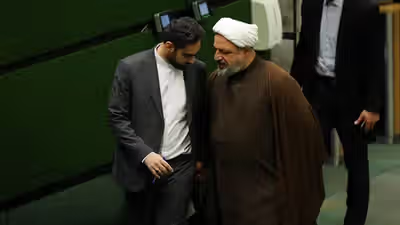
Nestled in the heart of Iran's second holiest city, the century-old Qom Seminary is the most influential Shi'ite clerical institution in the country and arguably the world.
As the academic and spiritual powerhouse of Shi'ism, the Qom Seminary plays a central role in shaping Iran's religious elite and, by extension, much of the country's theocratic structure. Beneath its religious facade, however, lies a vast, opaque network of political influence, financial entanglements and government control.
The seminary consists of nearly 60 schools, each established and operated either by high-ranking Shi'ite clerics—referred to as sources of emulation—or by state-affiliated institutions.
Tens of thousands of students study in Qom Seminary’s various schools, including thousands of foreign nationals from across the Shi'ite world—such as Lebanon, Iraq, Afghanistan, Nigeria and even China—drawn by Qom’s global religious stature.
Many of the country’s most influential officials and politicians who possess strong religious credentials hail from the Qom Seminary.
Roots in tradition and power
In addition to Qom, there are hundreds of Shi'ite seminary schools in Tehran, Mashhad, Isfahan and other cities across Iran. All of these institutions operate within a framework that is increasingly shaped and influenced by the state.
At the center of this framework is the Supreme Council of Seminaries, an official policy-making body responsible for overseeing curricula, setting educational standards, and managing the administration of seminaries.
The Council’s power is bolstered by the fact that its members are appointed by both Iran’s Supreme Leader, Ali Khamenei, and senior clerics who align with his religious and political interests.
Sacred duties, government funding
For centuries, seminary schools operated independently, funded primarily through religious dues called khoms or charity payments, zakat, that believers pay to their chosen source of emulation and the revenues from charitable endowments that they control.
These funds allowed sources of emulation to run their schools, pay stipends, and provide lodging for their students. This fostered a decentralized clerical tradition where independent scholars could thrive without state interference.
Since the 1979 Islamic Revolution, the state has consolidated its control over the administration of seminaries, incorporating them into the broader framework of governance and state-sponsored religion.
Government funding of seminaries is extensive but fragmented. Instead of channeling money through a single institution, the state allocates funds to a range of entities.
These include the Administrative Center of Seminaries, the Islamic Propaganda Organization, and various entities dedicated to supporting students and faculty members. Seminary students now routinely receive state-funded stipends, health insurance and other welfare benefits.
Khamenei’s grip on seminaries
Supreme Leader Ali Khamenei’s office provides additional financial support to selected seminary entities across the country. The details of these contributions—including amounts and recipients—are seldom made public, adding to seminaries’ overall lack of financial transparency.
His influence over Qom and other seminaries extends beyond funding and appointments. His office also uses intelligence surveillance, ideological monitoring, and strategic institutional control to maintain dominance over the clerical sphere.
Training the clerical elite
Becoming a fully qualified Shi'ite jurist or mujtahid—someone capable of independently interpreting Islamic law (ijtihad) -- typically requires at least two decades of intensive study in fields such as jurisprudence or fiqh, philosophy, logic and the Arabic language.
To be formally recognized as a jurist, a candidate needs the endorsement of a prominent clerical authority—often a source of emulation or another senior jurist.
Once recognized, a jurist can issue legal opinions or fatwas and may, in some cases, be acknowledged by peers and followers as a source of emulation.
Shi'ite laypeople are expected to follow the religious rulings of a living source of emulation, making these clerics deeply influential figures in both the religious and political spheres of Shiite-majority societies, especially in Iran.
Women in seminaries
While the leadership of seminaries remains exclusively male, more than 3,000 female seminarians currently study in a dozen gender-segregated schools in Qom Seminary alone. Their education is primarily focused on training women to teach religious principles—especially those related to women’s issues, family life, and Islamic ethics.
In rare instances, women have been permitted to attend advanced-level lectures typically reserved for male students. However, only a small number have ever attained the title of jurist.
Iran's Ayatollah Ali Khamenei writes on a document, file photo.
With the hawks in Washington pushing for a tougher stance on Iran, and the talks appearing to lose some positive initial momentum after three rounds, a sense of urgency about a potential deal appears to be taking hold in Tehran.
Former officials and media pundits are urging a swift agreement with the United States, warning that delays could harden President Trump’s position or allow regional developments to close the door on diplomacy.
“Time is certainly working against us this time. Reaching an agreement today is better than doing so tomorrow,” former minister Abbas Akhundi said in an interview with moderate daily Etemad on Monday.
“Trump is an opportunity if you understand his logic and act at the right time,” Akhundi added. “He is not someone who will be willing to negotiate forever … so we must be able to conclude the negotiations in a short time.”
Such bold statements on a potential thaw with the US are tolerated, if not encouraged, because supreme leader Ali Khamenei has not only endorsed the negotiations but also hushed its hardline opponents with his customary cryptic messaging.
Any viable nuclear deal would require significant concessions on Iran’s part. Khamenei needs to make those palatable to the loyalists who back him in the face of growing popular discontent. The longer the process the harder his task will become.
Regional developments are also a factor. Ceasefires in the Middle East often last not as long as the wars they tend to end.
Akhundi touched on this too in his Monday interview: “Israel is certainly unhappy about the possibility of a deal and may try to obstruct an agreement through psychological warfare, targeted assassinations, and cyber-attacks,” he warned.
Former conservative MP Mahmood Abbaszadeh Meshkini echoed the urgency while calling for a more proactive strategy.
“Trump is not interested in starting a war with Iran,” Mashkini told Khabar Online, urging the decision-makers in Tehran to take the lead in shaping the agenda.
Like many conservatives who have jumped ship on talks, Meshkini backed the official line and even went as far to hint at the rift between the rulers and the ruled as a hindrance for Iran advancing its interests abroad.
Another conservative commentator Mohammad Mohajeri charted another territory previously unnavigable: concessions.
“Eventually, both sides might come to accept that some red lines are also open to negotiation,” he told the outlet Rouydad24 briefly—and somewhat daringly—before quickly qualifying his remarks, perhaps to guard against criticism for his plain speech.
“However, if the other side demands that enrichment in Iran be reduced to zero or that our peaceful nuclear activities be entirely shut down, that is certainly unacceptable,” he added.
Tehran’s official position has remained constant during negotiations with Washington: low levels of enrichment are non-negotiable. On the other side, however, the stance seems to have hardened as president Trump and others in his team talk about Iran’s nuclear program being dismantled altogether.
The apparent sense of urgency reflected in Iranian media this week may have a thing or two to do with this.