"They are enriching uranium for one purpose: to obtain a nuclear weapon," the official US Senate Republicans account posted on X on Thursday.
"The only acceptable outcome is a complete and verifiable dismantlement of Iran’s nuclear program."

Tehran and Washington are set for another round of talks this weekend, but early optimism has dampened amid deep mistrust and mutual threats of attack, making any deal unlikely to lead to a lasting peace.
The most forthright caution, curiously, has come from Iran’s supreme leader Ali Khamenei, who—without referring to the current negotiations—reminded his hardline base that deals with foes are permissible if temporary.
The ultimate foe in Khamenei’s mind, of course, is America: presented more as an evil being than a country - the centerpiece of a narrative that manufactures, and is sustained by, hostility.
This narrative is, in many ways, reciprocated. Successive US administrations have portrayed Iran not just as a rival state, but the world’s leading sponsor of terrorism—a rogue actor bent on disrupting the global order.
Like Tehran’s view of America, this framing is not just rhetoric; it underpins policy, shapes alliances and narrows the space for diplomacy.
As talks resume, staunch anti-Americans in Iran warn against trusting “the Great Satan”, while the so-called hawks in the US decry any compromise with “the Mad Mullahs.”
Ingrained enmity
Despite gestures suggesting de-escalation—like the quiet removal of American flags from Iranian street protests—the hostile rhetoric has not faded. That’s because the tension is embedded not just in language, but in military posture.
The Trump administration has deployed two new warships to the region and deepened defense ties with Israel and Iran’s Arab neighbors.
Meanwhile the Iran-backed Houthis in Yemen managed to strike deep into Israel with a ballistic missile landing near its main airport on Saturday.
Both sides are redrawing lines of confrontation. Diplomacy is conducted under a constant shadow of war.
"I’m issuing a serious warning: if you make one wrong move, we will open up the gates of hell on you," Islamic Revolutionary Guard Corps chief Hossein Salami said on Thursday, referring to the United States and Israel.
"Sit down and stay in your place ... we have made extensive preparations."
The US government is not far off in tone. President Trump has framed the talks as a binary choice: agreement or war. “There are only two alternatives there," he told a conservative podcast on Wednesday. "Blow them up nicely or blow them up viciously."
Israel’s open threats to strike Iranian nuclear facilities and its insistence on the right to preemptive action only heighten the pressure.
In this climate, negotiations serve less to resolve conflict than to manage it. As long as each side sees the other as an irredeemable enemy—and enters talks prepared for battle—diplomacy becomes an extension of confrontation by other means.
Khamenei’s message about temporary deals may have been cryptic. But it had a clear implication: that diplomacy is a tool for crisis management, not conflict resolution.
Tehran and Washington may speak of de-escalation, but their dominant narratives remain unchanged—and the structures that sustain enmity show no signs of retreat.
Seen in this light, the ongoing talks appear to be more of a phase in a familiar cycle than an auspicious breakthrough.
Even if a deal is reached, without structural change, the hostility will likely endure—and should it unravel, military confrontation may appear a legitimate course more then ever.
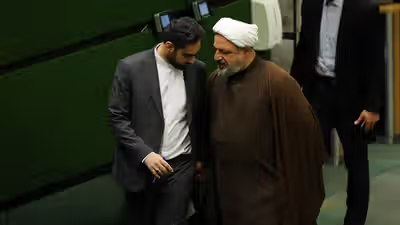
The commander of Iran's Revolutionary Guards (IRGC) has hinted at potential targeting of regional countries that get involved in any military operation against the country.
"Any location in any territory that serves as the origin of aggression against us will become the target of our retaliation," General Hossein Salami told state TV on Thursday while visiting a newly unveiled underground IRGC drone base.
"One aspect of our show of force is to correct the enemy’s miscalculations, and our enemies must become acquainted—at least to some extent—with the reality of our power."

The United States on Tuesday imposed fresh sanctions on another Chinese refinery and multiple logistics firms for facilitating the sale and shipment of Iranian oil, expanding its efforts to squeeze Tehran’s revenues.
The measure targets Hebei Xinhai Chemical Group Co., an independent refinery Washington asserts has received hundreds of millions of dollars’ worth of Iranian crude, some linked to the Islamic Revolutionary Guard Corps (IRGC).
Three Chinese port operators in Shandong province were also sanctioned for managing terminals that received sanctioned shipments from Iran’s shadow fleet, vessels used to hide the origin of shipments.
“The United States remains resolved to intensify pressure on all elements of Iran’s oil supply chain to prevent the regime from generating revenue to further its destabilizing agenda,” treasury secretary Scott Bessent said in a statement released on the website of the treasury's Office of Foreign Assets Control (OFAC).
Seven vessels and the companies that own them were also sanctioned, according to OFAC citing their role in transferring Iranian petroleum to China. Among those were tankers flagged in Panama and Hong Kong.
Two Indian ship captains were also designated for years-long involvement in steering sanctioned tankers carrying Iranian oil, the US treasury said.
The sanctions fall under executive orders by US president Donald Trump as part of his so-called maximum pressure campaign on Iran alongside the ongoing diplomatic push to resolve the standoff with Tehran over its nuclear program.
"We're trying to work on Iran to get that solved without having to get into any bombing," Trump said in his latest statement on Iran on Thursday.
"As we say, big bombing. I don't want to do that. I want them to be very successful," he added.
"We're trying to work on Iran to get that solved without having to get into any bombing," US President Donald Trump told reporters in the White House.
"As we say, big bombing. I don't want to do that. I want them to be very successful."
Iran's Fars news agency linked to the Islamic Revolutionary Guard Corps on Thursday released video it says depicts US warships, fighter jets and helicopters in the crosshairs of navy drones belonging to the paramilitary organization.
.