US sanctions independent Chinese oil refiner over Iran imports
The US Treasury on Thursday imposed sanctions on an independent Chinese oil refinery and three port terminal operators for what it called "purchasing or facilitating the delivery of hundreds of millions of dollars’ worth of Iranian oil."
"These teapot refineries, most of which are located in Shandong Province, purchase the majority of Iranian crude oil exports," the Treasury said in a statement, saying it was the third independent refinery to be sanctioned and the first in Shandong.
The move also blacklisted several firms, ships and sea captains it accused of being part of Iran’s “shadow fleet” transporting sanctioned Iranian oil.
"These are serious warnings to Zionist officials, to US officials. The criminal prime minister of the Zionist regime talks a lot these days, threatens Iran," Islamic Revolutionary Guard Corps chief Hossein Salami said in a speech on Thursday.
I’m issuing a serious warning: if you make one wrong move, we will open up the gates of hell on you," Salami added. "Sit down and stay in your place ... we have made extensive preparations."
"If you make a mistake, we’ll act on you in a way that you forget the True Promise 1 and 2," he added, referring to two direct Iranian attacks on Israel last year.
The US-based advocacy group United Against Nuclear Iran (UANI) will display an Iranian-made Shahed-136 drone inside the US Congress, the group announced on Thursday.
The event will feature appearances by US lawmakers including House Speaker Mike Johnson, Senator Ted Cruz, and Congressman Mike Lawler.
A similar drone was displayed at the CPAC conference in February.
The Shahed-136 drone is manufactured in Iran's military industries under the supervision of the IRGC. The IRGC is designated as a terrorist organization in the United States.
Russian forces have used thousands of these drones—rebranded as Geran-2—in Ukraine, with one striking Chernobyl’s radiation containment shelter on February 14.
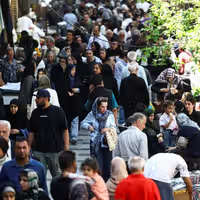
Iran’s capital is grappling with renewed electricity outages but growing evidence suggests the burden of power cuts is falling unevenly across the city, raising concerns over social equity and institutional bias in blackout management.
According to reports from Iranian media and residents, working-class neighborhoods in southern and western Tehran are experiencing up to four hours of daily blackouts, while more affluent districts in the north remain largely unaffected.
This disparity, once a topic of speculation among citizens, has now been corroborated by the reformist leaning Ham-Mihan newspaper, and acknowledged in comments by both energy officials and lawmakers.
A recent field investigation by Ham-Mihan found that nearly 75% of documented blackouts in Tehran province during the first two months of the Iranian calendar year (started March 20) occurred in lower-income areas. In contrast, power remained uninterrupted in wealthier northern districts, even during periods of peak demand.
While Tehran Electricity Distribution Company had released a blackout schedule for spring, residents across marginalized neighborhoods say cuts have been occurring unpredictably and far more frequently than indicated.
“We have power outages twice a day — sometimes lasting up to two hours each,” a resident of Islamshahr, a southern suburb, wrote online. Meanwhile, a resident in District 2, in northern Tehran, reported no outages since the start of the blackout cycle.
The discrepancies have sparked a wave of criticism on social media and from public figures.
Hossein Selahvarzi, a prominent economist and former head of Iran’s Chamber of Commerce, wrote: “If it is true that outages in the south of Tehran are more frequent than in the north, then our problem is not only energy imbalance — it is also a failure of social justice.”
In comments to Ham-Mihan, a senior official from Tehran’s regional power grid admitted the blackout pattern is not accidental. “To maintain network stability, we concentrate outages in outlying districts,” the unnamed source said.
“Blackouts in central or northern Tehran have political and media consequences that we try to avoid.”
The issue of unequal energy access is not confined to Tehran.
Hussein Haghverdi, a member of parliament representing the towns of Malard, Shahriar, and Qods in Tehran province, has publicly accused the Ministry of Energy of discriminatory energy allocation.
In a letter to Energy Minister Abbas Aliabadi, Haghverdi said that while the capital’s industrial zones faced a 50-megawatt blackout quota, neighboring residential and industrial towns were subjected to four times that amount.
“This vast disparity is unacceptable and has caused widespread dissatisfaction,” he wrote.
With temperatures rising and demand for cooling surging — particularly through water-intensive swamp coolers — Tehran’s daily water usage has already exceeded 3.1 million cubic meters.
Iran’s hydroelectric capacity — once a key component of the energy mix — has been severely curtailed by a historic drought.
Officials have warned that continued overconsumption could lead to even harsher cuts, with punitive 12-hour blackouts possible for chronic overusers.
But critics argue that the current approach to energy rationing lacks transparency and reinforces systemic inequalities.
“You can’t ask citizens to sacrifice while shielding elite districts from the consequences,” said an environmental policy expert in Tehran who requested anonymity. “This is not just a technical failure — it’s a governance issue.”
With no immediate relief in sight, the government is under mounting pressure to ensure that conservation efforts — and their consequences — are distributed fairly.
As one Ham-Mihan editorial put it: “The blackout map is becoming a social map — and it is illuminating more than just who has electricity.”
US President Donald Trump has sidelined Prime Minister Benjamin Netanyahu and is moving forward with Middle East initiatives without Israeli involvement, Israel Hayom reported, citing sources close to Trump.
“Trump is disappointed with Netanyahu and decided to advance moves in the Middle East without him.”
The paper described a “low point in personal relations and mutual disappointment” between the two leaders, aggravated by what Trump views as Israeli foot-dragging on normalization with Saudi Arabia, according to two senior officials quoted in the report.
Trump was also “furious at the attempt by Netanyahu and his people to push the fired National Security Advisor into military action in Iran,” Israel Hayom reported. Netanyahu has denied wrongdoing, but according to the paper, “Trump was not convinced.”
The report said Israeli officials were left out of recent US briefings, including those on the ceasefire with Houthi forces, and that Trump “is not currently scheduled to visit Israel” during his upcoming regional tour.
US President Donald Trump talks to Israeli Prime Minister Benjamin Netanyahu during a meeting where Trump announced nuclear talks with Iran, Washington, US, April 7, 2025.
Iran’s army air force commander said Thursday that while the country’s defense doctrine is defensive, it will respond to any aggression.
“Our doctrine is defensive, but we will respond powerfully to any attack,” said Brigadier General Hamid Vahedi.
He added that the air force stands firmly behind the people and the Islamic Republic, saying that no action would go unanswered and that forces would defend the country “to the last drop of blood.”
His remarks came as Newsweek reported the arrival of US B-52 bombers at Diego Garcia, expanding Washington’s strike capability in the Indian Ocean amid postponed nuclear talks with Tehran.