• العربية
  • فارسی
Brand
  • Iran Insight
  • Politics
  • Economy
  • Analysis
  • Special Report
  • Opinion
  • Podcast
  • Iran Insight
  • Politics
  • Economy
  • Analysis
  • Special Report
  • Opinion
  • Podcast
  • Theme
  • Language
    • العربية
    • فارسی
  • Iran Insight
  • Politics
  • Economy
  • Analysis
  • Special Report
  • Opinion
  • Podcast
All rights reserved for Volant Media UK Limited
volant media logo

Iran confirms media ban on port blast as threat of prosecution looms

Apr 30, 2025, 10:22 GMT+1Updated: 08:18 GMT+0

The Iranian government confirmed a media ban on coverage regarding last week's explosion at Rajaei port in Bandar Abbas where at least 70 people have died and more than 1,000 injured, with the threat of prosecutions confirmed by the judiciary.

Fatemeh Mohajerani, Iran's government spokeswoman, said the decision is aimed at “maintaining a single voice across state institutions.”

She described the directive not as a news blackout, but as a mechanism to “manage the issue properly.”

“The government is not interested in withholding information from the people,” she said, adding that provincial bodies have been instructed not to release information about the explosion’s cause until further notice.

Iran International reported earlier this week that journalists and outlets had received warnings about covering the incident, and described a heavy security presence in Bandar Abbas.

Judiciary spokesman Asghar Jahangir said on Wednesday that legal cases have been opened against several media figures for reporting on the blast, with warnings issued to individuals on social media.

Mizan, the judiciary’s official news agency, reported that violators of the media ban would face prosecution for “spreading illegal news.”

“An incident of this scale, with such casualties, demands precise and documented investigation,” he said. “We are waiting for the results to be finalized and announced." Jahangir said.

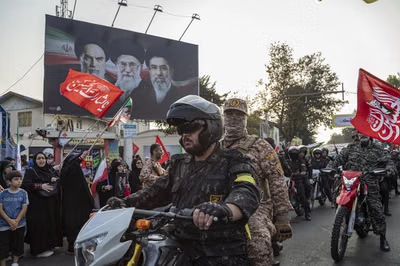
On Tuesday, The Guardian quoted a Tehran-based reporter speaking on condition of anonymity, who said, “Not only were we warned against ground reporting, we were also banned effectively from sharing reports on social media.”

“In the face of a tragedy such as this, what is there to hide? Either the death toll is way more than 70, or they are suppressing the real cause of the explosion. Following the filing of charges, our newsrooms are also self-regulating in fear that they’ll be facing legal consequences.”

No official casualty figures have been released by the health ministry, which, along with its subsidiaries, was ordered on Sunday to withhold all related information.

Iran International has been contacted independently from a worker at the port citing 29 deaths in one office alone.

Most Viewed

US blockade enters murky phase as tankers spoof signals and buyers hesitate
1
ANALYSIS

US blockade enters murky phase as tankers spoof signals and buyers hesitate

2

US tightens financial squeeze on Iran, warns banks over oil money flows

3
INSIGHT

Ideology may be fading in Iran, but not in Kashmir's ‘Mini Iran'

4
INSIGHT

Hardliners push Hormuz ‘red line’ as US blockade tests Iran’s leverage

5
VOICES FROM IRAN

Hope and anger in Iran as fragile ceasefire persists

Banner
Banner

Spotlight

  • Hardliners push Hormuz ‘red line’ as US blockade tests Iran’s leverage
    INSIGHT

    Hardliners push Hormuz ‘red line’ as US blockade tests Iran’s leverage

  • Ideology may be fading in Iran, but not in Kashmir's ‘Mini Iran'
    INSIGHT

    Ideology may be fading in Iran, but not in Kashmir's ‘Mini Iran'

  • War damage amounts to $3,000 per Iranian, with blockade set to add to losses
    INSIGHT

    War damage amounts to $3,000 per Iranian, with blockade set to add to losses

  • Why the $100 billion Hormuz toll revenue is a myth
    ANALYSIS

    Why the $100 billion Hormuz toll revenue is a myth

  • US blockade targets Iran oil boom amid regional disruption
    ANALYSIS

    US blockade targets Iran oil boom amid regional disruption

  • Iran's digital economy battered by prolonged blackout
    INSIGHT

    Iran's digital economy battered by prolonged blackout

•
•
•

More Stories

Iran executes political prisoner accused of spying for Israel

Apr 30, 2025, 08:42 GMT+1

Iran executed a political prisoner accused of spying for Israel at Ghezel Hesar prison near Tehran on Wednesday.

Mohsen Langarneshin had previously spoken of being coerced into confessing under the threat of torture and harm to his family.

Iran International reported on Monday that Langarneshin had been moved to solitary confinement, signaling the imminent execution.

Langarneshin had been arrested by security forces in Tehran on July 3, 2023 and was initially held at a Ministry of Intelligence safehouse.

He later recounted being threatened with torture on the first night of detention and said he was warned he would be subjected to severe torture unless he confessed.

“In the interrogations, they put me under so much pressure,” Langarneshin said in a voice message from prison. “They said they would arrest every member of my family and keep them until I no longer recognize them.”

He said that he was ultimately forced into making false confessions, including to buying a motorcycle equipped with a camera and transporting explosive materials.

A Revolutionary Court in Tehran accused Langarneshin of spying for Israel and sentenced him to death on charges of “waging war against God” and “spreading corruption on Earth”, according to the judiciary’s media outlet Mizan.

Mizan said Langarneshin had been recruited by Israel's Mossad. The judiciary accused him of “supporting the assassination of a person named Sayyad Khodaei, facilitating attacks on a Defense Ministry-linked industrial site in Isfahan, and handling logistics, equipment, safehouses, and money transfers for Mossad operatives.”

In the past four decades, numerous reports have documented the torture of political detainees in Iran, often leading to severe injury or death. The Islamic Republic has consistently denied responsibility.

Forced confessions have long tainted the Islamic Republic. In March, Iran Human Rights said: "The Islamic Republic has used televised confessions as a propaganda tool aimed at creating fear and justifying the heavy sentences handed down to its political opponents and activists since its inception in 1979."

"Such confessions are extracted after physical and/or psychological torture, lengthy solitary confinement, threats or promises of reduction in the gravity of sentences and threats against family members," according to the rights group.

Satellite imagery shows scale of destruction after Iran port explosion

Apr 30, 2025, 02:24 GMT+1

Satellite images obtained by Iran International show the aftermath of the April 26 explosion over a 50-hectare area at Rajaei port in Bandar Abbas, southern Iran.

The explosion which has devastated Rajaei port, the country's largest container port, has halted more than half of the country's nominal loading and unloading capacity.

The satellite images reveal that the Sina yard, the blast's epicenter which could hold between 12,000 and 20,000 twenty-foot containers, has been completely destroyed.

The area is operated by the US-sanctioned Sina Marine and Port Services, a subsidiary of the Mostazafan Foundation.

The foundation, a multi-billion-dollar conglomerate also sanctioned by the United States, is controlled by Supreme Leader Ali Khamenei and has close ties to the Islamic Revolutionary Guard Corps (IRGC).

Some images are partly obscured due to the massive smoke caused by the blast.

Area No. 1: the premises of Sina Marine and Port Services Development Company
100%
Area No. 1: the premises of Sina Marine and Port Services Development Company

1- Sina yard: 15 hectares

Satellite imagery shows that Sina yard, covering around 15 hectares, has been entirely leveled. Shattered containers are clearly visible in the images. The yard lies approximately 800 meters from the exit and gate control and about 1,400 meters from the first dock.

The administrative building of the Sina Marine and Port Services Development Company, located on the northwestern side of the yard, has been completely demolished.

The administrative building of Sina Marine and Port Services Development Company is located in the northwest section of the area
100%
The administrative building of Sina Marine and Port Services Development Company is located in the northwest section of the area

2- Khazar Qeshm Company: 10 hectares

To the east of the Sina yard lies the Khazar Qeshm Company area, covering 10 hectares, which has also been almost completely destroyed. The company’s warehouse roof, about 500 meters from the explosion’s epicenter, has completely collapsed.

Area No. 2: the roof of the Khazar Qeshm warehouse, adjacent to the Sina premises, has been completely destroyed
100%
Area No. 2: the roof of the Khazar Qeshm warehouse, adjacent to the Sina premises, has been completely destroyed

3- Rajaei port customs office: 5 hectares

South of the Sina yard are the administrative buildings of Rajaei port. Satellite images show that destruction extends up to 300 meters into the parking area.This zone had been evacuated, and scattered debris is visible.

Images show that the roof of a building 400 meters from the blast center has also collapsed in the administrative area.

Area No. 3: administrative section of Rajaei port — signs of damage are evident in the parking lot and the roofs of administrative buildings
100%
Area No. 3: administrative section of Rajaei port — signs of damage are evident in the parking lot and the roofs of administrative buildings

4- Onik area: 500 meters from blast

Explosion damage is visible 500 meters north of the Sina yard, in the Onik yard.

Area No. 4: Onik premises in the northern part of the Sina area, located 500 meters from the explosion’s epicenter
100%
Area No. 4: Onik premises in the northern part of the Sina area, located 500 meters from the explosion’s epicenter

5- Hazardous materials zone: 1,300 meters away

According to a map released by Rajaei port, the designated area for storing hazardous materials—marked as zone 5—is about 1,300 meters from the explosion center. No destruction is observed in this hazardous materials zone.

Area No. 5: hazardous materials zone
100%
Area No. 5: hazardous materials zone

6- Petroleum product storage tanks

The distance from the Sina premises, the site of the explosion, to the petroleum product storage area and tanks marked as No. 6 in the image is only about 1,000 meters. Had the fire spread to this area, the scale of the explosion could have been far more catastrophic.

Area No. 6: Petroleum product storage tanks
100%
Area No. 6: Petroleum product storage tanks

Domestic issues dog Tehran as it negotiates with Washington

Apr 29, 2025, 16:00 GMT+1
•
Behrouz Turani

Iran hopes to resolve its biggest foreign affairs challenge through talks with the United States at the same time it grapples with some of the toughest domestic problems in the Islamic Republic's nearly 50-year history.

Some commentators and former officials say the government of Masoud Pezeshkian is unable to resolve even the simplest domestic political issues that could improve the lives of ordinary Iranians.

One example, noted by centrist politician and former presidential candidate Mostafa Hashemi-Taba, is the failure to adopt daylight saving time to help with Iran's energy crisis.

Iran's parliament recently discussed the importance of the measure, but lawmakers refused to prioritize the bill, with Speaker Mohammad Bagher Ghalibaf joking that the matter would be taken up at a later date.

In an interview with the news website Rouydad24, Hashemi-Taba attributed such failures to a "lack of rationality" in governance.

"The government has no principles when it comes to addressing problems," he said, accusing officials of resorting to empty slogans instead of practical solutions, and engaging in futile debates until a new crisis diverts attention from unresolved issues.

"There is no public participation in Iran. Only a select group of people make decisions," Hashemi-Taba said.

Another stalled initiative is changing the weekend from Thursday–Friday to Saturday–Sunday to facilitate international commerce.

Despite months of debate in parliament and other government offices, the measure—deemed necessary by some economists—has been dismissed by some lawmakers with bizarre arguments.

Any weekend change, some critics have asserted, could hinder population growth, since Iranians traditionally conceive children on Thursday nights, and a Saturday–Sunday weekend would disrupt this pattern, as people would have to work on Fridays.

Meanwhile, more pressing issues, such as water and energy shortages, remain unresolved.

Tehran's freshwater resources stand at just 14% of their usual levels, according to official statistics, prompting the capital's governor to declare a water shortage emergency last week.

The government has not managed to find a solution, instead proposing to divert water from other regions—an approach that could cause shortages elsewhere.

Civil unrest erupted in the historic city of Isfahan last week, as residents took matters into their own hands by blocking the flow of water from the Zayandeh Rood River to neighboring Yazd Province.

Electricity is in short supply too, causing regular power cuts in the capital and other regions. Officials have released a blackout schedule, but people say it lacks clarity, leaving them to discover outages only when they are plunged into darkness.

"Fake experts make all the wrong decisions and prevent a minority of true experts from solving problems," prominent sociologist Taqi Azad Armaki told the news website Fararu.

The problem, Armaki argued, is that the government cannot compile or prioritize the crises it faces, as those making crucial decisions lack expertise and are disconnected from what the people want.

"The majority of our society desires peace, jobs and engagement with the world, free from constant worry," Armaki said. "This group constitutes approximately 90 percent of the population. But there is a 5-percent minority that opposes such a lifestyle.

"Those elected to parliament with the support of this minority are louder and disproportionately influential," he added. "The country's resources have been distributed unfairly and unevenly between these two groups."

About half of Israelis back strike on Iran's nuclear facilities, poll shows

Apr 29, 2025, 13:56 GMT+1

A new poll showed that nearly half of Israelis support a strike on Iran's nuclear facilities, even without US support, though divides between the Jewish and Arab demographic were stark.

Asked whether Israel should carry out a military strike on Iran’s nuclear facilities, even without American backing, 45% of Israelis believe Israel should do so and 41.5% do not.

Within the Jewish population, support for potential attacks reached 52% among proponents, with 34.5% expressing opposition. A significantly different perspective prevails among Arabs, where 76% are against the attacks and only 9% are supportive.

The data came from the April 2025 Israeli Voice Index, conducted by the Viterbi Center for Public Opinion and Policy Research.

Additionally, against the backdrop of talks between the United States and Iran on the Iranian nuclear program, 45.5% of Israelis think that Israel's security will be among President Trump's main considerations, while 44% think it will not.

Last month, US President Donald Trump openly threatened to bomb Iran if it did not agree to a new nuclear deal. It has since emboldened Israel to step up its rhetoric.

Earlier this week, Israeli premier Benjamin Netanyahu said, “A real deal that works is one that removes Iran’s capacity to enrich uranium for nuclear weapons... Dismantle all the infrastructure of Iran’s nuclear program. That is a deal we can live with.”

Iran's Parliament Speaker Mohammad Bagher Ghalibaf dismissed the remarks on Tuesday. “Netanyahu, in a desperate attempt to avoid political extinction, has resorted to threats. These worthless tirades are not taken seriously,” he said.

Gunpowder factory explosion kills two as Iran faces string of deadly blasts

Apr 29, 2025, 12:17 GMT+1

A new explosion at a gunpowder company operating under Iran's top security body in central Isfahan province killed two people on Tuesday, marking the latest in a wave of blasts across the country that have killed at least 73 people in just four days.

The incident occurred at the Ava Nar Parsian Chemical Industries warehouse in the Meymeh district of Isfahan province, according to the provincial crisis management office.

Emergency services and firefighters were dispatched to the site. No official cause has been announced.

Screengrab from state media footage showing the aftermath of the explosion at the Ava Nar Parsian warehouse in Meymeh, Isfahan province, on 29 April 2025.
100%
Screengrab from state media footage showing the aftermath of the explosion at the Ava Nar Parsian warehouse in Meymeh, Isfahan province, on 29 April 2025.

The blast comes amid a wave of explosions across Iran, including a deadly fire at a fuel depot in Zahedan on Monday that killed one person and critically injured two others, according to the local rights group Hal Vash.

Over the past four days, at least 73 people have been reported killed in similar incidents nationwide, including 70 killed in Saturday’s massive explosion at Rajaei port in the southern city of Bandar Abbas.

The site of Tuesday’s blast, Ava Nar Parsian, according to its website, manufactures fireworks and gunpowder and operates under the supervision of Iran’s National Security Council—the country’s highest decision-making body on security matters.

However, investigations by Iran International suggest the company may also be linked to Iran's security and military apparatus.

One of Ava Nar Parsian’s top executives, Damoun Beheshtnejad, previously held a managerial position at Nargostar Sepahan, another chemical facility in Isfahan that was the site of a major explosion in June 2021.

At the time, British newspaper The Guardian reported that the complex housed the Iran Aircraft Manufacturing Industrial Company (HESA), a key player in the Islamic Republic’s drone program.

According to official company filings, certain decisions at Ava Nar Parsian fall under the authority of the "Intelligence Protection Organization for Weapons and Ammunition Management of Isfahan Province." The company is licensed to produce, trade, import, and export commercial, industrial, and chemical explosives.