• العربية
  • فارسی
Brand
  • Iran Insight
  • Politics
  • Economy
  • Analysis
  • Special Report
  • Opinion
  • Podcast
  • Iran Insight
  • Politics
  • Economy
  • Analysis
  • Special Report
  • Opinion
  • Podcast
  • Theme
  • Language
    • العربية
    • فارسی
  • Iran Insight
  • Politics
  • Economy
  • Analysis
  • Special Report
  • Opinion
  • Podcast
All rights reserved for Volant Media UK Limited
volant media logo

Gunpowder factory explosion kills two as Iran faces string of deadly blasts

Apr 29, 2025, 12:17 GMT+1Updated: 21:43 GMT+1

A new explosion at a gunpowder company operating under Iran's top security body in central Isfahan province killed two people on Tuesday, marking the latest in a wave of blasts across the country that have killed at least 73 people in just four days.
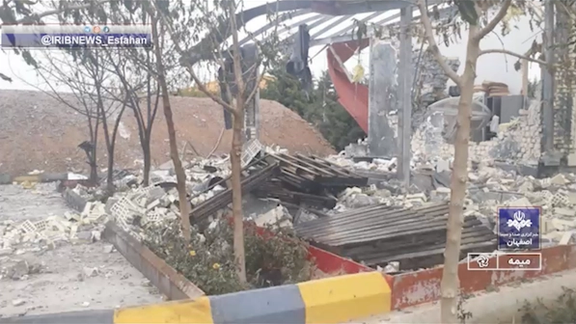

The incident occurred at the Ava Nar Parsian Chemical Industries warehouse in the Meymeh district of Isfahan province, according to the provincial crisis management office.

Emergency services and firefighters were dispatched to the site. No official cause has been announced.

Screengrab from state media footage showing the aftermath of the explosion at the Ava Nar Parsian warehouse in Meymeh, Isfahan province, on 29 April 2025.
100%
Screengrab from state media footage showing the aftermath of the explosion at the Ava Nar Parsian warehouse in Meymeh, Isfahan province, on 29 April 2025.

The blast comes amid a wave of explosions across Iran, including a deadly fire at a fuel depot in Zahedan on Monday that killed one person and critically injured two others, according to the local rights group Hal Vash.

Over the past four days, at least 73 people have been reported killed in similar incidents nationwide, including 70 killed in Saturday’s massive explosion at Rajaei port in the southern city of Bandar Abbas.

The site of Tuesday’s blast, Ava Nar Parsian, according to its website, manufactures fireworks and gunpowder and operates under the supervision of Iran’s National Security Council—the country’s highest decision-making body on security matters.

However, investigations by Iran International suggest the company may also be linked to Iran's security and military apparatus.

One of Ava Nar Parsian’s top executives, Damoun Beheshtnejad, previously held a managerial position at Nargostar Sepahan, another chemical facility in Isfahan that was the site of a major explosion in June 2021.

At the time, British newspaper The Guardian reported that the complex housed the Iran Aircraft Manufacturing Industrial Company (HESA), a key player in the Islamic Republic’s drone program.

According to official company filings, certain decisions at Ava Nar Parsian fall under the authority of the "Intelligence Protection Organization for Weapons and Ammunition Management of Isfahan Province." The company is licensed to produce, trade, import, and export commercial, industrial, and chemical explosives.

Most Viewed

Iran negotiators ordered to return after internal rift over Islamabad talks
1
EXCLUSIVE

Iran negotiators ordered to return after internal rift over Islamabad talks

2
ANALYSIS

US blockade enters murky phase as tankers spoof signals and buyers hesitate

3
ANALYSIS

Why the $100 billion Hormuz toll revenue is a myth

4

US tightens financial squeeze on Iran, warns banks over oil money flows

5
INSIGHT

Ideology may be fading in Iran, but not in Kashmir's ‘Mini Iran'

Banner
Banner

Spotlight

  • Hardliners push Hormuz ‘red line’ as US blockade tests Iran’s leverage
    INSIGHT

    Hardliners push Hormuz ‘red line’ as US blockade tests Iran’s leverage

  • Ideology may be fading in Iran, but not in Kashmir's ‘Mini Iran'
    INSIGHT

    Ideology may be fading in Iran, but not in Kashmir's ‘Mini Iran'

  • War damage amounts to $3,000 per Iranian, with blockade set to add to losses
    INSIGHT

    War damage amounts to $3,000 per Iranian, with blockade set to add to losses

  • Why the $100 billion Hormuz toll revenue is a myth
    ANALYSIS

    Why the $100 billion Hormuz toll revenue is a myth

  • US blockade targets Iran oil boom amid regional disruption
    ANALYSIS

    US blockade targets Iran oil boom amid regional disruption

  • Iran's digital economy battered by prolonged blackout
    INSIGHT

    Iran's digital economy battered by prolonged blackout

•
•
•

More Stories

Iran, Israel race to court Azerbaijan as rivalry in Caucasus heats up

Apr 28, 2025, 19:33 GMT+1
•
Umud Shokri

The Iranian president’s visit to Azerbaijan, soon to be followed by the Israeli prime minister's trip, highlights Baku’s sophisticated geopolitical maneuvering as Tehran and Tel Aviv vie for influence in the strategically vital South Caucasus.

It is a region where energy corridors, security alignments, and infrastructure ambitions increasingly converge.

President Masoud Pezeshkian’s trip—the first by an Iranian president since 2022—marks a cautious effort to mend a strained relationship.

Restoring Iran-Azerbaijan ties

Central to the distrust is Tehran’s long-standing fear that Azerbaijan could serve as a launchpad for Israeli operations against Iran, given Baku’s deepening military cooperation with Tel Aviv.

Relations further deteriorated after the 2023 attack on Azerbaijan’s embassy in Tehran, prompting a mutual expulsion of diplomats.

Equally important is Baku's accusation that Iran's Revolutionary Guards (IRGC) seeks to destabilize Azerbaijan through groups like the Huseyniyyun. Azerbaijani authorities assert that these groups have been involved in plotting attacks, fomenting unrest, and targeting foreign officials.

Another flashpoint is the Turkish-backed Zangezur Corridor, a proposed route connecting mainland Azerbaijan to Nakhchivan via Armenia.

Iran opposes the project, viewing it as a threat to its regional influence and access to Armenia. However, signs of de-escalation include joint Iranian-Azerbaijani naval drills in the Caspian Sea in late 2024 and progress on the North-South Transport Corridor with Russia.

While the Zangezur dispute remains unresolved, Pezeshkian’s visit focuses on practical cooperation, particularly in energy, rather than contentious territorial issues.

Israel's strategic countermove

Israeli Prime Minister Benjamin Netanyahu’s upcoming visit reflects Israel’s intention to bolster Azerbaijan’s role as a regional partner amid escalating tensions with Iran. The timing of this trip appears as a direct counter to Tehran's outreach.

Israel seeks to deepen its footprint near Iran’s borders, using Azerbaijan’s strategic geography as both a listening post and an energy partner.

Key goals of Netanyahu's visit include strengthening intelligence-sharing on Iran’s nuclear program, encouraging Baku to formalize its long-covert security ties with Israel, and leveraging Azerbaijani diplomacy to ease Turkish-Israeli frictions.

Expanding the Abraham Accords network to include Azerbaijan remains an aspirational longer-term objective.

Competing regional visions

These high-profile visits reflect a broader contest for influence across the South Caucasus.

Turkey and Israel favor the Zangezur Corridor as a means to enhance connectivity and weaken Iranian leverage, while Iran views the project as a direct challenge to its regional role.

Israel has consistently backed Azerbaijan’s position in the Nagorno-Karabakh conflict, while Iran—historically closer to Armenia—has taken a more pragmatic approach toward Baku.

In Syria, Israel and Turkey seek to curb Iranian entrenchment. Armenia’s gradual alignment with the West further deepens Tehran’s strategic anxiety.

For Israel, Azerbaijan offers a critical hub for intelligence gathering and diversification of energy supplies, anchoring its evolving South Caucasus strategy.

Enduring tensions, strategic risks

Despite gestures toward normalization, structural tensions between Iran and Azerbaijan remain deep.

The $9.3 billion in arms deals signed by Baku and Tel Aviv between 2020 and 2024 remains a major obstacle to trust. Iran has repeatedly threatened military action if the Zangezur Corridor advances without its involvement, underscoring how infrastructure projects have become proxies for larger geopolitical rivalries.

Meanwhile, regional flashpoints—such as Israel’s military operations in Gaza and Iran’s nuclear escalation—could further complicate Azerbaijan’s delicate balancing act.

As external pressures mount, Baku’s strategy of engaging both Tehran and Tel Aviv becomes increasingly fraught with risk.

Pezeshkian’s visit signals Iran’s pragmatic attempt to recalibrate its relationship with Azerbaijan after years of estrangement. It is less a breakthrough than a tactical reassessment in response to shifting regional dynamics.

Netanyahu’s impending trip adds another layer to the strategic competition, reinforcing Azerbaijan’s emergence as a pivotal mediator between rival powers.

Ultimately, the interaction between these two visits will shape not only the future of Iran-Azerbaijan ties but also the broader geopolitical realignment underway in the South Caucasus.

Karabakh is an inseparable part of Azerbaijan, Iran’s president says in Baku

Apr 28, 2025, 11:50 GMT+1

The Iranian president said that Nagorno-Karabakh is an inseparable part of Azerbaijan's territory during a meeting with his counterpart, supporting the country's rights over the disputed region as the two nations attempt to mend ties.

"We believe that the rights of the people of Azerbaijan must be respected, and Karabakh must belong to the country of Azerbaijan. Karabakh is an inseparable part of the soil of Azerbaijan, and we respect that," Masoud Pezeshkian said during a meeting with Azerbaijani officials in Baku on Monday.

Azerbaijani President Ilham Aliyev officially welcomed Pezeshkian at the Zagulba Presidential Palace on Monday afternoon, followed by a private meeting between the two leaders and a joint session of their high-ranking delegations.

Tensions between Tehran and Baku have run high for years, largely due to Baku's close ties with Iran's nemesis Israel and a January 2023 attack on Azerbaijan's embassy in Tehran.

Last week, Pezeshkian expressed hopes for a rapid improvement in relations and cooperation between the two countries as part of a broader effort to mend ties.

Iran and Azerbaijan held two-day joint naval exercises in the Caspian Sea in November, in moves towards rapprochement.

Iranian and Azerbaijani presidents during a meeting in Baku on April 28, 2025
100%
Iranian and Azerbaijani presidents during a meeting in Baku on April 28, 2025

Pezeshkian’s remarks come a month after Iran welcomed a peace agreement between Azerbaijan and Armenia.

The Nagorno-Karabakh conflict, a decades-long dispute rooted in the aftermath of the Soviet Union's dissolution, saw a significant development in March when both Azerbaijan and Armenia announced an agreement on the text of a peace treaty.

Nagorno-Karabakh, internationally recognized as part of Azerbaijan but historically with a majority ethnic Armenian population, had long been a flashpoint between the two South Caucasus nations. 

Iran, sharing a northern border with both countries, has consistently underscored its interest in regional stability, particularly along its 44-kilometer frontier with Azerbaijan.

Israel says it intercepted Iranian planes sent to aid Syria's Assad

Apr 28, 2025, 10:18 GMT+1

Israeli Prime Minister Benjamin Netanyahu said on Sunday that the air force diverted Iranian aircraft carrying troops to help former Syrian president Bashar al-Assad amid the country’s revolution last year.

“They had to rescue Assad,” Netanyahu said, adding that Iran wanted to send “one or two airborne divisions” to help the Syrian leader.

“We stopped that. We sent some F-16s to some Iranian planes that were making some routes to Damascus,” he said. “They turned back.”

Netanyahu made the announcement on Sunday in a speech which revealed insights into the country’s role in the fall of the long-time ruler, who was overthrown by insurgents in December.

At a Jewish News Syndicate conference, he said that Tehran sought to bolster Assad's position, especially after Hezbollah, a major ally in Lebanon, sustained considerable losses during last year's conflict with Israel.

Targeted airstrikes decimated Hezbollah's leadership, killing scores of top figures, including its long-time head Hassan Nasrallah, and obliterating extensive infrastructure both above and below ground.

Iran says major cyberattack on infrastructure repelled

Apr 28, 2025, 08:20 GMT+1

Iran said it foiled a major cyberattack targeting its infrastructure on Sunday in the midst of blazing fires following the explosion which rocked its key container port in Bandar Abbas.

"One of the most widespread and complex cyber attacks against the country's infrastructure was identified and preventive measures were taken," IRGC-affiliated Tasnim News quoted Behzad Akbari, CEO of Iran’s Telecommunications Infrastructure Company and Deputy ICT Minister as saying on Monday.

Akbari did not provide further details on the origins of the hack.

Only in September, Iran's Cybersecurity Strategic Management Center announced a state of cyber-readiness, issuing a red alert for financial, monetary, and communication sectors, and an orange alert for other sectors, according to Iranian media reports.

"Organizations are advised to maintain round-the-clock availability of technical teams and rapid response units due to the potential for cyber attacks," it said.

In the past Iran has blamed Israel for cyber attacks. A cyberattack that 70% of Iran's petrol stations in December 2023 was claimed by Gonjeshk-e-Darande or Predatory Sparrow, a hacking group that Iran has previously accused of having links to Israel.

In October 2021, Iran experienced a cyberattack that disrupted its fuel distribution system, affecting approximately 4,300 gas stations. Gholamreza Jalali, head of Iran’s civil defense organization, attributed the attack to foreign actors, specifically accusing the United States and Israel.

The cyberattack came just one day after Tehran and Washington concluded a third round of nuclear talks on Saturday in Oman.

Meanwhile, emergency services were fighting the fallout of a deadly explosion in Iran’s Rajaei Port in Bandar Abbas, with authorities yet to disclose the cause.

Emergency support was sent from Tehran's allies in Moscow to fight the disaster which saw at least 40 killed and hundreds more injured, according to Iran's official figures.

However, one worker at the port contacted Iran International saying that at least 23 women were killed in their office alone.

Iran denies presence of military cargo at blast-hit port

Apr 27, 2025, 13:59 GMT+1

Iran's Ministry of Defense said on Sunday that no military-related cargo was present at the Shahid Rajaei Port in Bandar Abbas, where a deadly explosion occurred over the weekend.

Defense Ministry spokesperson Brigadier General Reza Talaei-Nik told state media, "There were no imported or exported shipments related to military use or rocket fuel at the site of the incident," dismissing foreign media reports as psychological operations.

“Investigations and evidence confirm that no imported or exported cargo for fuel or military applications was present within the fire-stricken area or Shahid Rajaei port. Certain foreign media outlets are engaging in targeted sensationalism aligned with enemy psychological operations,” he said.

The remarks come following reports that the massive blast -- which killed at least 28 people and injured more than 1,000 -- was linked to the storage of sodium perchlorate, a chemical used in the production of solid rocket fuel.

While the exact cause remains undetermined, a source close to Iran’s Islamic Revolutionary Guard Corps told the New York Times that sodium perchlorate -- a precursor chemical used to make ammonium perchlorate, an important component in solid rocket fuel -- was the likely cause of the explosion.

Investigations into the cause of the blast are ongoing, Iranian officials said, adding that the Ministry of Interior and disaster management authorities are leading the probe. Authorities pledged to publicly disclose findings once the investigation concludes.

Earlier this year, shipping data tracked by The Maritime Executive indicated that two vessels owned by the US-sanctioned Islamic Republic of Iran Shipping Lines (IRISL) — the MV Golbon and MV Jairan — transported sodium perchlorate from China to Bandar Abbas in February and March.

The chemical is later processed at facilities such as Parchin and Khojir in Iran’s solid-fueled ballistic missile programs.

It remains unclear whether the containers from the shipments were still stored at the Sina container terminal at the time of the blast or if they played a role in the explosion.