Red Crescent says search for missing continues after Iran port blast
Iran’s Red Crescent said search efforts for the missing continue at the site of the deadly explosion in Bandar Abbas, which killed at least 70 and injured more than 1,200 people.
“The search operation at Shahid Rajaei port continues under difficult conditions until the situation is fully stabilized,” said Mokhtar Salahshour, head of the Red Crescent’s Hormozgan branch, at a mourning ceremony for the victims.
Iranian Red Crescent rescuers work following an explosion at the Shahid Rajaee port in Bandar Abbas, Iran, April 27, 2025.
The third round of indirect nuclear talks between Iran and the United States in Muscat concluded without a breakthrough, as both sides remained divided on five key technical issues, Khabar Online reported Wednesday.
Despite what officials described as detailed expert-level discussions, significant technical disagreements remain unresolved, hindering any breakthrough, added the website.
According to the report, the two sides remain sharply divided over five key areas: the level of uranium enrichment, the size and management of Iran’s enriched uranium stockpile, the scope of inspections by the International Atomic Energy Agency (IAEA), mechanisms for lifting US sanctions, and legal or political guarantees to ensure compliance with any potential deal.
The Iranian delegation argued that enrichment up to 20 percent is essential for civilian applications, particularly medical isotope production at the Tehran Research Reactor. They maintained that Iran’s right to peaceful nuclear technology is non-negotiable, the report added.
In contrast, the US team, headed by Michael Anton, demanded a full return to the JCPOA framework, including reducing enrichment to the 3.67 percent limit and dismantling advanced centrifuges such as the IR-6, said Khabar Online. American negotiators insisted that high-level enrichment, even for declared civilian use, poses proliferation risks that must be curtailed.
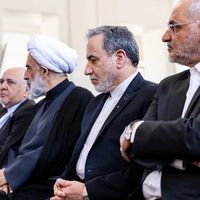
The Iranian delegation in Oman for indirect negotiations with the United States on April 12, 2025.
President Masoud Pezeshkian said his government would fully support the families of those killed in the Rajaei port explosion, calling the incident “deeply painful and distressing.”
“We will address every aspect of your needs,” he told victims’ relatives at a state-sponsored labor conference on Wednesday.
Pezeshkian said the government had approved measures to ensure the families would face no hardship. “We will not allow these loved ones to encounter problems in their lives,” he said.
However, Iranian insurance firms said they will only compensate victims of port explosion in line with their existing contracts.
“Each company pays according to its own commitment, not beyond that,” Alborz Insurance CEO Mousa Rezaei told Tuesday.
At least 18,354 workers in Iran were killed or injured in workplace accidents over the past year, according to a report by Human Rights Activist News Agency (HRANA) marking International Workers’ Day.
The group recorded 2,081 deaths and 16,273 injuries between May 2024 and April 2025. The report also mentioned 738 labor protests and 1,145 professional sector gatherings, marking a 72% rise in labor demonstrations.
HRANA said many workers were arrested or sentenced for peaceful protests or demanding fair wages. The findings come days after a deadly blast at Rajaei port, where officials confirmed 70 killed and more than 1,200 injured.
The Iranian government confirmed a media ban on coverage regarding last week's explosion at Rajaei port in Bandar Abbas where at least 70 people have died and more than 1,000 injured, with the threat of prosecutions confirmed by the judiciary.
Fatemeh Mohajerani, Iran's government spokeswoman, said the decision is aimed at “maintaining a single voice across state institutions.”
She described the directive not as a news blackout, but as a mechanism to “manage the issue properly.”
“The government is not interested in withholding information from the people,” she said, adding that provincial bodies have been instructed not to release information about the explosion’s cause until further notice.
Iran International reported earlier this week that journalists and outlets had received warnings about covering the incident, and described a heavy security presence in Bandar Abbas.
Judiciary spokesman Asghar Jahangir said on Wednesday that legal cases have been opened against several media figures for reporting on the blast, with warnings issued to individuals on social media.
Mizan, the judiciary’s official news agency, reported that violators of the media ban would face prosecution for “spreading illegal news.”
“An incident of this scale, with such casualties, demands precise and documented investigation,” he said. “We are waiting for the results to be finalized and announced." Jahangir said.
On Tuesday, The Guardian quoted a Tehran-based reporter speaking on condition of anonymity, who said, “Not only were we warned against ground reporting, we were also banned effectively from sharing reports on social media.”
“In the face of a tragedy such as this, what is there to hide? Either the death toll is way more than 70, or they are suppressing the real cause of the explosion. Following the filing of charges, our newsrooms are also self-regulating in fear that they’ll be facing legal consequences.”
No official casualty figures have been released by the health ministry, which, along with its subsidiaries, was ordered on Sunday to withhold all related information.
Iran International has been contacted independently from a worker at the port citing 29 deaths in one office alone.
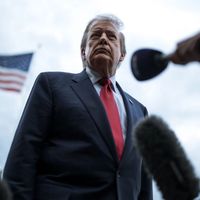
US Senator Tom Cotton said that Iran has no need for advanced centrifuges or highly-enriched uranium for civilian nuclear power purposes, echoing President Donald Trump's stance that all paths for Tehran to obtain a nuclear weapon must be cut off, or the consequences would be severe.
In an audio excerpt shared on X, Senator Cotton pointed to President Trump's threat of military intervention if Iran does not agree to a deal, contrasting this direct statement with the traditional Republican refrain of keeping "all options on the table."
He said Trump has been more blunt, saying, "We will be bombing" if necessary. However, Trump has said on several occasions that he preferred a diplomatic solution.
Cotton elaborated on what constitutes an acceptable agreement, saying, "A good deal is obviously a deal that cuts off all of Iran’s paths to a nuclear bomb, that includes all of their highly-enriched uranium and their advanced centrifuges. They don’t need the centrifuges and highly-enriched uranium for civilian nuclear power.”