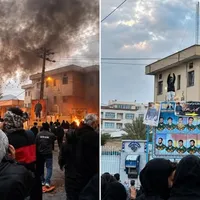
During a mourning ceremony for the victims of the port explosion held on Monday evening in Bandar Abbas, several families of the deceased protested the authorities’ lack of accountability regarding the incident.
According to videos received by Iran International, some family members chanted slogans such as "Incompetent officials, resign, resign."

The Iranian president’s visit to Azerbaijan, soon to be followed by the Israeli prime minister's trip, highlights Baku’s sophisticated geopolitical maneuvering as Tehran and Tel Aviv vie for influence in the strategically vital South Caucasus.
It is a region where energy corridors, security alignments, and infrastructure ambitions increasingly converge.
President Masoud Pezeshkian’s trip—the first by an Iranian president since 2022—marks a cautious effort to mend a strained relationship.
Restoring Iran-Azerbaijan ties
Central to the distrust is Tehran’s long-standing fear that Azerbaijan could serve as a launchpad for Israeli operations against Iran, given Baku’s deepening military cooperation with Tel Aviv.
Relations further deteriorated after the 2023 attack on Azerbaijan’s embassy in Tehran, prompting a mutual expulsion of diplomats.
Equally important is Baku's accusation that Iran's Revolutionary Guards (IRGC) seeks to destabilize Azerbaijan through groups like the Huseyniyyun. Azerbaijani authorities assert that these groups have been involved in plotting attacks, fomenting unrest, and targeting foreign officials.
Another flashpoint is the Turkish-backed Zangezur Corridor, a proposed route connecting mainland Azerbaijan to Nakhchivan via Armenia.
Iran opposes the project, viewing it as a threat to its regional influence and access to Armenia. However, signs of de-escalation include joint Iranian-Azerbaijani naval drills in the Caspian Sea in late 2024 and progress on the North-South Transport Corridor with Russia.
While the Zangezur dispute remains unresolved, Pezeshkian’s visit focuses on practical cooperation, particularly in energy, rather than contentious territorial issues.
Israel's strategic countermove
Israeli Prime Minister Benjamin Netanyahu’s upcoming visit reflects Israel’s intention to bolster Azerbaijan’s role as a regional partner amid escalating tensions with Iran. The timing of this trip appears as a direct counter to Tehran's outreach.
Israel seeks to deepen its footprint near Iran’s borders, using Azerbaijan’s strategic geography as both a listening post and an energy partner.
Key goals of Netanyahu's visit include strengthening intelligence-sharing on Iran’s nuclear program, encouraging Baku to formalize its long-covert security ties with Israel, and leveraging Azerbaijani diplomacy to ease Turkish-Israeli frictions.
Expanding the Abraham Accords network to include Azerbaijan remains an aspirational longer-term objective.
Competing regional visions
These high-profile visits reflect a broader contest for influence across the South Caucasus.
Turkey and Israel favor the Zangezur Corridor as a means to enhance connectivity and weaken Iranian leverage, while Iran views the project as a direct challenge to its regional role.
Israel has consistently backed Azerbaijan’s position in the Nagorno-Karabakh conflict, while Iran—historically closer to Armenia—has taken a more pragmatic approach toward Baku.
In Syria, Israel and Turkey seek to curb Iranian entrenchment. Armenia’s gradual alignment with the West further deepens Tehran’s strategic anxiety.
For Israel, Azerbaijan offers a critical hub for intelligence gathering and diversification of energy supplies, anchoring its evolving South Caucasus strategy.
Enduring tensions, strategic risks
Despite gestures toward normalization, structural tensions between Iran and Azerbaijan remain deep.
The $9.3 billion in arms deals signed by Baku and Tel Aviv between 2020 and 2024 remains a major obstacle to trust. Iran has repeatedly threatened military action if the Zangezur Corridor advances without its involvement, underscoring how infrastructure projects have become proxies for larger geopolitical rivalries.
Meanwhile, regional flashpoints—such as Israel’s military operations in Gaza and Iran’s nuclear escalation—could further complicate Azerbaijan’s delicate balancing act.
As external pressures mount, Baku’s strategy of engaging both Tehran and Tel Aviv becomes increasingly fraught with risk.
Pezeshkian’s visit signals Iran’s pragmatic attempt to recalibrate its relationship with Azerbaijan after years of estrangement. It is less a breakthrough than a tactical reassessment in response to shifting regional dynamics.
Netanyahu’s impending trip adds another layer to the strategic competition, reinforcing Azerbaijan’s emergence as a pivotal mediator between rival powers.
Ultimately, the interaction between these two visits will shape not only the future of Iran-Azerbaijan ties but also the broader geopolitical realignment underway in the South Caucasus.

Israel's strategic affairs minister said on Monday that he believes US President Donald Trump would reject any "bad" nuclear agreement with Iran.
Speaking at a conference in Jerusalem hosted by the Jewish News Syndicate, Ron Dermer said, "I am confident President Trump would walk away from a bad deal today."
When asked if Israel would consider targeting Iran's "military facilities" on its own, Dermer declined to discuss operational matters but emphasized that Prime Minister Benjamin Netanyahu should be taken seriously when he says Israel will do whatever is necessary to prevent Iran from acquiring a nuclear weapon.
Iran has proposed holding a meeting with the European parties to the 2015 nuclear agreement, possibly in Rome this Friday, if its talks resume with the United States, Reuters reported on Monday citing four diplomats.
"It is important to remain on the same page with all parties to the 2015 deal. Therefore, meeting the E3 countries this week ahead of the next round of talks with Americans would be useful," Reuters reported citing an Iranian official.
However, the diplomats said that the Europeans had not yet responded to the proposal.
The E3 were assessing whether it was in their interest to meet Iran now or wait to see how talks with Washington developed, European and Western diplomats were quoted as saying.
After the third round of Iran-US talks in Muscat, Omani officials said another round of negotiations could take place on May 3, although no official decision has been made yet.
Iran says the new round will be held in Europe but the Omani mediators have yet to decide the venue.

Negotiations between Iran and the United States are making cautious progress, but the outcome remains highly uncertain as fundamental divisions persist and any overlap between the two sides’ red lines remains elusive.
The third round of talks took place in Muscat on Saturday, marking the first time that technical experts engaged directly.
Although the initiation of technical discussions is a positive development, addressing detailed issues exposed deep divisions, slowing the momentum. Statements by Oman’s Foreign Minister Badr al-Busaidi and Iran’s Foreign Minister Abbas Araghchi were notably cautious, signaling limited optimism.
Araghchi emphasized the substantial gap between the two sides' demands, noting that goodwill alone will not bridge it. Talks are scheduled to continue next week at both expert and chief negotiator levels.
Potential breakthrough?
Despite the uncertainties, a deal could be easier to forge compared to the one in 2015, for several reasons:
Both Washington and Tehran prefer a diplomatic outcome over military confrontation. However, historical, political, and ideological differences complicate the path forward.
Core obstacles
First, the legacy of mistrust remains deep. Decades of conflict, sanctions, and failed diplomacy have hardened suspicions on both sides.
President Trump's withdrawal from the 2015 deal heightened Iranian concerns about American reliability. Meanwhile, US officials remain wary of Iran’s actions. Any agreement would require both sides to genuinely believe that commitments will be honored—an especially tall order given the political volatility in both countries.
Second, Tehran is unwilling to fully dismantle its nuclear infrastructure, resisting a repeat of Libya’s disarmament model. It may agree to reduce uranium enrichment and degrade highly enriched stockpiles but will preserve advanced centrifuge capabilities.
Iran’s regional influence, although waned, still concerns Washington, particularly with regard to Israel. Many in Benjamin Netanyahu's cabinet believe the current window offers a rare chance to cripple Iran’s nuclear capabilities and may push for covert or limited military operations to derail negotiations.
European powers are another factor. Britain, Germany, and France, alarmed by Iran’s growing military cooperation with Russia, are considering reimposing UN sanctions if no progress is made. Though not directly involved in current talks, their support will be critical to any final agreement.
Sanctions are another obstacle. While economic pressure has hurt Iran deeply, many sanctions, particularly those linked to terrorism, were codified by Congress and cannot be lifted by the administration alone. A complex framework for phased sanctions relief will be necessary.
Interim agreement?
In sum, while opportunities for a breakthrough exist, formidable challenges remain. Mistrust, nuclear safeguards, regional tensions, domestic politics, and sanctions enforcement all complicate diplomacy.
An interim agreement—laying the groundwork for a broader, binding deal—appears the most realistic short-term path.
Israel and the United States are in close, open contact over Tehran's disputed nuclear program, The Times of Israel reported on Monday citing an Israeli official.
“We have a dialogue with the Americans, the dialogue is not one-sided and we also express positions,” the official was quoted as saying.
“There is an ongoing dialogue on many levels. I would urge you to avoid premature conclusions. There is a good, intimate relationship between the governments.”