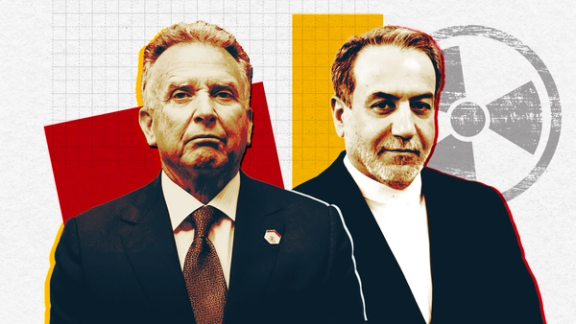
US special envoy for the Middle East Steve Witkoff and Iran's foreign minister Abbas Araghchi
Negotiations between Iran and the United States are making cautious progress, but the outcome remains highly uncertain as fundamental divisions persist and any overlap between the two sides’ red lines remains elusive.
The third round of talks took place in Muscat on Saturday, marking the first time that technical experts engaged directly.
Although the initiation of technical discussions is a positive development, addressing detailed issues exposed deep divisions, slowing the momentum. Statements by Oman’s Foreign Minister Badr al-Busaidiand Iran’s Foreign Minister Abbas Araghchi were notably cautious, signaling limited optimism.
Araghchi emphasized the substantial gap between the two sides' demands, noting that goodwill alone will not bridge it. Talks are scheduled to continue next week at both expert and chief negotiator levels.
Potential breakthrough?
Despite the uncertainties, a deal could be easier to forge compared to the one in 2015, for several reasons:
Regional dynamics have shifted, with Arab states now largely supporting an agreement.
Iran’s frozen assets are significantly lower—$10–20 billion today, compared to $80–150 billion in 2015.
Iran’s regional influence through proxy groups has weakened.
Domestic unrest has eroded the IRI’s internal position, increasing its incentive to negotiate.
The reduced intensity of US-Russia rivalry removes a complicating factor.
The US-China trade war may hamper Washington’s ability to apply maximum pressure.
Both Washington and Tehran prefer a diplomatic outcome over military confrontation. However, historical, political, and ideological differences complicate the path forward.
Core obstacles
First, the legacy of mistrust remains deep. Decades of conflict, sanctions, and failed diplomacy have hardened suspicions on both sides.
President Trump's withdrawal from the 2015 deal heightened Iranian concerns about American reliability. Meanwhile, US officials remain wary of Iran’s actions. Any agreement would require both sides to genuinely believe that commitments will be honored—an especially tall order given the political volatility in both countries.
Second, Tehran is unwilling to fully dismantle its nuclear infrastructure, resisting a repeat of Libya’s disarmament model. It may agree to reduce uranium enrichment and degrade highly enriched stockpiles but will preserve advanced centrifuge capabilities.
Iran’s regional influence, although waned, still concerns Washington, particularly with regard to Israel. Many in Benjamin Netanyahu's cabinet believe the current window offers a rare chance to cripple Iran’s nuclear capabilities and may push for covert or limited military operations to derail negotiations.
European powers are another factor. Britain, Germany, and France, alarmed by Iran’s growing military cooperation with Russia, are considering reimposing UN sanctions if no progress is made. Though not directly involved in current talks, their support will be critical to any final agreement.
Sanctions are another obstacle. While economic pressure has hurt Iran deeply, many sanctions, particularly those linked to terrorism, were codified by Congress and cannot be lifted by the administration alone. A complex framework for phased sanctions relief will be necessary.
Interim agreement?
In sum, while opportunities for a breakthrough exist, formidable challenges remain. Mistrust, nuclear safeguards, regional tensions, domestic politics, and sanctions enforcement all complicate diplomacy.
An interim agreement—laying the groundwork for a broader, binding deal—appears the most realistic short-term path.
Revived US-Iran nuclear negotiations risk empowering Iran and accelerating a strategic shift away from Washington’s traditional influence in the Middle East, according to an analysis by Jerusalem Center for Security and Foreign Affairs.
Arab states, particularly in the Persian Gulf, have adopted a cautious stance toward the talks, not out of trust in Tehran but out of skepticism toward US reliability, political analyst Dalia Ziada wrote. "The muted Arab response is a hedging strategy."
Meanwhile, regional powers are advancing their own nuclear programs. Egypt is building a Russian-backed civilian nuclear plant at El Alamein and has recently conducted its first-ever joint military exercise with China, the article pointed out.
Saudi Arabia’s atomic energy project is progressing, with Riyadh exploring cooperation with China and Russia if the US does not allow domestic enrichment.
"Arab states are learning to live with ambiguity," Ziada wrote, adding that many are leveraging new relationships with Beijing and Moscow to balance Washington’s influence.
US President Donald Trump's optimistic pronouncements regarding negotiations with Iran are primarily an effort to maintain Tehran's engagement in the talks, according to Shahram Kholdi, a professor of international relations.
Speaking to Iran International, Kholdi characterized Trump's optimism as a strategy to prevent any disruption to the process.
"Trump is trying to paint a silver lining around this very gray and ambiguous cloud of negotiations, in the hope that there might be a light at the end of the tunnel and the Islamic Republic agrees to stop enrichment," he said.
Kholdi said that Trump's expressions of confidence are largely intended to keep the Iranian delegation at the negotiating table. "Trump's optimism is mostly to keep the other side at the negotiating table."
Iran’s foreign ministry said on Monday that any agreement with the US must respect Tehran’s key demands, including the continuation of uranium enrichment inside the country and the effective lifting of sanctions.
Foreign Ministry spokesman Esmail Baghaei told reporters at his weekly press briefing that the upcoming talks — expected to be chaired by Iran’s foreign minister and the US special envoy — follow an understanding reached in Muscat.
Baghaei stressed that Iran’s fundamental negotiating principles remain unchanged. "Entering the details of any negotiation must be within the framework of broad outlines agreed upon by both sides," he said.
"Uranium enrichment inside the country and the effective removal of sanctions are Iran’s red lines and will be pursued with seriousness."
On the ongoing visit of an International Atomic Energy Agency (IAEA) technical team, Baghaei said the discussions would focus purely on technical issues and pending safeguarding matters.
"The visit of the IAEA technical delegation is a continuation of the discussions that took place between the Director General (Grossi) and Iranian officials, and today they will have talks with officials of the Atomic Energy Organization, and it is only technical. The discussion will be about the remaining safeguards issues,” he said.
Following the conclusion of the third round of nuclear talks in Oman on Saturday, Iran's foreign minister said IAEA experts might join the next round of talks on Saturday.
Visiting Tehran earlier in April, IAEA Chief Rafael Grossi said his agency could help achieve a positive outcome in the negotiations.
Last week, speaking at the US-based think tank Council on Foreign Relations, Grossi said Iran has enough enriched uranium to produce several nuclear warheads and could do so within months.
In 2018, Trump withdrew the US from a 2015 nuclear pact between Iran and major world powers, leading Iran to subsequently surpass that deal's uranium enrichment limits and limit the IAEA's oversight.
In February, the IAEA released a report saying the current situation is concerning as Tehran is enriching uranium to up to 60% purity, near weapons grade. Tehran has long denied seeking nuclear weapons.
Baghaei also addressed the role of European nations in the nuclear talks. "We hope the Europeans will play a constructive role," he said, adding that Iran’s continued engagement with neighboring countries and other JCPOA participants signals the Islamic Republic's good will.
When asked about the decision to exclude three European parties of the JCPOA from the talks, Baghaei said, "That was their own choice... Iran stands ready for European nations to play a role in these discussions.”
He criticized US pressure tactics beyond Iran, saying, "The maximum pressure policy is not limited to Iran; it is being pursued against other countries like China and disrupts free trade. It ultimately violates the human rights of individuals subjected to sanctions."
US President Donald Trump has threatened to bomb Iran if it does not agree to a new nuclear deal and on Sunday night, Israeli PM Benjamin Netanyahu said: "We are in close contact with the United States. But I said, one way or the other, Iran will not have nuclear weapons."
Baghaei responded to the threats saying: "Any adventurism against Iran will face a crushing response. Western countries, especially those continuing to support this regime [Israel], must understand they are assisting an entity whose survival depends on crisis."
Baghaei confirmed that the next round of talks is planned for Saturday, warning that the process will not be fast. "Entering technical issues is time-consuming and an inseparable part of negotiations," he said. "We have said that we are serious."
He emphasized that sanctions relief must be comprehensive and includes Tehran’s access to its assets blocked in foreign banks due to US sanctions. "Effective termination of sanctions is a key term that must include a diverse set of commitments. Ensuring free access to Iran’s resources and assets is our right."
The type of fire and smoke confirms that the explosive material was a derivative of sodium, and that a container is by no means a suitable vessel for storing sodium perchlorate, as the heat inside a container cannot be controlled, Farzin Nadimi, a senior defense and security analyst at the Washington Institute, told Iran International.
He said it did not appear that the containers were refrigerated, and the rise in temperature could have been one of the factors triggering the reaction and fire.
“If someone wanted to cause such a reaction leading to a fire, it would be very easy to set off an explosion in such a shipment. It did not seem that there were any serious security measures in place beyond surveillance cameras," Nadimi said regarding the possibility of an act of sabotage.
According to the analyst, either a person or an aerial device could have been responsible.
Nadimi added: “In the video, we did not see anything hitting the container from the sky, but on the ground, a very small and simple explosive device could have triggered the initial fire.”
Resolving the wide-ranging disputes between the United States and Iran will require days of intensive negotiations, political analyst and journalist Omid Memarian told Iran International on Sunday.
Memarian said Iran seeks the full removal of US oil and banking sanctions, but Washington has conditioned any lifting of sanctions on Tehran’s cooperation with the International Atomic Energy Agency (IAEA) — a demand the Islamic Republic has so far resisted.
"Verification and access by the IAEA to Iran’s nuclear activities remain major points of contention," Memariansaid, adding that while US officials are pressing for more comprehensive inspections, Iranian authorities continue to impose restrictions on the agency's monitoring efforts.