Israel is in close contact with US on Iran talks - Times of Israel
Israel and the United States are in close, open contact over Tehran's disputed nuclear program, The Times of Israel reported on Monday citing an Israeli official.
“We have a dialogue with the Americans, the dialogue is not one-sided and we also express positions,” the official was quoted as saying.
“There is an ongoing dialogue on many levels. I would urge you to avoid premature conclusions. There is a good, intimate relationship between the governments.”
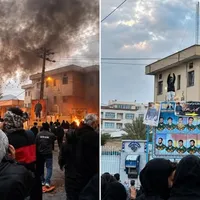
Many young women are missing following the deadly explosion at Rajaei port, said a labor official on Monday. “Three female workers were confirmed dead and one remained missing, while numerous families have reported their daughters lost at the site,” Esmail Hajizadeh, executive secretary of the Hormozgan Workers' House, told ILNA news outlet.
He added that many truck drivers are also unaccounted for. "Families are wandering the port, desperately searching for their children," Hajizadeh said.
Revived US-Iran nuclear negotiations risk empowering Iran and accelerating a strategic shift away from Washington’s traditional influence in the Middle East, according to an analysis by Jerusalem Center for Security and Foreign Affairs.
Arab states, particularly in the Persian Gulf, have adopted a cautious stance toward the talks, not out of trust in Tehran but out of skepticism toward US reliability, political analyst Dalia Ziada wrote. "The muted Arab response is a hedging strategy."
Meanwhile, regional powers are advancing their own nuclear programs. Egypt is building a Russian-backed civilian nuclear plant at El Alamein and has recently conducted its first-ever joint military exercise with China, the article pointed out.
Saudi Arabia’s atomic energy project is progressing, with Riyadh exploring cooperation with China and Russia if the US does not allow domestic enrichment.
"Arab states are learning to live with ambiguity," Ziada wrote, adding that many are leveraging new relationships with Beijing and Moscow to balance Washington’s influence.
Several individuals were summoned over the explosion at Rajaei port that killed tens of people, said Iran's interior minister on Monday.
Eskandar Momeni told a crisis meeting the blast was linked to failures in civil defense and safety protocols. "A committee determined that shortcomings, including failure to observe passive defense and safety measures, contributed to the incident," he added. He said that the number of missing or unidentified bodies matches the confirmed death toll. According to the minister, only about 3,500 out of 130,000 containers at Rajaei port were affected by the fire.
The explosion at Rajaei port stemmed from internal safety failures and mismanagement, said an Iranian lawmaker, rejecting foreign involvement.
"No evidence has been presented so far to suggest foreign actors were involved," said Ali Khezrian, a member of parliament’s National Security Committee said on Monday.
"Deflecting blame under current circumstances will only distract public attention from those truly responsible for this disaster," he added, according to Iranian media.
The Iranian president said that Nagorno-Karabakh is an inseparable part of Azerbaijan's territory during a meeting with his counterpart, supporting the country's rights over the disputed region as the two nations attempt to mend ties.
"We believe that the rights of the people of Azerbaijan must be respected, and Karabakh must belong to the country of Azerbaijan. Karabakh is an inseparable part of the soil of Azerbaijan, and we respect that," Masoud Pezeshkian said during a meeting with Azerbaijani officials in Baku on Monday.
Azerbaijani President Ilham Aliyev officially welcomed Pezeshkian at the Zagulba Presidential Palace on Monday afternoon, followed by a private meeting between the two leaders and a joint session of their high-ranking delegations.
Tensions between Tehran and Baku have run high for years, largely due to Baku's close ties with Iran's nemesis Israel and a January 2023 attack on Azerbaijan's embassy in Tehran.
Last week, Pezeshkian expressed hopes for a rapid improvement in relations and cooperation between the two countries as part of a broader effort to mend ties.
Iran and Azerbaijan held two-day joint naval exercises in the Caspian Sea in November, in moves towards rapprochement.
Iranian and Azerbaijani presidents during a meeting in Baku on April 28, 2025
Pezeshkian’s remarks come a month after Iran welcomed a peace agreement between Azerbaijan and Armenia.
The Nagorno-Karabakh conflict, a decades-long dispute rooted in the aftermath of the Soviet Union's dissolution, saw a significant development in March when both Azerbaijan and Armenia announced an agreement on the text of a peace treaty.
Nagorno-Karabakh, internationally recognized as part of Azerbaijan but historically with a majority ethnic Armenian population, had long been a flashpoint between the two South Caucasus nations.
Iran, sharing a northern border with both countries, has consistently underscored its interest in regional stability, particularly along its 44-kilometer frontier with Azerbaijan.