New explosions heard as huge blaze continues to burn at Rajaei port
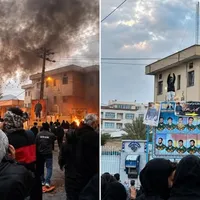
A large fire continued to burn at Rajaei Port on Saturday night, and as the flames spread to other containers, new explosions occurred in the area, according to media reports.
Explosions could still be heard from the port compound, videos shared on social media show.
The fire at the dock and container yard of Rajaei Port remains large and widespread.
The massive blast at Iran's Rajaei port "was reportedly the result of improper handling of a shipment of solid fuel intended for use in Iranian ballistic missiles,” the Associated Press reported citing private security firm Ambrey.
Earlier in January, the Financial Times reported that two Iranian cargo ships, the Golbon and the Jairan, left China loaded with 1,000 tons of sodium perchlorate, a crucial ingredient for making solid rocket propellant.
Citing unnamed security officials in two western countries, the FT said the chemicals were being shipped to the Iran's Revolutionary Guard Corps (IRGC) in Bandar Abbas.
Ship-tracking data analyzed by AP put one of the vessels believed to be carrying the chemical in the vicinity in March.
The Maritime Executive also reported in March that one of the ships mentioned by the Financial Times, the MV Jairan, was passing through the Strait of Malacca en route to Bandar Abbas.
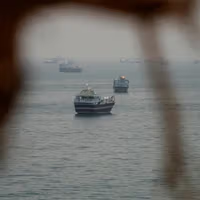
CNN reported in February that the Golbon, the first of two Iranian cargo vessels carrying sodium perchlorate from China, had anchored off the Iranian port of Bandar Abbas after departing from Taicang Port on January 21.
Iran has not publicly acknowledged receiving the shipments and has denied that Saturday's explosion is related to the country’s oil industry.
Israel's denial of playing any role in Saturday morning’s explosions in southern Iran is part of the country’s usual and routine practice, an Israeli source told Iran International.
Earlier, the Jewish state's Channel 12 cited Israeli officials as saying the country was not involved in the explosion.
Iran has yet to announce the cause of the explosion which has left over 700 injured and at least five dead, according to official figures.
The number of people injured in the explosion at Rajaei Port in Bandar Abbas has surpassed 700, the head of Hormozgan Province’s Crisis Management Organization said on Saturday.
Six people are also missing, according to Ali-Akbar Javidan, a local police chief.
All those injured have been transferred to hospitals across Bandar Abbas, IRGC-affiliated Tasnim news agency quoted Mehrdad Hassanzadeh as saying on Saturday.
The number of casualties could continue to rise, Hassanzadeh added.
Tasnim also reported that blood supplies were dispatched from the provinces of Gilan, Tehran, Yazd, Hamedan, Kerman, North Khorasan, and Isfahan to help treat the injured in Bandar Abbas.
The explosion at Shahid Rajaei port on Saturday likely involved missile fuel rather than ordinary chemical materials, aerospace expert Adrian Fazaeli said in an interview with Iran International.
"This type of material does not explode under normal conditions with just heat or air," Fazaeli said. "They need an initial detonation to ignite and explode."
Fazaeli said the intensity of the explosion, the mushroom-shaped cloud, and the color of the smoke all pointed to the presence of aluminum compounds used in missile fuel. "The white smoke we saw is very similar to the burning of missile fuel, which contains aluminum and oxidizers," he said.
He added that the timing of the explosion coincided with the unloading of fuel reportedly purchased from China, and this made it unlikely that the incident was caused by industrial negligence.
"The chance that this was a safety issue is very, very low," Fazaeli said. "Especially since Iran’s domestic solid fuel mixers were destroyed recently, and Iran had to buy ready-made fuel likely from China."
Fazaili said the circumstances suggest the materials involved were military-grade, intended for Iran’s missile program.