Negotiations in Oman have drawn criticism from Israel and foreign media, said a member of Iran’s parliament, who accused them of seeking the failure of the talks.
“Israel is furious about the Oman talks and doesn’t want them to succeed,” Ahmad Anaraki told semi-official ISNA news outlet on Monday.
He said Israel and sanctions profiteers fear losing influence if diplomacy yields results, adding, “They want to prolong chaos and the current situation.”
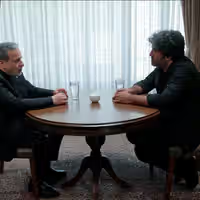
Fars News Agency, affiliated with Revolutionary Guards, contradicted a report by Axios regarding a meeting between Iranian Foreign Minister Abbas Araghchi and US envoy Steve Witkoff in Muscat.
Citing an unnamed informed source, Fars reported that the conversation occurred at the end of negotiations, lasted only a few minutes, and was proposed by the Omani side.
This account contrasts with an Axios report which, citing a source with knowledge of the talks, said that the two lead negotiators spoke for approximately 45 minutes on Saturday – a duration longer than publicly disclosed.
The Axios source described this dialogue, the highest-level between US and Iranian officials in eight years, as "substantive, serious and excellent."
Another media outlet linked to IRGC, Tasnim, also quoted an informed source as reporting that the second phase of negotiations will definitely be held with Oman's presence and mediating role, and emphasized that comments about the Iran-US negotiations becoming direct are not correct.
Tasnim added the country where the negotiations will be held geographically has not yet been finalized, rejecting another part of the Axios scoop about Rome will be the venue of the next weekend's meeting.

The United States has shown interest in investing in Iran and committed to implementing any future agreement reached in nuclear talks, Iran’s deputy foreign minister told lawmakers on Sunday.
“We should neither get overly excited nor disappointed during the negotiations. However, the American side did express interest in investing in Iran and said that they are serious about resolving the issue,” Majid Takht-e Ravanchi said at a closed-door briefing to the National Security and Foreign Policy Committee on recent negotiations in Muscat.
“They said they are serious and not seeking war,” Takht-e Ravanchi said, according to the committee’s spokesperson. “They emphasized that if we reach an agreement, they will adhere to it.”
A member of Iran's parliament has called the recent indirect talks with the United States in Oman a display of the Islamic Republic's honor, adding that dialogue with Washington is not considered a taboo.
Ahmad Fatemi, a representative for Babol, referring to the Muscat discussions, said, "Everyone saw and witnessed that on Saturday in Muscat, a display of the honor and authority of the Islamic Republic system was established."
He added, "We have faith in the wisdom, intelligence, and prudence of the Supreme Leader, and we do not consider negotiation a taboo."
Fatemi's remarks highlight a narrative within some segments of the Iranian establishment that views engagement with the US as a sign of strength and strategic decision-making, rather than a concession.

Any breakthrough in nuclear negotiations depends on American conduct, and Iran will reject pressure tactics, said the Supreme Leader’s representative in the Revolutionary Guard Quds Force.
“If they act logically, the talks may lead to a good outcome,” Ali Mohammadi Sirat told ILNA on Monday.
He said Iran would respond forcefully to any attack on its national security and urged Washington to avoid “selfishness, bullying, and domineering behavior” if it seeks a negotiated solution.


Iran’s foreign ministry spokesperson said that US-Iran negotiations are indirect because direct talks would not be effective or beneficial for the Islamic Republic.
Esmail Baghaei said that indirect negotiations are not unusual and have occurred before, adding that they are currently taking place in other contexts as well.
“Direct negotiations, in a situation where one side insists on a coercive approach, uses threats, and resorts to force, are neither beneficial nor acceptable to a side like the Islamic Republic of Iran,” he said speaking to reporters on Monday. “Therefore, we will continue with the form and approach we have chosen.”
Baghaei also said that the next round of talks may take place in a location other than Oman, adding that the location is not as important as ensuring the framework of interaction between Iran and the US remains unchanged.
On Sunday, Axios reported that Rome will host second round of Iran-US negotiations next week.
Baghaei added that the Iran's main demand in the negotiations is the removal of sanctions, which the Islamic Republic is pursuing with determination.
Baghaei also confirmed that the Director General of the UN's nuclear watchdog Rafael Grossi will likely visit Tehran this week. Earlier the Wall Street Journal reported that Grossi will visit Tehran this week ahead of the next round of US-Iran talks on Saturday.
He also addressed Tehran's economic cooperation with Washington, saying: "The Islamic Republic has never placed any obstacles to economic cooperation with other parties, but the real problem lies with the US, which, through complex laws, has deprived its own citizens of any economic dealings with Iran."
Baghaei confirmed that Foreign Minister Abbas Araghchi will travel to Moscow later this week for a pre-planned visit.
"The trip was planned in advance, but there will be consultations regarding the talks with the US," Baghaei said.