Former Iranian President Hassan Rouhani said Iran still holds powerful options despite US pressure, after President Donald Trump threatened military action if diplomacy fails.
“Trump’s mistake is thinking Iran has no cards on the table,” Rouhani said, according to ILNA news agency. “America had the economic pressure as a card, and it has already used it. Right now, they have only one other card left.”
“Iran, contrary to US beliefs, has at least four important cards on the table,” Rouhani added. He did not say what those cards were, only that “these can be explained at the right time.”


The main headline on the front page of a conservative Iranian newspaper captures the national mood ahead of the upcoming Iran-US talks in Oman: “The Saturday of Hope and Doubt.”
Across two dozen newspapers on Wednesday, the sentiment was echoed in varying language—hope for a breakthrough tempered by uncertainty over whether the two sides will meet face to face and make tangible progress.
Gholamhossein Karbaschi, a prominent politician and proprietor of the centrist daily Ham Mihan, told the press that “if Iran’s political system had no intention of negotiating with the United States, it would not have responded to Trump’s letter.” In Iranian political discourse, “the political system” is often used as a stand-in for Supreme Leader Ali Khamenei.
Karbaschi added, “Some believe a revolutionary stance means constant confrontation and chanting slogans. But the people want a peaceful life. Breaking the current deadlock requires self-sacrifice from the negotiators.”
He urged negotiators to ignore the hardline rhetoric, alluding to MP Amir Hossein Sabeti, who recently said negotiations are unlikely to change anything, as well as to vigilante groups threatening to rally outside the Foreign Ministry.
At the same time, Hadi Borhani, an expert in Israeli affairs, sought to reassure the public in an interview with Khabar Online, saying that Israel must now operate within the limits set by President Trump. He added that Prime Minister Benjamin Netanyahu was likely caught off guard by Trump’s remarks about engaging in negotiations with Iran. Nonetheless, Borhani emphasized that Israel remains firmly opposed to the talks in Oman.
Meanwhile, reformist commentator and political analyst Ahmad Zeidabadi described the upcoming talks as a prelude to a potential reset in Tehran-Washington relations. He said the primary goal of this round of negotiations is to end the longstanding hostility between the two countries.
However, Zeidabadi cautioned that the Muscat talks cannot continue indefinitely. “There is a limited time frame for these negotiations, and their outcome—success or failure—could have far-reaching consequences,” he warned, calling the talks “extremely sensitive, critical, complicated, and fragile.”
Commenting on the fragility of the negotiations, the IRGC-affiliated daily Javan warned that “one word from Trump about Iran’s missile power will abruptly end the talks.” The paper argued that the most Iran can realistically offer is a reduction in uranium enrichment levels in exchange for the full lifting of sanctions.
Meanwhile, Hesamoddin Ashna, former deputy intelligence minister and adviser to President Hassan Rouhani, cautioned Iran’s leaders against “behaving like Qaddafi’s Libya” or entertaining illusions of leading the Arab and Muslim world. He also warned against overstating the strategic value of Iran’s outdated nuclear technology.
Elsewhere, the conservative newspaper Farhikhtegan predicted that internal divisions over how to approach negotiations with the US could reshape Iran’s political landscape—particularly within the conservative camp, where opposition to the talks remains strong.
Iran’s former security chief Ali Shamkhani emphasized the strategic value of the country’s nuclear program in a post on X, writing: “Iran’s peaceful nuclear capability is a complete chain from mine to final product—not just a scientific achievement, but a vital driver for medicine, energy, agriculture, and the environment. This national technology is stabilized, irreversible, and indestructible.”
Meanwhile, the debate over direct versus indirect negotiations continued. Vali Nasr, professor at Johns Hopkins SAIS and author of Iran’s Grand Strategy: How Sanctions Work, argued on X that while Trump created a bottleneck by insisting on direct talks, this approach could actually work in Iran’s favor. “Both sides will probably start the talks indirectly but eventually shift to direct negotiations,” Nasr wrote. Echoing Iranian Foreign Minister Abbas Araghchi, he added that “the form of the talks is less important than their content.”
The Trump administration has begun internal discussions on possible military targets inside Iran, including nuclear and missile-related facilities, current and former US officials told the Free Press in a report published Thursday.
According to the report, potential strike targets include Iran’s main uranium enrichment sites, ballistic missile and drone-production facilities, and, in a more aggressive scenario, infrastructure critical to Tehran’s stability—such as the oil-export hub at Kharg Island and command centers of the Islamic Revolutionary Guard Corps (IRGC).
Officials cited in the article said a US strike on IRGC assets could risk igniting further domestic unrest in Iran, which has faced waves of protests in recent years over economic hardship and social issues.
US Defense Secretary Pete Hegseth said it was up to Iran to interpret whether the recent deployment of American B-2 bombers was a message, as he expressed hope for a peaceful resolution to nuclear talks with Tehran.
“We’ll let them decide,” Hegseth told reporters when asked if the move was meant to signal Tehran. “It’s a great asset... it sends a message to everybody.”
In March, up to six B-2 bombers were sent to the US-British base on Diego Garcia in the Indian Ocean, US officials told Reuters. The deployment came amid a bombing campaign in Yemen and rising tensions with Iran.
The B-2s, which have stealth capability and can carry the US's most powerful bombs including nuclear weapons, are rarely used. The Air Force has just 20 in its fleet.
“President Trump’s been clear ... Iran should not have a nuclear bomb,” Hegseth said. “We very much hope – the President is focused on doing that peacefully.”
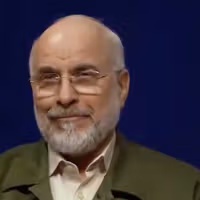
Iran’s nuclear chief announced late Wednesday that Rafael Grossi, director of the International Atomic Energy Agency (IAEA), is expected to visit Tehran around April 20, likely to address unresolved issues related to monitoring Iran’s nuclear activities.
Mohammad Eslami gave no details about the purpose of Grossi’s trip, but the visit comes as Iran continues to restrict the UN watchdog’s access to its nuclear facilities—a limitation in place since 2021. The timing suggests a possible link to the upcoming nuclear negotiations with the United States, set to begin Saturday.
Read more...

Iran’s nuclear chief announced late Wednesday that Rafael Grossi, director of the International Atomic Energy Agency (IAEA), is expected to visit Tehran around April 20, likely to address unresolved issues related to monitoring Iran’s nuclear activities.
Mohammad Eslami gave no details about the purpose of Grossi’s trip, but the visit comes as Iran continues to restrict the UN watchdog’s access to its nuclear facilities—a limitation in place since 2021. The timing suggests a possible link to the upcoming nuclear negotiations with the United States, set to begin Saturday.
Eslami also underscored what he described as Iran’s nuclear progress, claiming the country has achieved uranium enrichment without any foreign assistance and is the only nation with a fully indigenous nuclear program.
US President Donald Trump on Wednesday reiterated his warning that military action remains on the table if Iran refuses to halt its nuclear activities, adding that Israel would play a leading role in any such operation.
“I’m not asking for much … but they can’t have a nuclear weapon,” Trump told reporters during a press event at the White House, following the signing of several executive orders. He warned that if diplomacy fails, military measures could follow.
“If it requires military, we're going to have military,” he said. “Israel will, obviously, be … the leader of that. No one leads us. We do what we want.”
Trump declined to give a timeline or specific conditions for when military action might occur, saying only, “When you start talks, you know if they’re going along well or not. And I would say the conclusion would be when I think they’re not going along well.”
The comments come just days after Trump made a surprise announcement that direct talks between Washington and Tehran are set to begin Saturday. He warned on Monday that Iran would face “great danger” if negotiations fail to produce a breakthrough on its nuclear program.
The Biden-era nuclear negotiations collapsed in 2022, and since returning to office, Trump has taken a more aggressive stance, demanding that Iran completely abandon its uranium enrichment efforts that have reached an alarming stage, with high levels of uranium enrichment. Tehran has continued to insist on its right to peaceful nuclear development.