Nuclear program, sanctions relief sole focus of talks
Iranian Foreign Minister Abbas Araghchi saidthat the upcoming discussions with the United States, led by US envoy Steve Witkoff, will solely focus on Iran's nuclear program in exchange for the lifting of sanctions.
"The nuclear issue, in the sense of clarifying and assuring the peaceful nature of Iran's nuclear program in exchange for the lifting of the cruel sanctions, is the only topic of discussion," Araghchi said regarding his meeting with Witkoff.
Araghchi emphasized that the talks scheduled for Saturday in Oman present "a new opportunity for diplomacy and a test to gauge America's seriousness; a country with a long history of bad faith and unilateralism in its record."
A prominent Iranian analyst and former diplomat hailed the upcoming talks between Iran and the United States as a potential turning point in relations, while cautioning about the challenges ahead, particularly from hardliners and the limited timeframe.
In an editorial in the daily Donya-e-Eqtesad, Kourosh Ahmadi, a former Iranian diplomat at the United Nations, wrote that the confirmation of talks by Foreign Minister Abbas Araghchi following Donald Trump's announcement should be seen as the start of a new era in Iran-US relations and the nuclear negotiations.
Ahmadi expressed optimism that the Foreign Ministry is leading the talks, hoping it will develop principled and logical plans, standing firm against vested interests and what he called "delusional" influential figures, a tacit reference to the hardliners.
He stressed that avoiding war and its immense damage should be the top priority, leaving diplomacy and negotiation as the only viable path.
The dry bed of Zayandeh Rud in Isfahan and the city's historical Khajoo Bridge
A month-long protest by farmers in the central Iranian province of Isfahan over their water rights has once again brought the country’s growing water crisis into sharp focus.
Farmers' protests in Isfahan culminated last week in the sabotage of water transfer infrastructures and the cutting of drinking water supplies to the neighboring province of Yazd, highlighting the growing potential for civil unrest and national security risks linked to water scarcity.
Over 95 percent of Iran is currently experiencing prolonged drought. Yet experts argue that the root causes of the crisis go beyond climate, pointing to decades of mismanagement, poor resource planning, and development strategies that ignored environmental realities.
Among the most contentious issues is the concentration of water-intensive industries—such as steel and ceramics—in already water-stressed provinces like Isfahan and Yazd.
Environmental geologist and activist Nikahang Kowsar, who has been warning of a looming water catastrophe since the early 2000s, blames government policies stretching back to the reformist era of President Mohammad Khatami.
Khatami’s supporters, however, argue that plans to transfer water from Isfahan’s Zayandeh Rud to Yazd, Khatami’s hometown, began much earlier and were only completed during his presidency.
The video in the tweet shows the broken pipeline
Experts also cite excessive groundwater extraction for agriculture—pushed in the name of food security—as a major contributor to dropping water tables and land subsidence across much of the country.
Iran’s Supreme Leader Ali Khamenei has long championed agricultural self-sufficiency. In a March 2021 speech, he called for domestic production of key crops such as wheat, corn, and barley, asserting that the goal was both necessary and achievable. But critics say this policy has encouraged unsustainable water use, especially in arid regions.
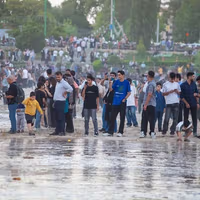
Tensions in Isfahan flared last month as local farmers demanded the release of water from behind Zayandeh Rud Dam to the dry river to irrigate their parched lands. The government temporarily eased the standoff on April 5 by releasing water into the river for ten days, prompting celebratory gatherings of citizens along the dry riverbed.
Zayandeh Rud, once the lifeline of Isfahan, has not maintained a permanent flow since 2006. The decline is attributed to drought, upstream agricultural expansion in Chaharmahal and Bakhtiari Province, and the controversial diversion of water to Yazd.
Much warmer months, however, are ahead with temperatures exceeding 40 degrees celsius and both farmers and residents of the city are highly likely to face serious water issues for the irrigation of the crops and normal use, including the running of evaporative air conditioners.
Isfahan’s farmers claim that water diverted to Yazd is being used to support industrial operations, including a major steel plant and greenhouse agriculture such as the cultivation of cucumbers for export. Officials, however, maintain that the pipeline primarily supplies drinking water.
Isfahan Province is also a highly industrial city with a massive steel complex (Mobarakeh Steel Company). Local farmers also grow highly water-intensive crops such as watermelons and rice.
In recent days, angry demonstrators destroyed three pumping stations and damaged the main pipeline to Yazd. Supply of water has been partially restored. Government sources say full restoration of the pipeline could take up to two months.
The resulting emergency triggered a major water crisis in Yazd, forcing the government to announce the closure of government offices and educational facilities on Saturday and Sunday and to begin the distribution of drinking water with tankers to the city’s over half a million population.
The pipeline has long been a flashpoint. It was first sabotaged in 2012, and subsequent protests over water scarcity in Isfahan, Khuzestan, and Bushehr in 2018 and 2021 were met with a heavy government crackdown.
While protests in Isfahan temporarily subsided in Isfahan, the deeper crisis remains unresolved. Isfahan continues to suffer from some of the worst water stress in the country, even as it remains a hub for heavy industry.
Amid growing concerns, some officials have even floated the idea of relocating the capital from Tehranto the water-rich Makran region along the Gulf of Oman—a dramatic proposal that underlines the severity of Iran’s water crisis and its potential to destabilize the country’s future.
A fighter fires a Kornet-variant anti-tank guided missile in this image released by Uli al-Baas on January 14.
A new Iran-backed militant group, Uli al-Baas, has emerged in Syria, positioning itself against the United States and its regional allies, Newsweek reported on Tuesday.
Newsweek quoted the group, officially known as the "Islamic Resistance Front in Syria - Uli al-Baas," as saying it is aligned with the broader Axis of Resistance, a coalition of Iran-backed political and military actors in the Middle East such as Hamas in Gaza, the Houthis in Yemen, and Hezbollah in Lebanon.
"Uli al-Baas is a faith-based, revolutionary, nationalist movement with an Arab nationalist dimension, unaffiliated with any existing organization in Syria," the group's political office told Newsweek, adding that it does not support the current ruling government.
"It [the group] has its own political project of resistance that guarantees the establishment of a strong, capable, and freedom-supporting state," the group added.
While Uli al-Baas said that it is "not affiliated with any regional party or any country," logos used, particularly the raised Kalashnikov-style rifle, mirrors the signature style of Iran's Revolutionary Guards (IRGC) and has been adopted by other Axis of Resistance groups, including Hezbollah and Iraqi militias.
Newsweek also quoted the group speaking about the Islamic Republic, in what appeared to echo similar manifestos of Tehran's allied groups.
"As for the constant threat posed to the Islamic Republic of Iran, this is because it maintains an independent identity and refuses to submit," Uli al-Baas said,
"However, the truth is that Iran is challenging the advanced state in West Asia, namely the Zionist entity," the group added.
Experts suggest that the group may have originated from Iran’s efforts to maintain influence in Syria, a key Arab ally under the ousted Bashar al-Assad government.
“While UAB’s kinetic capabilities remain unproven, its emergence could signal the early stages of a new Iran-backed militia formation in Syria, an outcome that was always likely post-Assad,” a Washington Institute analysis said in March.
The group has since published the Newsweek story on their Telegram channel.
Israeli Prime Minister Benjamin Netanyahu discussed the Libyan model for dismantling Iran’s nuclear program during a recent meeting with Donald Trump, The Jerusalem Post reported Tuesday citing Israeli officials.
The model, which led to Libya’s full nuclear disarmament in the early 2000s, would require Tehran to eliminate its enrichment infrastructure entirely.
However, according to i24NEWS, Trump gave no assurance he would adopt the model, and “his policy on this matter remains unclear.”
“The chances of the Iranians agreeing to a nuclear deal based on the Libyan model are low,” the Post reported citing one Israeli official.
Elliott Abrams, who was Trump’s special envoy to Iran during his first term, told the Post that talks could serve as a prelude to military action.
“It’s useful to have a negotiation, go through it, watch it fail, so that’s your explanation of why you had to use military force,” he added.
The first round of US-Iran nuclear talks is scheduled for Saturday in Oman.