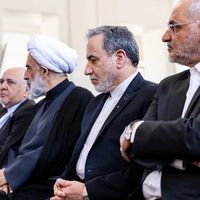
Representatives from Iran, Russia, and China began a trilateral meeting behind closed doors in Moscow on Tuesday, with no press access, according to Iranian state media.
The meeting, which started on Tuesday afternoon, was previously announced by Iranian Foreign Ministry Spokesman Esmail Baghaei.
Baghaei said on Monday that the discussions would be held at an expert level and would focus on the Iranian nuclear program, the Joint Comprehensive Plan of Action (JCPOA), and UN Security Council Resolution 2231.
According to the spokesman, the Iranian delegation consists of mid-level representatives and legal experts from the Ministry of Foreign Affairs.
The specific agenda and expected duration of the trilateral meeting were not disclosed.
Iran's Foreign Minister Abbas Araghchi said again on Tuesday that Tehran will only engage in indirect talks with the United States, rejecting any attempts by Washington to impose its will through pressure and threats.
Speaking to Iranian media, Araghchi said, "The format we prefer is indirect negotiations, and our reasons are clear. If they want to impose their will through pressure and threats, that is not negotiation; that is dictation."
"The format of the negotiations, whether direct or indirect, isn't, in my view, the most important thing." He added, "What really matters is whether the talks are effective, the seriousness and intentions of both sides, and their commitment to reaching an agreement."
Araghchi, who is slated to lead the Iranian delegation in upcoming discussions in Oman, argued that the indirect format is more conducive to effective and fruitful negotiations.
He pointed to historical precedent and the ongoing indirect talks between Russia and Ukraine as examples.
He firmly dismissed reports in foreign media suggesting a two-stage process involving initial indirect talks followed by direct engagement. "The news in foreign media about the negotiations initially being indirect and then direct is baseless, and we have no such agreement with the other side.”
Iran’s currency strengthened modestly on Tuesday, recovering from historic lows as anticipation grew over high-level indirect talks with the United States scheduled to take place this weekend in Oman.
The rial, which hit a record low of 1,050,000 per US dollar last month, bounced back to about 960,000 rials on Tuesday amid growing anticipation of renewed diplomacy between Tehran and Washington.

Iran’s Revolutionary Guard naval forces have seized an oil tanker in the Persian Gulf over allegations of fuel smuggling, Iranian state media reported on Tuesday.
Fars News Agency said the vessel was intercepted by the Islamic Revolutionary Guard Corps (IRGC) Navy and that six individuals were arrested. It did not specify the nationality of the tanker or those detained. Fars added that 100,000 liters of smuggled fuel were discovered during the inspection of the tanker.
The reported seizure follows an operation last month in which the IRGC detained two foreign tankers allegedly carrying over three million liters of smuggled diesel fuel. Those vessels, intercepted by the IRGC’s Second Naval District, were said to be systematically involved in fuel trafficking and were being moved to the port of Bushehr under judicial orders.
The IRGC regularly announces such actions, saying they are part of efforts to combat fuel smuggling in the Persian Gulf, a vital maritime route through which a significant share of global oil shipments passes.
Iran has previously seized tankers over alleged maritime violations or as retaliatory measures.
In April 2023, the Iranian Navy detained the Advantage Sweet, a Marshall Islands-flagged tanker, in the Gulf of Oman, citing a collision with an Iranian vessel.
In January, Iran seized the St. Nikolas, also Marshall Islands-flagged, in response to a US confiscation of Iranian oil the previous year.
Tensions between Iran and the United States have flared in recent years over a series of maritime incidents in the region, often involving oil shipments and sanctions enforcement.
As indirect talks with the US loom, an Iranian lawmaker said on Tuesday that no system can be toppled by force, warning against a perceived "surrender or war" ultimatum.
“Negotiations with the enemy will begin on Saturday. He (Trump) has said either surrender or war and bloodshed. The enemy is pinning its hopes on internal factors and its agents, otherwise no system has fallen or will fall with bombs and missiles,” lawmaker Salar Velayatmadar said in parliament.
The Kremlin said on Tuesday that Russia supports both direct and indirect talks between Iran and the US over Tehran's nuclear program, as they could lead to a de-escalation of tensions between the two sides.
In a call with reporters, Kremlin spokesman Dmitry Peskov again voiced Russia's support for a diplomatic and political settlement.