Iran seizes two foreign oil tankers in Persian Gulf

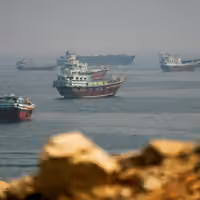
Iranian Revolutionary Guard naval forces seized two foreign oil tankers in the Persian Gulf on Monday, state media reported, accusing them of smuggling diesel fuel.

Iranian Revolutionary Guard naval forces seized two foreign oil tankers in the Persian Gulf on Monday, state media reported, accusing them of smuggling diesel fuel.
The tankers were intercepted in a maritime operation by the Islamic Revolutionary Guard Corps (IRGC) Second Naval District and are now being transferred to the port of Bushehr.
“The two tankers, with a total of 25 crew members, were systematically involved in fuel smuggling in the central waters of the Persian Gulf and were collectively carrying over three million liters of smuggled diesel fuel,” read a statement by the IRGC unit.
“These two tankers were systematically engaged in fuel smuggling and were identified through intelligence monitoring by IRGC naval forces,” the statement added. “They are now being moved to the Bushehr oil pier under judicial order for fuel confiscation.”
The IRGC regularly announces such seizures, citing efforts to combat fuel trafficking in the Gulf.
In April 2023, the Iranian Navy seized the Advantage Sweet, a Marshall Islands-flagged oil tanker, in the Gulf of Oman, alleging it had collided with an Iranian vessel.
Similarly, in January 2024, Iran seized the St. Nikolas (formerly known as Suez Rajan), another Marshall Islands-flagged tanker, in retaliation for the US confiscation of its oil cargo the previous year.
In 2019, the Revolutionary Guards seized the British-flagged oil tanker Stena Impero in the same waterway for allegedly ramming a fishing boat and released it two months later.
Iran has frequently justified such actions by citing fuel smuggling, maritime violations or reciprocal measures.
Iran and the United States have traded barbs in recent years over a spate of incidents in the sensitive waters of the Persian Gulf, through which much of the world's energy supplies passes.

Food prices in Iran surged more than 70% in the past Iranian calendar year ending March 20, a member of the country’s Food Committee at the Chamber of Guilds said, driven by soaring costs for packaging and transport.
“Packaging costs rose in some cases by 200%, and freight charges climbed 55%,” said Ahmadreza Bakhshi.
“When you add the removal of subsidized foreign exchange, overlapping import platforms, and VAT enforcement, it's clear why food production has become dramatically more expensive,” he added.
Iran’s economic crisis has worsened across all sectors. The rial has hit a historic low, with US dollar being exchanged at 1,050,000 rials. Inflation continues to climb, making everyday goods unaffordable amid misgovernance and Donald Trump’s “maximum pressure” policy to intensify sanctions.
Bakhshi pointed to the currency's near-daily loss of value. “Every day, our currency loses value,” he said. “These factors made the cost of production higher in the second half of the year than the first.”
The timing made matters worse. With Nowruz and Ramadan coinciding at the end of the year, demand for food items spiked well beyond levels seen in the same period the previous year, Bakhshi said.
Over the past five years, tens of millions of Iranians have seen their living standards erode as wages fail to keep pace with soaring inflation. Today, the average worker earns roughly $120 per month, while official estimates suggest that a minimum of $500 is needed for the basic survival of a family of three.

A top Iranian commander said US military bases in the region would be in the crosshairs after any attack, upping Tehran's rhetoric against Washington after US President Donald Trump threatened to bomb the country.
"The Americans have at least 10 bases with 50,000 troops in the region, meaning they are sitting in a glass room," said Amir Ali Hajizadeh, the commander of the Aerospace Division of the Revolutionary Guards.
"Someone in a glass house should not throw stones at anyone," he added.
Hajizadeh was given a "victory" military commendation by Supreme Leader Ali Khamenei for his leadership of a direct missile attack on Israel last year and is a key military decision-maker.
US President Donald Trump on Sunday warned the United States would bomb Iran if Tehran fails to reach a deal over its nuclear program.
"If they don't make a deal, there will be bombing — and it will be bombing the likes of which they have never seen before," he told NBC News.
His comments were more stark than previous ones giving Tehran and ultimatum to come to a deal or face a military intervention.
Iran denies seeking a nuclear weapon but the United Nations nuclear watchdog says it has enriched more uranium than any state lacking a bomb.
Khamenei promised on Monday to retaliate if Iran was attacked.
"The enmity from the US and Israel has always been there. They threaten to attack us, which we don’t think is very probable, but if they commit any mischief, they will surely receive a strong reciprocal blow," he said in a televised addressed.
Iran on Monday issued a formal complaint about Trump’s threat to the Swiss embassy in Tehran, which represents US interests in the country, and Iran's foreign ministry spokesman called it a "shocking affront" to the core principles of international peace.

Iran's most senior Sunni leader said that direct negotiations with the United States and other world powers would be more effective than working through mediators, in a direct challenge to Supreme Leader Ali Khamenei.
Mowlavi Abdolhamid Ismaeelzahi, said, "In my opinion, direct negotiation is more effective," after leading the Eid al-Fitr prayers in Zahedan, marking the end of the fasting month of Ramadan.
"Intermediaries cannot powerfully defend the country's interests and respond to the other side's doubts. Rather, the person with the pain and the problem can speak better and achieve a better result."
The Sunni leader, who has become famed for his fearless opposition to the government, made the comments on Monday following threats from US President Donald Trump to bomb Iran if it does not agree to a new nuclear deal.
He emphasized the importance of adapting policies to foster progress and better international relations, saying, "The success of all developed and developing countries and nations is the result of creating change, transformation, and innovation in laws and policies."
Abdolhamid's call for direct dialogue stands in contrast to the official stance of Iran's Supreme Leader Ali Khamenei, who voiced his rejection of direct negotiations with the United States earlier in the day, although he indicated that indirect talks could continue.
Khamenei's position was underscored during his televised speech, where he also warned the US of a "strong blow" if it acted on Trump's bombing threat.
As Khamenei delivered his remarks, crowds present chanted, "Death to America."
Echoing Khamenei's stance, Friday prayer leaders across Iran, who serve as his representatives, have also condemned Trump's threats.

Mohammad Mehdi Hosseini Hamedani, Khamenei's representative and the Friday prayers leader of Karaj, said on Monday, "Our response to the heavy bombing threat is the repetition of the slogan 'Death to America.'"
President Masoud Pezeshkian has also rejected direct talks with Washington but left the door open for indirect negotiations.
“The response by the Supreme Leader to Trump’s letter was delivered to the US contact in Oman,” Pezeshkian said on Sunday.
“In that response, direct negotiations have been rejected, but regarding indirect talks, Iran has always been involved in such discussions, and the Supreme Leader has emphasized that indirect talks can still continue.”
Meanwhile, economic and political figures within Iran have warned that failure to engage with the US could deepen the country’s crisis.
Khamenei’s senior adviser Ali Larijani and leading economists in Tehran have urged policymakers to seek a resolution with Washington to ease sanctions that have crippled Iran’s economy.
Earlier this year, Trump reinstated his “maximum pressure” strategy against Iran. Trump's maximum pressure approach in his first term, which started in 2018, pummeled Iran's economy, causing a dramatic decline in oil exports and skyrocketing inflation.

Iran summoned the Swiss envoy in Tehran on Monday to deliver a formal warning following US President Donald Trump’s threat of bombing Iran if a nuclear deal is not reached, according to state media.
The Swiss diplomat was told that Iran would respond decisively to any such threats, according to IRGC-affiliated Tasnim News website.
The report referred to the envoy in Iran as the "caretaker of the embassy," implying the absence or unavailability of the Swiss ambassador.
Switzerland represents US interests in Iran since Washington and Tehran cut ties shortly after the 1979 Islamic Revolution. The Swiss embassy in Tehran has been consistently relaying diplomatic communications between the Islamic Republic and the United States.
Earlier in the day, Iran's foreign ministry spokesman condemned Trump's threat of bombing Iran if the country failed to reach a new nuclear deal with Washington, calling it a "shocking affront" to the core principles of international peace and security.
Iran's Supreme Leader Ali Khamenei also warned that the United States would face a strong blow if it follows through on Trump’s threat to bomb the country.
Khamenei's warning, delivered in a televised speech marking the end of Ramadan, came a day after Trump told NBC News that if a deal was not reached, "there will be bombing — and it will be bombing the likes of which they have never seen before."
Iran International has put a request for comment to the Swiss foreign ministry.

Supreme Leader Ali Khamenei on Monday vowed the United States would face retaliation if it follows through on President Donald Trump’s threat to bomb Iran.
Khamenei's warning, delivered in a televised speech marking the end of Ramadan, came a day after Trump told NBC News that if a deal was not reached, "there will be bombing — and it will be bombing the likes of which they have never seen before."
Khamenei said, "The enmity from the US and Israel has always been there. They threaten to attack us, which we don’t think is very probable, but if they commit any mischief, they will surely receive a strong reciprocal blow."
"If the enemies think they can instigate sedition within the country, the Iranian nation itself will respond to them," he added.
As Khamenei delivered these remarks, the crowd erupted into chants of "Death to America." He held an assault rifle in his hand—echoing a tradition from the 1980s, when clerics often appeared armed during sermons following the establishment of the Islamic Republic.
He did not specify what he meant by sedition. Iranian authorities often blame the West for protests, including those sparked by the death of Mahsa Amini in custody for alleged hijab violations in 2022, and the 2019 nationwide demonstrations over fuel price increases.
On Sunday, Iran's President Masoud Pezeshkian said the country rejects direct negotiations with the United States, but added that indirect talks can continue.
"The response by the Supreme Leader to Trump's letter was delivered to the US contact in Oman...In that response, direct negotiations have been rejected, but regarding indirect talks, Iran has always been involved in such talks, and the Supreme Leader has emphasized that indirect talks can still continue," Pezeshkian said.
Also on Sunday, government spokeswoman Fatemeh Mohajerani said that "Iran's response to the sent letter was prepared and delivered," as Iran's foreign ministry stressed the confidentiality of the exchanged letters.
Trump on Friday warned that “bad, bad things” would happen if Tehran did not agree to a nuclear deal.
While Iran denies seeking a nuclear weapon the UN's nuclear watchdog says it has enriched more uranium than any state lacking a bomb.
In February, Trump signed a directive restoring the so-called maximum pressure policy on Iran of his first term and warned of "catastrophic" consequences if Tehran does not make a deal on its nuclear program.
Trump's maximum pressure approach in his first term, which started in 2018, pummeled Iran's economy, causing a dramatic decline in oil exports and skyrocketing inflation.
Earlier this week, Khamenei's senior adviser Ali Larijani, as well as prominent economists in Tehran said that Iran needs to address its problems with the United States urgently in a bid to lift or reduce US sanctions and give the ailing economy a chance to grow after many years of crises and stagnation.