"Trump threatened to strike Iran, but he aligns more with the dovish camp that favors a diplomatic solution," Axios reported on Tuesday.
"Witkoff and VP Vance also believe a deal with Iran is possible and preferable," the report said citing a source familiar with their thinking.
Witkoff will lead the US delegation in the upcoming nuclear talks with Iran, slated to be held in Oman on Saturday.
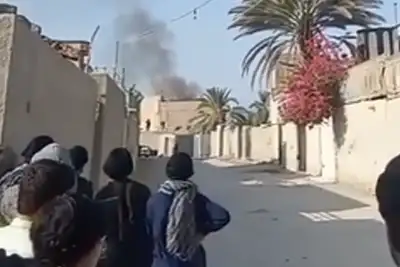

Iran’s Quds Force is overseeing the transfer of weapons, equipment and money to Hezbollah in Lebanon via maritime routes, a Western security source told Al Arabiya on Tuesday.
Iran’s Quds Force is managing the operation through its Unit 190 and Unit 700, according to the unidentified source. Shipments are arriving either directly to Lebanon or through intermediary countries.
Intelli Times also reported the same information about Quds Force involvement, citing the same two units.
“Hezbollah has refocused and reimposed its control over the port of Beirut,” the source said, referring to the facility’s gradual return to normal operations following the August 2020 explosion.
The Iran-backed group turned to sea routes after losing access to overland supply lines through Syria following the fall of former Syrian president Bashar al-Assad and after Lebanese authorities curtailed its influence at Beirut’s Rafic Hariri International Airport following a US-French brokered ceasefire with Israel in November.
The source said Hezbollah operates freely at the port through a network inside customs and port oversight bodies, directed by senior Hezbollah official Wafiq Safa.
“Safa is seeking, through his agents at the port, to facilitate the smuggling of equipment, weapons and money without any inspection or oversight,” the source said.
The source warned that the use of Beirut Port by Hezbollah - designated a terrorist group by countries such as the UK and US - risks Lebanon’s economic interests and may deter foreign investment.
“The Lebanese state must act urgently in light of Hezbollah’s violations and plans, which could repeat the August 2020 catastrophe,” the source said.
Speaking in a separate interview with LBCI aired Sunday, US Deputy Special Envoy for the Middle East Morgan Ortagus said Hezbollah and all militias in Lebanon must be disarmed “as soon as possible.”
“We, of course, always bring up disarming Hezbollah, but not just Hezbollah, all militias in this country,” Ortagus said.
“Only by disarming militant groups could the Lebanese people be ‘free from foreign influence, free from terrorism, free from the fears that have been so pervasive in society.’”
Ortagus added that President Joseph Aoun had made it clear in his inaugural speech that “he wanted the state to have the monopoly of force, he wanted the state to be the one with the weapons. That is a position that we support.”
China called on the United States Tuesday to demonstrate sincerity in the upcoming nuclear talks with Iran.
"As the country that unilaterally withdrew from the comprehensive agreement on the Iran nuclear issue and caused the current situation, the US should demonstrate political sincerity (and)... mutual respect," Chinese foreign ministry spokesman Lin Jian said Tuesday.
Washington should "participate in dialogue and consultation, and at the same time stop its wrong practice of using force to exert extreme pressure," Lin added."China will continue to maintain communication with all relevant parties, actively promote peace and dialogue and push for a diplomatic solution at an early date.”
Iranian officials conveyed to Reuters on Tuesday a palpable wariness and deep-seated suspicion regarding Washington's intentions, tempering expectations for significant progress in the upcoming talks with the US.
In Tehran, US President Donald Trump's warnings are seen as a way to box the Islamic Republic into accepting concessions in the talks Trump demands or face air strikes, Reuters quoted three Iranian officials as saying.
The officials added that Washington wanted to push other issues too, including Iranian influence across the Middle East and its ballistic missiles program, which they said were off the table.
"Trump wants a new deal: end Iran's regional influence, dismantle its nuclear program, and halt its missile work. These are unacceptable to Tehran. Our nuclear program cannot be dismantled," one of the officialssaid.
"Our defense is non-negotiable. How can Tehran disarm when Israel has nuclear warheads? Who protects us if Israel or others strike?" Reuters quoted another Iranian official as saying.

Iran insists that upcoming nuclear talks with the United States in Oman will be indirect, pushing back against US President Donald Trump’s announcement that direct negotiations will be underway.
The Iranian side, as reiterated by government spokeswoman Fatemeh Mohajerani and Foreign Minister Abbas Araghchi, maintains that Araghchi’s upcoming talks with US envoy Steve Witkoff in Oman will be conducted indirectly. However, Mohajerani did not explicitly rule out the possibility of direct negotiations, noting that Araghchi will lead Iran’s nuclear negotiating team as its highest-ranking official.
Both Araghchi and foreign ministry spokesman Esmaeil Baqaei had previously denied any negotiations were taking place—until Trump’s surprise Monday evening announcement during his meeting with Israeli Prime Minister Benjamin Netanyahu changed the calculus.
Shahram Kholdi, a Middle East and international relations expert, told Iran International TV that Iran’s insistence on indirect talks stems from Supreme Leader Ali Khamenei’s stance that direct negotiations with the US would be dishonorable.
Jason Brodsky, policy director at United Against Nuclear Iran (UANI), offered a different interpretation. In a post on X, he suggested that Tehran may have been caught off guard by Trump’s announcement. According to Brodsky, the announcement was likely meant “to pressure Tehran and make it look unreasonable should it reject the meeting.” He added that indirect negotiations might still occur on Saturday, but both sides would be creative in defining what counts as direct or indirect.
Meanwhile, Nour News, a website close to Iran’s Supreme National Security Council, dismissed suggestions that Iran was responding to US pressure. In a post on X, the outlet stated that Iran had set the time and location of the talks in Oman and communicated them to the US through Omani intermediaries. “No one-sided narratives—the initiative was in Tehran's hands,” the post read.
Ali Nasri, a Tehran-based foreign relations expert, criticized the ongoing obsession with terminology. “The bias regarding the words ‘direct’ or ‘indirect’ in the matter of negotiations does not benefit the lives of the Iranian people,” he wrote on X. “What matters is whether the negotiation process is effective or ineffective. Whichever method is more effective in securing national interests is the right path.”
Hossein Mousavian, Iran’s ex-ambassador to Germany (1990–1997) and a former senior nuclear negotiator, offered a historical analogy. In an X post, he recalled how negotiations during the Obama administration in Istanbul began under the supervision of EU’s supervision Catherine Ashton but soon transitioned to direct talks between Iranian and American officials. He predicted a similar setup in Oman. “It seems that Washington and Tehran have adopted a wise approach, and there is a chance for an agreement. Both negotiators [Witkoff and Araghchi] are capable, experienced, moderate, and wise,” he wrote.
Reza Nasri, another political commentator, argued that Iran has strategic reasons to consider negotiating with Trump. “Biden couldn’t deliver due to internal weakness and fear of the anti-Iran lobbies. Obama reached a deal, but Republicans killed it. Ironically, Trump may be the only U.S. president strong enough to defy the establishment, bypass Washington’s foreign policy elite, and strike a deal that actually lasts,” he posted on X.
The Iranian market has responded favorably to the prospect of talks, whether direct or indirect. Tehran’s Stock Exchange (TSE) rose by 59,000 points, reaching 2.8 million, while the rial rebounded slightly from last week’s record low, climbing to around 960,000 per dollar from 1,050,000.
Former Iranian President Hassan Rouhani said on Tuesday that the 2015 nuclear deal (JCPOA) would have taken two decades to achieve, if at all, had it relied on indirect negotiations, highlighting the necessity of direct talks with foreign ministers.
"If the JCPOA negotiations were to be indirect, we would not have reached the JCPOA in two years, let alone twenty years," Rouhani said in comments reported by Iranian news outlet Entekhab. He emphasized that direct engagement with foreign ministers was crucial to the agreement.
Rouhani, who was president during the JCPOA talks, acknowledged that the current circumstances surrounding potential negotiations with the United States are different and require a different strategy.
"We hope that with the efforts of the esteemed 14th government and the guidance of the Supreme Leader, we will achieve results and remove the shadow of war from the country and succeed in the negotiations. The issue of economic sanctions is important for our region and country," Rouhani added.