Houthis say they targeted airport in Israel with Iranian missile, IDF says intercepted
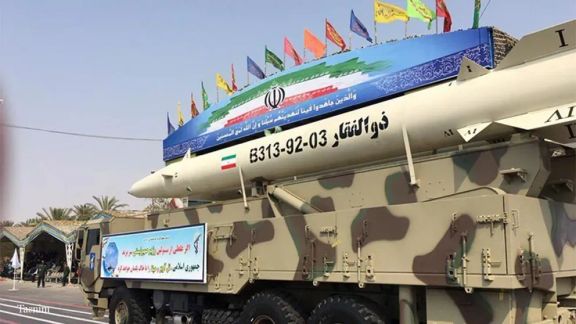
Iran’s Zolfaghar missile during a military parade in Tehran
Yemen's Houthis announced on Sunday said they targeted Ben Gurion Airport with an Iranian Zolfaghar missile, as Israel's military denied the missile reaching Israeli territory, saying it was intercepted before impact.
"We targeted Ben Gurion Airport in the occupied Jaffa area with a Zolfaghar ballistic missile, and this operation was successfully carried out with God’s blessing," Yahya Saree, the spokesman for the Houthis said Sunday in a statement.
The Israeli military disputed the Houthi claim, saying, "Following sirens that sounded a short while ago in several areas in Israel, a missile launched from Yemen was intercepted by the IAF prior to crossing into Israeli territory. Sirens were sounded in accordance with protocol."
The Zolfaghar missile is an Iranian short-range ballistic missile (SRBM) developed as an enhanced version of the Fateh-110 missile system. It was first unveiled during a military parade in September 2016 and entered service in 2017.
Shortly after IDF made the announcement, former Israeli Prime Minister Naftali Bennett said Israel should respond to Houthi attacks by targeting Iran directly, arguing Tehran finances and controls the Yemeni group.
"It is Iran that finances, arms, trains, and operates the Houthis. Iran has a lot to lose; the Houthis have much less. Therefore, Israel must levy a high price on Iran. Only in this way will Iran understand," he said on X.
This comes as US President Donald Trump, less than a fortnight ago, warned that Iran will bear brunt of any Houthi attack.
"Every shot fired by the Houthis will be looked upon, from this point forward, as being a shot fired from the weapons and leadership of IRAN, and IRAN will be held responsible, and suffer the consequences, and those consequences will be dire!" Trump wrote on his Truth Social platform.
In January last year, US forces intercepted a shipment carrying military aid from Iran to the Houthis, including drone parts, missile warheads, and anti-tank missile units.
Writing for The Council on Foreign Relations, Kali Robinson said that, "For the Houthis, the Iran connection provides more sophisticated weaponry than they could acquire on their own, especially missiles and drones.
"Iranian support has bolstered the group’s fighting abilities, helping the Houthis gain and maintain military superiority within Yemen, but experts say it has had greater impact elsewhere."
Iran would strike a British-American naval base in the Indian Ocean if it is attacked by the US, The Telegraph reported citing an Iranian military official, after Washington deployed long-range bombers at the strategic airbase.
B-2 Spirit bombers have arrived at Naval Support Facility Diego Garcia in Chagos Islands, a US Strategic Command spokesperson confirmed to Iran International earlier this week as Washington ramps up rhetoric against Iran.
In an apparent response to the deployment, a senior Iranian military official told The Telegraph, "There will be no distinction in targeting British or American forces if Iran is attacked from any base in the region or within the range of Iranian missiles."
“When the time comes, it won’t matter whether you’re an American, British, or Turkish soldier – you will be targeted if your base is used by Americans," the senior official was quoted as saying.
However, the Indian Ocean base is 3,800 kilometers from the Iran and Iranian ballistic missiles have a maximum range of 2,000 kilometers.
A British government spokesman on Saturday condemned Iran's threats in the strongest terms.
"The UK Government continues to work with partners across the region to encourage de-escalation. The base on Diego Garcia is vital to UK and US security and plays a crucial role in maintaining regional and international security," The Telegraph reported citing the spokesman.
The US military has deployed the B-2 stealth bombers along with C-17 cargo planes and 10 aerial refueling tankers in the last few days, defense industry outlet The War Zone reported on Wednesday citing satellite imagery.
The joint UK-US military base at Diego Garcia has previously been used to launch US strikes on the Middle East including Iraq and Afghanistan, with the deployment suggesting the potential for large-scale air operations in the region.
US President Donald Trump has in a letter to Iran's Supreme Leader Ali Khamenei demanded Tehran come to a deal over its nuclear program or face a military intervention.
The Islamic Republic, in response, has rejected any negotiations on its ballistic missile program or regional allies, and any nuclear talks beyond the framework of the 2015 nuclear deal.
Meanwhile, the US military continues a bombing campaign on Tehran-aligned Houthi fighters in Yemen, warning that any attack by the Houthis would be treated as emanating from Iran.
A ship fires missiles at an undisclosed location, after U.S. President Donald Trump launched military strikes against Yemen's Iran-aligned Houthis on Saturday over the group's attacks against Red Sea shipping, in this screengrab obtained from a handout video released on March 15, 2025.
The United States on Friday intensified its campaign against Iran-aligned groups, conducting extensive airstrikes on Houthi-controlled areas in Yemen and pressuring Hezbollah in Lebanon.
Suspected US airstrikes hit Yemen overnight into Saturday, reportedly killing at least one person, as the American military confirmed an earlier strike on a major military site in central Sanaa controlled by Houthi rebels, the Associated Press reported.
According to Houthi-affiliated media, American warplanes carried out 14 airstrikes each on the Yemeni capital Sanaa and the northern city of Saada, as well as several strikes in al-Jawf province.
While full casualty figures remain unclear, the group’s said one person was killed and four injured in Saada, describing the fatality as a civilian. However, such figures may downplay military losses, given the Houthis’ pattern of operating in civilian attire.
The escalation follows Houthi threats and attacks on maritime traffic Since 2023, which the group said were acts of solidarity with Palestinians in Gaza. Between November 2023 and January 2024, Houthi forces targeted over 100 commercial vessels. The US and its allies restarted strikes in Yemen in mid-March after a brief lull.
Meanwhile, the US Treasury Department announced sanctions against five individuals and three companies accused of helping finance Hezbollah through oil smuggling operations tied to Iran’s Islamic Revolutionary Guard Corps’ Quds Force. The department described the network as a commercial front funneling millions of dollars into Hezbollah’s accounts under the oversight of senior financier Muhammad Qasir, who died in late 2024.
“These evasion networks strengthen Iran and its proxy Hezbollah and undermine the courageous efforts of the Lebanese people to build a Lebanon for all its citizens,” said Bradley T. Smith, Acting under secretary for terrorism and financial intelligence in a statement.
The Treasury added that Washington's Rewards for Justice program is offering up to $10 million for information on Hezbollah’s financial infrastructure.
On the same day, Israeli warplanes struck a building in Beirut’s southern suburbs, a Hezbollah stronghold, for the first time since a November ceasefire. Israeli officials said the site was used by the Iran-backed group to store drones.
In Washington, State Department spokesperson Tammy Bruce defended the strike.
"The Government of Lebanon is responsible for disarming Hezbollah," Bruce told reporters. "The reason that any attacks have happened is because terrorists launched rockets into Israel from Lebanon. That is a violation of the cessation of hostilities."
"Israel has to respond as the United States would have to respond," Bruce said. "We stand by Israel."
The US push on multiple fronts highlights a broader effort to limit the influence of Tehran’s allies and proxies in the region.
US President Donald Trump recently sent a letter to Tehran giving Iran a two-month deadline for reaching a new nuclear deal, Axios reported citing one US official and two sources briefed on the letter.
"You've got a lot of stuff going on with Iran, and we sent a letter to Iran," Trump said this week. "You're going to have to be speaking to us one way or the other pretty soon, because we can't let this happen."
Trump has demanded Tehran come to a deal or face a military intervention and warned any attack by Yemen's Houthis would be treated as emanating from Iran.
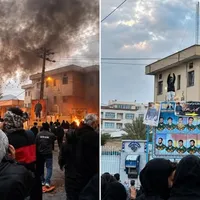
A person holds a burning banner depicting Israeli flag as Iranians take part in a protest marking the annual al-Quds Day (Jerusalem Day) on the last Friday of the holy month of Ramadan in Tehran, Iran, March 28, 2025.
A senior Iranian commander on Friday called on the country and its regional allies to prepare for what he described as a “major operation,” warning that the United States and Israel were at their weakest point in decades.
“Everyone must be ready for the big operation,” said Brigadier General Mohammad Reza Naqdi, deputy coordinator of Iran’s Islamic Revolutionary Guard Corps (IRGC), during a speech in Karaj. “The US and the Zionist regime are at their weakest point in history. We must bring the mission we started 46 years ago to a proud conclusion — and that moment is near.”
Naqdi’s comments follow a letter sent by US President Donald Trump to Iran’s Supreme Leader, giving Tehran two months to accept a new nuclear agreement or face the prospect of a military response. Foreign Minister Abbas Araghchi confirmed on Thursday that Iran had issued a formal reply and sent it through Oman.
Speaking again on Friday during Quds Day rallies, Araghchi said Washington's letter had been carefully reviewed. “Some parts of it were threatening,” he said. “We will not allow anyone to speak to the Iranian people in the language of threats.” He added that efforts had been made to keep a diplomatic window open.
Quds Day, marked across Iran on the last Friday of Ramadan, saw officials delivering a range of messages in response to growing US and Israeli pressure over Tehran’s nuclear and regional activities — with military commanders adopting a combative tone, while others struck a more measured stance.
Major General Abdolrahim Mousavi, commander of Iran’s army, described the day as “a global stand against oppression,” saying more people each year were opposing the actions of the United States and Israel. “The key message of Quds Day is that the end of the Zionist regime is near, and that the rights of the oppressed will be restored,” he said.
Iran has rejected Trump’s ultimatum and maintains that it will not negotiate under pressure. Meanwhile, regional tensions continue to rise. On Thursday, Israel said it intercepted two missiles launched from Yemen, where the Iran-aligned Houthi movement has claimed responsibility for multiple drone and missile attacks in support of Hamas.
The United States has responded with ongoing airstrikes on Houthi targets since mid-March and has warned it will hold Tehran accountable for any further attacks.
To reinforce its regional posture, the US military has deployed B-2 stealth bombers, C-17 cargo planes, and aerial refueling tankers to its base on Diego Garcia in the Indian Ocean — a move seen as preparing for sustained long-range operations.
Iran’s ambassador to Iraq, Mohammad Kazem Al-Sadegh, said this week that Iran’s regional allies remain active. “The resistance in Lebanon is still strong and capable. The resistance in Yemen is active,” he said. “The axis of resistance remains and is alive.”
US president Donald Trump ordered airstrikes on Houthi-controlled areas of Yemen
An ongoing US military campaign must defeat Houthi fighters in Yemen to prove Washington's resolve to their Iranian backers, US Senator John Hoeven told Iran International.
"We need to take out the Houthis. We need to stop the Houthis from these attacks. It's not good enough to just play defense. We actually have to take out their ability to make these attacks," the Republican senator from North Dakota said.
"They are a proxy for Iran. They are funded by Iran. They are armed by Iran," he added. "It's not only important we take out the Houthis so that we can have safe, safe shipping in the Red Sea, in the Gulf of Aden. It's also important to send very clear message to Iran that we know their proxies are armed and funded by Iran and doing Iran's bidding."
President Donald Trump on Mar. 15 ordered large-scale military strikes against dozens of Houthi targets in Yemen, warning Iran not to keep supporting the group.
'Offshoot of Iran'
A Shi'ite religious militia, the Houthis seized much of the war-torn country beginning in 2014 and have been provided advanced drone and missile technology by Iran.
Following an attack by Iran-backed Hamas militants on Israel on October 7, 2023 and Israel's incursion into Gaza, the Houthis began attacking commercial and military vessels in the waterways astride Yemen in what they called solidarity with Palestine.
Following this week's attacks on the Houthis, Trump asserted once more that the Yemen group was Tehran's offshoot.
"They make their own missiles. They get their missiles also from Iran. It's an offshoot of Iran, another offshoot," he told reporters at the White House on Tuesday.
"You've got a lot of stuff going on with Iran, and we sent a letter to Iran. You're going to have to be speaking to us one way or the other pretty soon, because we can't let this happen," he added.
Senior Iraqi politicians opposed to Iranian influence in the country have called for Tehran-backed militias to disarm and disband now that the Islamic Republic's sway over the region has diminished.
“Armed groups supported by Tehran have no choice but to accept change,” said Sheikh Abdullah al-Jaghifi, Secretary-General of the Ahrar al-Furat Movement.
Al-Jaghifi said Syria was a cautionary tale of how geopolitical transformations can unravel entrenched alliances. Tehran lost its oldest Arab ally there, the Assad dynasty, to hardline Islamist-led rebels close to Turkey.
Speaking to Iran International, al-Jaghifi predicted 2025 would bring major changes across Iraq and the broader region, with Iran's influence continuing to wane.
The remarks come after discussions over integrating the militias into the Popular Mobilization Forces (PMF) – a move presented as a means to depoliticize Iraq’s paramilitary landscape. Yet critics question the sincerity and effectiveness of the initiative.
Mithal al-Alusi, founder of the Democratic Party of the Iraqi Nation, dismissed the proposed merger as a semantic maneuver.
“Iran is using wordplay to maintain its grip on Iraq and is turning the country into a base for extremist operations,” he told Iran International. He warned that Iran-backed networks are involved in transferring funds, passports and weaponry under the guise of Iraqi state structures.
Al-Alusi argued that Hezbollah and Hamas are being financed with dollars funneled through Iraqi channels, calling the practice “a serious crime against Iraq and the region – against people killed whether Israelis, Palestinians, Lebanese, Syrians and Yemenis alike.”
The leadership in Baghdad is pressuring Tehran-aligned armed groups not to attack Israeli targets to avoid a punishing military response, The New Arab news outlet reported on Wednesday.
The move follows a reported effort by a senior Iranian military commander to urge Tehran's armed allies in Iraq and Yemen to stand down attacks on their Mideast nemesis, potentially signaling an Iranian desire for detente in the region.
Iran faces an ultimatum by US President Donald Trump to ink a new nuclear deal or face attack after its home front and armed allies in the region have been dealt historic military blows from Israel in over a year of war.