A Ring doorbell camera records Khalid Mehdiyev as he surveils the home of Iranian expat Masih Alinejad in Brooklyn, NY in July 2022.
A mobster, who admitted to trying to kill Iranian-American journalist Masih Alinejad on US soil in 2022, took the stand Thursday exposing the alleged links between Iran’s government and organized crime.
The US Treasury slapped sanctions on Iran's oil minister Mohsen Paknejad on Thursday, putting to one side its usual practice of sparing senior political figures and escalating Washington's standoff with Tehran over its disputed nuclear program.
“The Iranian regime continues to use the proceeds from the nation’s vast oil resources to advance its narrow, alarming self-interests at the expense of the Iranian people,” said Secretary of the Treasury Scott Bessent said in a statement.
“Treasury will fight and disrupt any attempts by the regime to fund its destabilizing activities and further its dangerous agenda.”
US President Donald Trump reinstated his so-called maximum pressure campaign of sanctions on Iran last month in a bid to bring oil revenues upon which the state relies to zero and force Tehran to the negotiating table over its nuclear program.
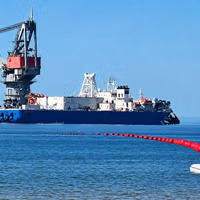
The sanctions announced on Thursday also included entities in China and India the treasury accused of owning and operating vessels involved in the trade of Iranian oil - dubbed a "shadow fleet" by Washington.
Iran's oil ministry criticized the move and said it would circumvent US sanctions.
"The sanctions on Mohsen Paknejad are due to his extensive efforts to sell Iranian oil. He has repeatedly emphasized that Iranian oil exports will never stop and that the US policy of maximum pressure has failed," it said in a statement.
"In recent years, Iran has repeatedly demonstrated its ability to bypass sanctions and continues to sell its oil in international markets through various methods," it added.
The US treasury explained its targeting of Paknejad as a means of combatting Iran's security apparatus.
"Iran’s oil industry ... generates tens of billions of dollars annually for the regime."
"Under (Paknejad's) leadership, Iran’s Ministry of Petroleum has allocated billions of dollars’ worth of Iranian oil to the Iranian armed forces, including the Islamic Revolutionary Guard Corps and the Iranian Law Enforcement Forces, both critical instruments in the regime’s tools of oppression," it added.
Iran's Revolutionary Guards have tightened control over the country's oil industry and now manage up to half of exports, according to Reuters report late last year, funding its military capabilities and those of armed allies across the Middle East.
The US state department too announced sanctions on several Indonesia-based entities it says facilitate Iranian oil shipments.
Washington has been ramping up sanctions on Iran's oil exports since the latter days of the Joe Biden administration, pinching Iran's economy and deepening financial hardship for its people which could threaten unrest.
US competitor China, the world's top oil importer, is Iran's customer for over 90% of its oil exports and has continued to buy the supplies through a world-spanning network of traders and shell companies dodging US-led sanctions.
Iran denies seeking a nuclear weapon but a United Nations watchdog said this month that its uranium enrichment levels had sharply risen to levels which in principle could be refined further into six atomic bombs.
A prominent Iranian-Austrian lawyer aided a Vienna-based firm in securing special visas for senior Iranian officials and attempting to bypass sanctions on Tehran, an Austrian daily reported on Thursday.
According to Der Standard’s report citing business documents, the company Blue River Holding GmbH also pursued a plan to export luxury cars to Iran.
“The documents obtained indicate that (Ramin) Mirfakhrai acts or acted as a confidant of a clique of Viennese citizens of Iranian descent. He likely maintains extremely close ties to the internationally isolated Iranian regime,” wrote Der Standard.
Contacted by Der Standard, Mirfakhrai denied any wrongdoing.
“I have not conducted or been involved in any legally or morally questionable transactions,” he said. Mirfakhrai acknowledged he had worked for Blue River in the past but said he no longer has ties to the company.
Mirfakhrai first gained public attention in 2019 as the initiator of the so-called Ibiza video, a secretly recorded meeting on the Spanish resort island which allegedly exposed corruption within the far-right Freedom Party (FPÖ), leading to the downfall of Austria's coalition government.
His commissioning of the covert filming, Mirfakhrai said at the time, was a civic gesture aimed at exposing abuses of power.
Der Standard's investigation suggested that at the same time Mirfakhrai was involved in business dealings with individuals connected to Iran’s economic and political establishment.
One of these ventures was Blue River Holding, which held a license from Spar International, based in Amsterdam, to operate Spar supermarkets in Iran.
The company is also suspected of facilitating visa access for high-ranking Iranian officials and exploring ways to set up a payment system between Iran and Europe that could circumvent international sanctions.
Documents reviewed by Der Standard show that in 2021, Blue River sought a €10 million loan to fund its Iran-related projects.
A controversial luxury car deal
In late 2021, Blue River attempted another project—this time involving the export of luxury cars to Iran.
The company sought to establish a business partnership between Bentley and the Iranian conglomerate Zar Group, a Tehran-based company best known for food production but increasingly expanding into other sectors.
Zar Group's CEO, Morteza Soltani, has been publicly associated with Iran’s leadership, including Supreme Leader Ali Khamenei. His son, Arash Soltani, was honored by the Basij militia, a paramilitary force linked to the Islamic Revolutionary Guard Corps (IRGC), as a so-called Top Jihad Manager in late 2023.
Italy has installed Starlink antennas in four high-risk embassies, including one in Iran, as part of a test phase amid Tehran's internet restrictions, a government minister confirmed on Thursday.
Officials insist no national security contract has been signed with Elon Musk's company while the trial is piloted in four countries known for limiting internet freedom.
“Some experiments with Starlink satellite systems were started at diplomatic offices in Burkina Faso, Bangladesh, Lebanon, and Iran, which were therefore equipped with Starlink antennas, although none are active to date," Luca Ciriani, Italy’s Minister for Parliamentary Relations, was quoted by Reuters as saying.
Ciriani clarified that the antennas were installed purely for testing purposes. "The procedure is that the antennas are activated only to test their functioning and are then suspended with the aim of reactivating them only when necessary," he said.
Italy's government is seeking encrypted communication solutions for officials operating in high-risk areas.
Starlink, operated by Musk’s SpaceX, is one of the companies under consideration. However, opposition parties have raised concerns about the involvement of Musk, citing his close political ties to US President Donald Trump.
Ciriani pushed back against security concerns, stressing that the antennas would not be used for classified communications. He also underscored that the installations were arranged through third-party companies. "There has been no entrustment of the country's critical infrastructure to Starlink," he said.
Starlink's role in Iran has grown significantly over recent years. The number of its users in the country has now surpassed 100,000, according to Pouya Pirhosseinlou, head of the Internet and Infrastructure Committee at Iran’s E-Commerce Association.
"Over 30,000 unique users are utilizing satellite internet, suggesting that the total number of satellite internet users exceeds 100,000," Pirhosseinlou told Iran's ILNA news agency earlier this year.
Starlink gained prominence in Iran following the 2022 "Woman, Life, Freedom" protests, which erupted after the death of Mahsa Amini in morality police custody. The Iranian government responded with internet blackouts and widespread censorship, prompting citizens to turn to satellite services like Starlink and virtual private networks (VPNs) to bypass restrictions.
Despite being officially prohibited in Iran, Starlink’s appeal lies in its unrestricted access and high-speed service—an alternative to the heavily filtered and controlled local internet where Iran ranks among the world's lowest for internet freedom, according to Freedom House.
The US government’s 2022 decision to lift certain restrictions allowed SpaceX to provide Starlink access in Iran, offering a lifeline for digital freedom.
However, the service has also faced backlash from Iranian authorities who argue that its high costs drain foreign currency and undermine domestic internet infrastructure. The government has even lobbied the International Telecommunication Union (ITU) to restrict Starlink's coverage over Iran.
Iran's Ministry of Foreign Affairs has summoned the ambassadors of the United Kingdom, France, and Germany in protest against their cooperation with the United States in convening a closed-door meeting of the UN Security Council regarding Iran's nuclear program.
The meeting, held on Wednesday, was criticized by Iran as an "abuse of Security Council mechanisms."
The summons was issued by Mohammad Hassan-Nejad Pirkouhi, Director-General for Peace and International Security at Iran's Foreign Ministry.
During the meeting, Pirkouhi cited the "irresponsible and provocative" actions of the three European countries, emphasizing that Iran's peaceful nuclear program complies with its obligations under the Nuclear Non-Proliferation Treaty (NPT) and does not violate the Joint Comprehensive Plan of Action (JCPOA).
He criticized the closed UN Security Council session as lacking legal and technical justification, labeling it as a politically motivated move influenced by the US's unilateral policies.
The summons comes amid rising tensions after the United States called on the UN Security Council to confront Iran over its nuclear program, accusing Tehran of violating IAEA safeguards and defying the Council.
The closed-door meeting was called by six of the council's 15 members - the US, France, Greece, Panama, South Korea and Britain.
Additionally, the United Kingdom has signaled its readiness to trigger the snapback mechanism—a process to reinstate UN sanctions if Iran does not curb its uranium enrichment.
Concerns were amplified following the February IAEA report which revealed that Iran had accumulated 275 kilograms of uranium enriched to 60% purity, a level far exceeding civilian needs.
With the UN's sanctions relief from the 2015 nuclear deal set to expire in October, European powers have indicated that they may resort to the snapback mechanism if diplomacy fails to prevent Iran from advancing its nuclear capabilities.
Iranian authorities have intensified their campaign against online dating content, summoning or arresting 15 people involved in organizing blind date events on social media.
The arrests, announced on February 25 by the head of Iran’s Public Security Police Majid Feyz Jafari, were carried out in coordination with the judiciary in response to what officials describe as a growing phenomenon of anonymous meet-ups facilitated through digital platforms.
"Given the rising popularity of blind dates in online spaces, this action follows numerous family complaints and intelligence monitoring," Jafari said.
Iran has faced criticism from rights groups over its sweeping internet restrictions, which have led many citizens to rely on virtual private networks (VPNs) to bypass censorship and access blocked platforms like YouTube, Twitter, and Instagram.
The issue resurfaced on Wednesday when judiciary spokesperson Asghar Jahangir revealed that a criminal case had been opened against those it had detained.
"The main defendant remains in custody, while four others are held due to an inability to post bail. The primary charge involves encouraging corruption and inciting individuals to immoral acts," Jahangir said at a press conference.
Social life via social media
While the authorities frame blind date programs as a moral threat, the concept itself is neither new nor exclusive to Iran. In Iran, such interactions were once mediated through family or traditional matchmakers, but digital platforms have reshaped how young people connect.
Sociologist Aliyeh Shekarbeigi argues that the response of Iranian authorities reflects a broader gap between official policies and evolving social norms.
"Iranian society consists of both formal and informal structures. The formal structure, represented by government policies lags behind the realities of how people live and interact," she told Sharq daily.
Public backlash and concerns over restrictions
Critics of the crackdown see it as part of a broader attempt to control digital spaces. The Iranian government has long imposed restrictions on internet use, blocking platforms such as YouTube and Twitter while tightly monitoring domestic social media activity.
Shekarbigi warns that suppressing digital spaces for communication could have unintended consequences. "If authorities attempt to silence informal social structures through force, society will simply adapt by finding alternative, often underground, means of interaction," she added.
Iran has previously targeted social media influencers and content creators for promoting what authorities deem "un-Islamic" lifestyles.
Last year, officials seized the Instagram page of Blind Date, a popular show hosted by an influencer known as Vinnie Vids, who had garnered 1.2 million followers. The show had drawn millions of views before being abruptly taken offline under judicial orders.
Khalid Mehdiyev said one of the defendants in the Russian mob group, Rafat Amirov confessed to him that Iran's government was behind the plot to murder the Iranian-American journalist.
Jacob Gutwillig, a federal prosecutor said in court this week: "The defendants were hired guns for the government of Iran."
Alinejad has been of the strongest and most vocal critics of Tehran's human rights abuses and persecution of women and minorities.
Since she fled Iran in 2009, she has had a target on her back.
Masih Alinejad
“I was trying to get the easy way to kill her," the bearded Mehdiyev confessed in the Manhattan courtroom.
Prosecutors have said Iran’s government offered to pay Amirov, 45, and Omarov, 40, about $500,000.
Amirov and Omarov, both fellow natives of Mehdiyev’s Azerbaijan, are on trial for the murder-for-hire and attempted murder in aid of racketeering. The duo both pleaded not guilty.
Mehdiyev, who said he was paid $30,000 for the failed assassination attempt, is cooperating with the federal government after pleading guilty in an effort to lessen his potential sentence.
Watching and Waiting
Mehdiyev got dangerously close to Alinejad.
He parked outside of Alinejad's Brooklyn home for two days, watching her every move, and even slept in his car, ordering doordash meals to his vehicle.
The self-proclaimed Russian mobster watched and waited for his target.
The would-be assassin told the court he tried to open Alinejad's door, took videos and photos of himself touching her flowers in her front yard to prove to his mobster associates he was getting close to his mission, and asked his mob boss for a bike to conduct more surveillance.
In bone chilling testimony, Mehdiyev said even tried to hire a woman to lure Alinejad outside her home. He said he told the woman that his target owed him money and once she was in plain sight from the door opening, he would take care of the rest and pay her his share.
“I was there to try to kill the journalist,” said Mehdiyev.
He said in court Thursday that he saw Alinejad outside her Brooklyn home in at least on occasion. The shocking revelation made even more significant since Alinejad was already under FBI protection at the time.
Khalid Mehdiyev standing outside of Masih Alinejad's front porch in Brooklyn, New York.
But his assassination plans failed with some errors.
Once Alinejad spotted the stranger lurking around her home, peering into her window and wandering around her, she reported him to the FBI.
Mehdiyev ran a stop sign as authorities trailed him, leading to his arrest and the discovery of a loaded Ak-47, with one in the chamber and a ski mask.
The ski mask, he calmly said in court was "to cover my face when I was going to kill the journalist."
A past of kidnappings and murder-for-hire plots
Mehdiyev faced a grueling cross-examination that focused on his extensive criminal past.
Elena Fast, Omarov’s defense attorney, asked if he was ever caught for committing crimes in other parts of the world. He allegedly committed crimes in 7 countries around the world, but has only been convicted in the U.S.
Mehdiyev told the court he once tried to orchestrate a kidnapping in Ukraine as he was also managing a pizza shop called Peppino’s.
His resume included alleged kidnappings, extortion and murder-for-hire plots.
Green Card for an Informant (S Nonimmigrant)
Mehdiyev was born in Azerbaijan and left for the United States in 2017 after fear of rival gangs emerged in his home country.
He said he was offered by one of his mob bosses, known as a Vor in Russian, to run the gang division in the U.S. Mehdiyev said his goal was to one day became a Vor himself, and move up the ranks from his position.
He entered the U.S. on Nov 4, 2017 and later applied for political asylum, claiming that he would be tortured by Azerbaijani authorities. Mehdiyev admitted it was a lie as Fast, Omarov’s defense attorney said he was wanted in Azerbaijan for crime.
As a witness who has agreed to cooperate with the US government Mehdiyev's entire immediate family including his father, mother and brother are living in the United States with a S greencard, provided to informants.
Meantime, Alinejad hasn't seen her family in more than 15 years. Even Alinejad's brother was imprisoned in Iran in an attempt to put pressure on her to cease her activism.
As a witness, Alinejad cannot discuss the case, but posted to X on Wednesday how profoundly grateful she was to US law enforcement for saving her life.
“In a federal court, he admitted he was sent by the Islamic Republic to kill me for the ‘crime’ of speaking out,” Alinejad wrote on X.