• العربية
  • فارسی
Brand
  • Iran Insight
  • Politics
  • Economy
  • Analysis
  • Special Report
  • Opinion
  • Podcast
  • Iran Insight
  • Politics
  • Economy
  • Analysis
  • Special Report
  • Opinion
  • Podcast
  • Theme
  • Language
    • العربية
    • فارسی
  • Iran Insight
  • Politics
  • Economy
  • Analysis
  • Special Report
  • Opinion
  • Podcast
All rights reserved for Volant Media UK Limited
volant media logo

Iran media purveys disinformation to justify Khamenei's rejection of US talks

Feb 10, 2025, 21:20 GMT+0

Several Iranian state media outlets are reporting false information that Donald Trump imposed outlandish preconditions for talks with Tehran, in what analysts call a coordinated campaign to justify Supreme Leader Ali Khamenei's rejection of talks with the US.

Iranian news site Khabar Fori cited a report it falsely attributed to The Wall Street Journal on Monday saying one of President Trump’s conditions for negotiating with Iran was the "transfer of three Iranian islands to the United Arab Emirates."

The control of the islands is a deeply felt issue for many Iranians across the political spectrum.

Hours later, other Iranian media outlets reported that the American newspaper had not published any such report.

At the same time, an article in Arman-e Melli newspaper and Nameh News listed seven alleged conditions, including "US oversight of all of Iran’s peaceful nuclear activities."

The report also said that, according to these conditions, all American and European prisoners "must be released unconditionally," and that Iran must "dismantle or place under full US supervision" all space technology and satellite research centers.

None of the alleged conditions appear in President Trump's official executive order on Iran, or in his public remarks on potential negotiations.

According to Iran International's in-house analysts, the disinformation campaign—emerging amid sharply rising prices and an unprecedented decline in the national currency rial—appears designed to shape public opinion, justify the Supreme Leader’s decision and mitigate public resentment toward him.

Trump ramps up pressure, Khamenei rejects talks

On February 5, Trump signed a presidential directive to resume his "maximum pressure" policy against the Islamic Republic, with the aim of preventing Tehran from acquiring nuclear weapons, countering its malign influence in the region by reducing its oil exports to zero.

Khamenei expressed opposition to negotiating with the US, saying such talks "have no impact on solving the country’s problems".

"Negotiating would not be wise, intelligent or honorable," added Khamenei, who is the ultimate decision-makers on all matters of state.

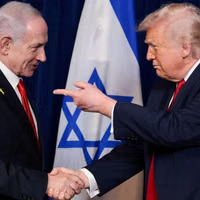
A day later, Trump expressed hope about reaching a deal with the Islamic Republic, saying that such a deal would forestall an Israeli attack on Iran.

Khamenei's categorical rejection of negotiations drew skepticism from some pro-government social media users and a few officials within the Islamic Republic.

Telegram channel Seda-ye Hashemi, which is said to be affiliated with associates of former President Akbar Hashemi Rafsanjani, published an editorial titled "Foreign Policy or Historical Stubbornness?", criticizing Khamenei’s reference to past nuclear negotiations.

"National interests should be defined based on realities, not historical and political prejudices," the author of the editorial wrote.

Parliament Speaker Mohammad Bagher Ghalibaf, however, addressed the matter, saying, "My expectation and demand from the president is that he and his colleagues in the government implement the Supreme Leader’s directive."

Tehran aligns with Supreme Leader on US talks

On Monday, during state-led celebrations marking the anniversary of the Islamic Revolution, several officials commented on Trump’s threats and the issue of negotiations.

In a speech, President Masoud Pezeshkian said, "Trump says, ‘Let’s negotiate,’ but signs every possible conspiracy against Iran and then claims he is ready for talks." Earlier, Pezeshkian said, "Our enemies think that if they besiege us, we will die of hunger," aligning with Khamenei’s stance against negotiations.

The country’s foreign minister, Abbas Araghchi, also referred to "America’s betrayal in the JCPOA," saying, "We do not trust negotiations and will never negotiate under pressure and coercion." A similar narrative came from Defense Minister Aziz Nasirzadeh, who said, "We will not negotiate under conditions of threats and sanctions."

On the other hand, Mahmoud Vaezi, former chief of staff to President Hassan Rouhani and deputy head of the Moderation and Development Party, suggested that Khamenei’s remarks do not rule out negotiations entirely but are specifically directed at the current circumstances under Trump.

Mostafa Pourmohammadi, secretary-general of the Combatant Clergy Association, echoed this view, saying that based on Khamenei’s position, negotiations should take place "at the right time, from a position of power and dignity."

Trump's remarks on Iran further inflamed currency and gold markets, driving dramatic price surges amid an already strained economy. In response, some officials stressed the need to "clarify" the Supreme Leader’s stance against negotiations with the US.

Gholam-Ali Haddad-Adel, head of the Coalition Council of Revolutionary Forces, said, "The Supreme Leader provides reasoning for his position, and those who support negotiations with Trump should also present their arguments." He acknowledged the "negative reactions of some on social media" to Khamenei’s remarks, attributing them to economic hardships and the pressure on vulnerable groups, but insisted that negotiations would not resolve these problems.

Despite some of Tehran's efforts to justify Khamenei’s decision and spread disinformation about Trump’s alleged preconditions for talks, many among the wider public continue to blame the Supreme Leader and state officials for Iran’s economic and social crises.

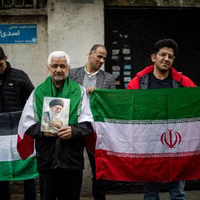
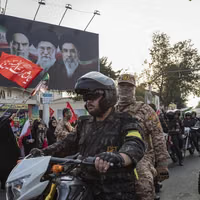
On the eve of the 46th anniversary of the 1979 Islamic Revolution, citizens in various Iranian cities chanted slogans against the Islamic Republic, including "Death to the Dictator" and "Death to Khamenei."

Most Viewed

Iran negotiators ordered to return after internal rift over Islamabad talks
1
EXCLUSIVE

Iran negotiators ordered to return after internal rift over Islamabad talks

2
ANALYSIS

US blockade enters murky phase as tankers spoof signals and buyers hesitate

3
ANALYSIS

Why the $100 billion Hormuz toll revenue is a myth

4

US tightens financial squeeze on Iran, warns banks over oil money flows

5
ANALYSIS

US blockade targets Iran oil boom amid regional disruption

Banner
Banner

Spotlight

  • Hardliners push Hormuz ‘red line’ as US blockade tests Iran’s leverage
    INSIGHT

    Hardliners push Hormuz ‘red line’ as US blockade tests Iran’s leverage

  • Ideology may be fading in Iran, but not in Kashmir's ‘Mini Iran'
    INSIGHT

    Ideology may be fading in Iran, but not in Kashmir's ‘Mini Iran'

  • War damage amounts to $3,000 per Iranian, with blockade set to add to losses
    INSIGHT

    War damage amounts to $3,000 per Iranian, with blockade set to add to losses

  • Why the $100 billion Hormuz toll revenue is a myth
    ANALYSIS

    Why the $100 billion Hormuz toll revenue is a myth

  • US blockade targets Iran oil boom amid regional disruption
    ANALYSIS

    US blockade targets Iran oil boom amid regional disruption

  • Iran's digital economy battered by prolonged blackout
    INSIGHT

    Iran's digital economy battered by prolonged blackout

•
•
•

More Stories

Khamenei-linked Iranian daily resists court order to return confiscated land

Feb 10, 2025, 20:21 GMT+0

The hardline Kayhan newspaper which is overseen by Iran's Supreme Leader has yet to comply with a court ruling requiring the return of a sizable tract of public land, according to a whistleblower journalist.

The land dispute involving a body at the heart of Iranian establishment illuminates the controversy around alleged land grabs involving well-connected people and institutions.

Centering on 200 hectares in Damavand near Tehran, the case dates back to 1996, three years after longtime editor Hossein Shariatmadari was appointed as Ali Khamenei’s representative at the Kayhan Institute overseeing the newspaper.

According to the journalist Yashar Soltani, at the time, the government transferred the land for tree farming and grazing. However, subsequent legal changes challenged such allocations.

“On November 25, 1996, Gholamreza Forouzesh, the minister of agriculture, approved the allocation of 200 hectares of land to the Kayhan Institute. The land was intended for the construction of a township to consolidate all of the institute's publications, as well as for a printing house and administrative facilities.

"However, it was later transferred to the institute under the vague and general pretexts of livestock farming,” said a report by Soltani.

A law passed in 2003 mandated that land transfers made after 1985 without provincial commission approvals must be reversed if the intended projects had not materialized.

Following this, the ministry of agriculture pursued legal action in several cases, including the Kayhan land deal.

In 2007, a court ruled that the land deed should be invalidated and converted into a lease, yet the institute has refused to recognize the decision.

Despite the law’s explicit language, officials from Tehran’s Natural Resources Directorate have been unable to enforce the ruling.

Tehran's Friday prayer leader, Kazem Sedighi, another appointee of the supreme leader, has faced scrutiny in the wake of allegations that he and his family purchased a valuable 45,200 sq ft plot in northern Tehran.

Khamenei presents his office as incorruptible and apart from any financial peccadillos of officialdom but is Iran's ultimate source of authority.

MP urges stronger ties with China, Russia as Iran’s leader rejects US talks

Feb 10, 2025, 19:40 GMT+0

A senior Iranian lawmaker called for strengthening ties with China, Russia, and neighboring countries after Supreme Leader Ali Khamenei rejected the idea of negotiations with the United States.

“We pursue and advance our national issues and interests independently of the United States,” said Alaeddin Boroujerdi, a member of the National Security and Foreign Policy Committee.

“Therefore, it is essential to strengthen our relations with major countries like China and Russia, as well as with our neighboring countries,” Boroujerdi told ISNA news agency.

Khamenei said on Friday that talks with Washington are "neither wise, intelligent nor honorable."

He also said that US withdrawal from the 2015 nuclear deal under President Donald Trump shows Washington is unreliable.

“The Islamic Republic trusted America once, despite the Supreme Leader’s clear distrust. The Americans, however, failed to honor their commitments, even tearing up an agreement backed by a UN resolution,” Boroujerdi added.

He also said Iran’s policies must reflect reciprocity, warning that threats to Iranian national security would be met with countermeasures.

The remarks indicate that hardliners are coalescing around the intransigent take of the Supreme Leader on talks, in opposition to the public desire for talks mooted by the relatively moderate government.

While Iran’s leadership frames its anti-US approach as protecting national sovereignty, the economic toll of sanctions and isolation has taken a heavy toll.

Ordinary Iranians are confronted with worsening standards of living as the US dollar is being exchanged at over 890,000 rials on Saturday, a new record low. Inflation, unemployment, and shortages in critical sectors continue to strain daily life.

Trial of Salman Rushdie's knife-wielding attacker begins

Feb 10, 2025, 19:00 GMT+0

The trial began on Monday of a man accused of stabbing Salman Rushdie, the irreverent author menaced with a religious death warrant from Islamic Republic founder Ayatollah Ruhollah Khomeini.

Hadi Matar, a 27-year-old American whose parents are of Lebanese Shi'ite extraction, pleaded not guilty to second-degree attempted murder and assault.

Jurors in the Mayville, New York courtroom have heard the prosecutor's opening statements on how the knife attack at a 2022 New York lecture unfolded in a matter of seconds, leaving Rushdie blinded in one eye and fighting for his life in hospital.

Moments before 77-year-old Rushdie was stabbed on stage, a poet was introducing the book event on the topic of keeping writers safe from harm, Chautauqua District Attorney Jason Schmidt told the jury according to Reuters.

The defendant is accused of running on stage and stabbing Rushdie up to 10 times. The attack also damaged Rushdie’s liver and paralyzed one hand.

Matar’s defense team has questioned the neutrality of police officers’ testimony.

Lynn Schaffer, an assistant public defender here in Chautauqua County, opened her remarks by saying it was an honor to defend Matar and argued that the case and sequence of events is not straightforward, a BBC journalist attending the trial said.

Matar’s lead defense lawyer, Nathaniel Barone, was absent due to illness.

Who is Hadi Matar?

In July 2024, two years after the incident, an unsealed indictment charged the defendant with providing material support to Iran-backed Hezbollah, sometime between September 2022 and August 2022.

The indictment did not specify how Matar is linked to the group.

In an interview with the Daily Mail, Matar's mother told the outlet that her son went on a month-long trip to the Middle East in 2018 and came back radicalized.

Rushdie was forced to spend about 10 years in hiding throughout the United Kingdom and United States for much of the 90s after Khomeini issued a fatwa or religious edict to kill the author.

Khomeini called on “the proud Muslim people of the world” to kill the author of “The Satanic Verses,” which centered on the life of the Prophet Mohammad.

The trial is expected to last up to 10 days, the Associated Press reported.

Rushdie who released a memoir after the attacked called Knife, is expected to take the stand and come face-to-face with his would-be murderer later in the trial.

Iranian woman arrested for 'death to dictator' protest, eyewitness says

Feb 10, 2025, 18:41 GMT+0

A young Iranian woman was arrested for appearing without a mandatory head covering and chanting "death to the dictator" in a public square in southwestern Iran on Monday, an eyewitness told Iran International.

The protest points to smoldering discontent even after authorities quashed by force a nationwide protest movement against clerical rule which began in 2022.

At the central clocktower square in the city of Yasuj, a young woman who appeared to be in her late 20s removed her headscarf and outer layer of clothes in the midst of a crowd according to the eyewitness, who declined to be identified for security reasons.

Dressed in a tank top and trousers, she chanted “Death to the dictator!” the source added. The slogan is a common refrain among dissidents against 85-year-old Supreme Leader and theocrat Ali Khamenei.

Iran International later obtained a video showing the woman chanting "Long Live the King".

Security forces promptly descended on the woman, wrapping her in a blanket and forcibly bundling her into a departing car.

A source, speaking to Iran International on condition of anonymity for security reasons, said two men were also arrested after attempting to defend her during the arrest.

The Woman, Life, Freedom movement in Iran was sparked by the death of a young woman, Mahsa Amini, in September 2022 while in police custody over hijab violations.

Hardliners have intensified efforts to enforce strict dress codes for women even as a new law on hijab enforcement appears to have lapsed and Javad Zarif, a relative moderate Iranian vice president, said the government aimed not to pressure women.

Despite the official statements and widespread public defiance, government measures to reinforce mandatory hijab laws have persisted, resulting in the closure of businesses and the impoundment of vehicles associated with hijab offenses.

Q&A: the new US sanctions on Iranian oil

Feb 10, 2025, 17:15 GMT+0
•
Sam Shahravi

The United States imposed new sanctions last week on an international network accused of transferring Iranian oil to China, the first such measure under President Donald Trump’s so-called maximum pressure policy on Iran.

The US Treasury Department said the network has transported millions of barrels of Iranian crude oil, generating hundreds of millions of dollars used to fund Iran’s armed forces and Tehran's allies in the region.

Who is targeted by these sanctions?

The sanctions primarily target Sepehr Energy, a front company allegedly financing Iran’s General Staff of the Armed Forces, according to the Treasury.

A secret fleet of oil tankers and transport management firms involved in smuggling Iranian oil has also been blacklisted.

Sepehr Energy, established in 2010, has been linked to key figures in Iran’s petrochemical sector, with investments in methanol and ammonia plants.

Additionally, several individuals and three oil tankers registered under Panamanian and Hong Kong flags have been sanctioned.

Why now?

President Trump said during his campaign that he would resume his so-called maximum pressure policy against Iran once he's in office.

The main driver, as confirmed by the administration, is concern that Tehran might be closer than ever to a nuclear weapon.

“We will use all available tools to hold Iran accountable for its destabilizing activities and pursuit of nuclear weapons,” a Treasury spokesperson said.

The sanctions are enforced by the Departments of Treasury, State, and Justice. The Trump administration asserts that these steps are necessary to protect national security and that of its allies.

What do the sanctions aim to do?

The sanctions are structured around several coordinated measures, implemented by multiple US agencies:

  • Reducing Iran’s oil exports to zero

The US aims to pressure Iran’s main oil buyers, particularly China, to halt purchases of Iranian crude, impacting Tehran’s foreign currency reserves. There may also be attempts, with US allies' help, to intercept and seize Iranian oil shipments on international routes.

  • Revoking economic exemptions

Previously granted exemptions, such as those for Chabahar Port development projects, are now under review and likely to be canceled.

  • Targeting the IRGC’s financial networks

The US will target accounts, shell companies and funding channels associated with the Islamic Revolutionary Guard Corps (IRGC).

  • Seizing Iranian assets

Iranian government assets within the US and abroad, deemed by Washington to be involved in financing terrorism or evading sanctions, will be seized.

  • Restricting technology and arms exports

Dual-use goods with both civilian and military applications will face tighter controls.

What else?

The US Department of Justice will prosecute individuals involved in espionage, cyber threats, and terrorism financing on behalf of Iran.

The Department of State will lead an international campaign to limit Iran’s influence in global organizations, pressure its allies and restrict travel by Iranian officials.

What would be the implications for Iran?

These sanctions could significantly reduce Iran’s oil revenues, deplete its foreign currency reserves, and trigger higher inflation and a decline in the rial’s value.

Seizing oil shipments may also disrupt Iran’s unofficial export channels.

As pressure mounts, Iran may reduce cooperation with the International Atomic Energy Agency (IAEA) or strengthen ties with countries such as China and Russia.

Given Iran’s regional influence, the sanctions could heighten tensions in the Persian Gulf, Red Sea and along the borders of Syria and Lebanon.

Iran may retaliate by ramping up uranium enrichment or boosting the capabilities of its regional allies.

What are the challenges in implementing the sanctions?

Despite the sanctions’ scope, implementation faces hurdles.

China may continue purchasing Iranian oil, while Iran’s extensive experience with informal financial networks could help it maintain some oil sales through intermediaries.

Economic pressure could provoke countermeasures from Iran, regionally or through its nuclear program.

Trump’s return to the maximum pressure strategy aims to curtail Iran’s influence, but its success depends on how serious the administration is in enforcing the measures and how cooperative other major international players are.