UK, Israel agree to continue defense cooperation against Iran's threat
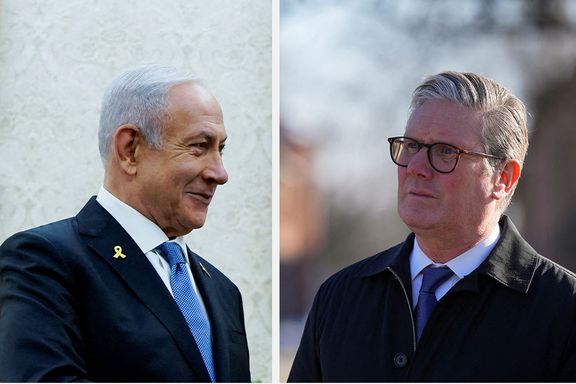
The leaders of Britain and Israel on Tuesday vowed to continue their cooperation against the threat posed by the Islamic Republic of Iran.
The leaders of Britain and Israel on Tuesday vowed to continue their cooperation against the threat posed by the Islamic Republic of Iran.
In a phone call on Tuesday, British Prime Minister Keir Starmer and his Israeli counterpart Benjamin Netanyahu “agreed to continue their close co-operation on defense and security matters in support of wider stability in the region – particularly in the face of the ongoing threat posed by Iran," according to the Downing Street.






Israel's President Isaac Herzog said on Tuesday that the new US administration will address Iran and its nuclear program as a key priority.
“Iran will be a main issue on Donald Trump's agenda in the very near future, and it will have to be deliberated,” Herzog told CNN's Fareed Zakaria at the World Economic Forum in Davos, Switzerland.
“Iran cannot have nuclear capabilities and has to stop with its proxies and axis of evil," he said.
The rulers of Tehran, he added, are “working day in and day out even now … rushing toward the bomb and of course planning all the time terror attacks the world over and in our region."
Tensions have escalated between Iran and Israel over the past year, marked by direct military confrontations in 2024 including Iran's unprecedented missile and drone attacks on Israel in April and October.
The hostilities have raised concerns about the potential for a broader conflict between the arch enemies involving the United States, especially with President Donald Trump's return to the White House.
Saudi Arabia's Foreign Minister, Prince Faisal bin Farhan Al Saud said on Tuesday that he does not believe President Trump's return to office increases the risk of an Iran-Israel war.
A war between Israel and Iran should be avoided, bin Farhan said in Davos on Tuesday, adding that he did not see the Trump administration contributing to the risk of direct conflict.
Meanwhile, the leaders of Britain and Israel on Tuesday vowed to continue their cooperation against the threat they say Iran poses.
In a phone call, British Prime Minister Keir Starmer and his Israeli counterpart Benjamin Netanyahu “agreed to continue their close co-operation on defense and security matters in support of wider stability in the region – particularly in the face of the ongoing threat posed by Iran," according to Downing Street.
The chief of the UN's nuclear watchdog has called on Iran to reach an understanding with the new Donald Trump administration over its nuclear program, warning of the risks of escalating tensions in the Middle East.
“There was an agreement that existed before President Trump decided that was not the path he wanted to follow,” IAEA Director General Rafael Mariano Grossi was quoted by Bloomberg as saying in Davos on Tuesday.
“Now we need to come to terms with how we deal with this, excluding, of course, a war.”
Grossi also reiterated concerns about Iran’s growing stockpile of highly-enriched uranium (HEU), which has surged since the US exited the 2015 nuclear deal.
He emphasized the importance of US involvement in resolving the issue. “We are engaging with Russia, with China, with the European countries, but it’s clear for everybody that the US is indispensable,” he said.
“What we need is to find an understanding. This is going to be our mission in the next few weeks.”
According to the IAEA, Iran’s production of HEU has increased dramatically. In December, the country boosted its production capacity sevenfold to about 34 kilograms (75 pounds) per month, following a diplomatic censure in November.
Iran’s stockpile of 20% enriched uranium also grew by 18 kilograms in the last quarter, further raising concerns.
European powers, including France, Germany, and the UK, are also increasing their scrutiny. They have directed the IAEA to prepare a special report on Iran’s nuclear activities during the first half of 2025.
The report is expected to be presented to the United Nations Security Council, which may consider reimposing UN sanctions before they expire in October.
“This is something that needs to be put back on track,” Grossi said, noting his intention to meet with Trump administration officials in the near future.
Tehran is prepared to start sanctions-lifting negotiations if other parties show readiness, Iran's deputy foreign minister for international and legal affairs said on Tuesday.
Kazem Gharibabadi's remarks follow President Donald Trump's Monday speech, where he referenced Iran's oil revenue, potentially hinting at a continuation of a maximum pressure policy in his new term.
Speaking to reporters the next day, Gharibabadi laid out Tehran's consistent willingness for dialogue.
“We have always been prepared for negotiations, and if the other parties share this readiness, talks will proceed and yield results,” he said, adding, “However, if their policies change, Iran will adjust its approach accordingly.”
At his first rally since being sworn in on Monday, Trump said that during his previous presidency, Israel would not have been attacked on October 7 by Hamas because Iran was financially strained. "Iran was broke," he said, adding "Anyone that bought oil from Iran ... China passed, everybody passed."
During his first presidency, Trump imposed sanctions that put pressure on Iran's oil revenue and aimed to curtail Tehran's spending on armed allies in the region.
In his comments after Trump's inauguration, Gharibabadi touched on Iran’s nuclear program, repeating Tehran's line that it is peaceful and that unilateral sanctions have failed to meet their objectives.
“Sanctions impact people’s lives in any targeted country, but they have not achieved their goal of forcing changes in Iran. The logical path is to return to proper dialogue and lift sanctions,” he said.
Gharibabadi also said that talks with European parties on lifting sanctions are set to continue.
“We have agreed to hold further talks, with the date to be determined through mutual consultations,” he said.
As Donald Trump returned to the White House, Iran is seeking Iraqi mediation to facilitate talks with the United States, according to UAE-affiliated Erem News on Monday.
An unnamed political figure in Iraq has received approval to create a special channel for mediation between Washington and Tehran, the outlet said, citing its sources.
The report noted that with the growing possibility of Israeli attacks on Iran, Iraqis feel concerned about the potential harm to their country’s security and stability.
"Iranian political leaders, on behalf of Masoud Pezeshkian’s government, told Iraq they are ready to start talks and sit at the table with the US," Erem News said, quoting one of its anonymous sources.
Last week, Iraqi Foreign Minister Fuad Hussein stated that his country aims to maintain good relations with the US during Trump’s presidency.
Donald Trump was sworn in for his second, nonconsecutive term as US President on Monday.
During his first term, Trump introduced a series of measures in order to curb Tehran's regional influence, focusing on its nuclear program. Washington's sanctions also significantly impacted the Iranian economy.
Trump withdrew his country from the nuclear agreement with Tehran, but, despite some overtures for talks, avoided pursuing negotiations for a new deal, focusing instead on a "maximum pressure" campaign.
Meanwhile, on Tuesday, Iranian Deputy Foreign Minister Kazem Gharibabadi said Tehran is ready to negotiate, calling it "the wisest course of action to start lifting sanctions."
"We have always been ready, and if others are prepared too, we believe talks will begin and succeed. If others take a different approach, Iran will adjust its strategy," he added.
Former Iranian parliamentarian Ali Motahari told the Rouydad24 website that Iran should hold direct talks with the US, stating, "Using a mediator cannot solve the issue."
Earlier this month, the country's Supreme Leader Ali Khamenei called supporters of talks with the US "intimidated by the enemy" and urged officials not to bow to "unreasonable American expectations" when addressing issues like hijab, inflation, and currency.
In recent weeks, the Kayhan newspaper, funded by Khamenei, has repeatedly criticized officials who discussed negotiating with the US.
On Monday, Kayhan doubled down on its narrative, writing that President Trump could only "enter Iran" under one condition—"to face punishment for ordering" the assassination of Qassem Soleimani.
Iran's Supreme Leader Ali Khamenei attended an exhibition at the Imam Khomeini Hussainiya in Tehran on Tuesday, and met with private sector representatives.
The event, like a number others recently, took place within the high-security leadership compound near Pasteur Street, which houses both the hussainiya and the official residence of the Supreme Leader, the so-called the House of Leadership (Beite Rahbari).
These venues serve as Khamenei's administrative and ceremonial hub.
On Sunday, Khamenei led the funeral prayers for two Supreme Court judges killed by an assailant, donning a visibly bulky bulletproof vest during the ceremony at the same hussainiya.
Last month, he also delivered a speech on Syria’s recent developments from this secured location.
Khamenei’s recent repeated use of the hussainiya for public appearances suggests an increasing preference for staying within the confines of his headquarters.