EU says watching Iran-Russia deal for potential security fallout
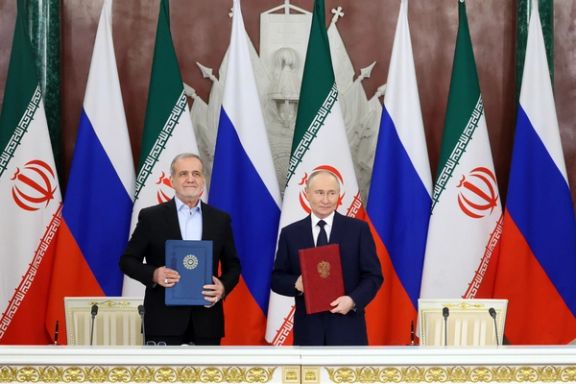
The European Union will assess the potential impact of the recent strategic partnership agreement between Tehran and Moscow on its security, an EU spokesperson told Iran International.

The European Union will assess the potential impact of the recent strategic partnership agreement between Tehran and Moscow on its security, an EU spokesperson told Iran International.
"The recent Russia-Iran partnership agreement signals deepening cooperation across multiple areas, including foreign policy and defense," Anitta Hipper, the EU Spokesperson for Foreign Affairs and Security Policy, said in response to an email inquiry by Iran International.
"We will closely monitor its implications for EU security and the rules-based international order," she added.
Russian President Vladimir Putin and his Iranian counterpart Masoud Pezeshkian signed a comprehensive strategic partnership agreement in Moscow on Friday.
In the strategic pact, the two countries agreed to strengthen cooperation in the fields of security and defense, Russian state-run TASS news agency reported.
"Russia and Iran have agreed that in the event of an attack on one party, the other party will under no circumstances support the aggressor," the report said.
Moscow and Tehran have stepped up military cooperation and Russia has deployed Iranian drones and missiles in Ukraine, despite Tehran's denials.
"Regarding Iran’s support for Russia’s war against Ukraine, we have consistently called on Tehran to immediately halt all assistance to Russia, which is a clear violation of the UN Charter," the EU spokesperson said.
Hipper added that "Russia’s increasing reliance on Iran to sustain its aggression also further highlights its growing weakness and isolation."
Analysts say the timing of the Iran-Russia strategic partnership agreement is a sign Moscow and Tehran are bracing for Donald Trump's second term in office, which started on January 20, 2025.
Trump's advisors are reportedly crafting a wide-ranging sanctions strategy to facilitate a Russia-Ukraine diplomatic accord in the coming months while at the same time squeezing Iran, Bloomberg reported citing people familiar with the matter.
President Donald Trump will seek the restoration of United Nations sanctions on Iran which were lifted by a 2015 nuclear deal, newly sworn-in secretary of state Marco Rubio told congress.
"I believe it is in our national security interest for the UN Security Council to snap back the sanctions that were suspended under the JCPOA," Rubio told the Senate foreign relations committee in written responses to Senator Ted Cruz, referring to the deal.
"I will execute the President's guidance and work with our allies to ensure that snapback takes place," Rubio added, according to the remarks read by Cruz at the confirmation hearing of Trump's pick for UN Ambassador, Elise Stefanik.
Rubio, Cruz and Stefanik are all staunchly pro-Israel and anti-Tehran and have signaled they will pressure Iran to hold back on support to armed allies and advancing its nuclear program.
"Pushing back on Iran is a top priority. It was a success during President Trump's first term," Stefanik said.
The so-called snapback of UN sanctions on Iran can technically be restored automatically if any party to the Joint Comprehensive Plan of Action (JCPOA) deems Iran to be non-compliant.
Then sanctions that were lifted under the JCPOA will snap back into place after 30 days unless the council's five permanent members unanimously vote to keep the sanctions lifted.
Trump pulled the United States out of the deal in 2018, arguing that the easing of sanctions gave Iran revenue to arm itself and regional allies like Hamas and Hezbollah. Now outside the deal, Washington cannot itself trigger the snapback but has promised to push for it in talks with its European allies.
Russia and China, whose relationship to the West is increasingly adversarial, have boosted ties with Iran in recent years and are unlikely to challenge it.
Activating the snapback would then fall to one of the three European countries, or E3, parties to the deal, France, Britain and Germany. Those powers are currently negotiating with Iran about future steps to salvage the agreement.
Britain has mooted willingness to eventually trigger the UN sanctions, citing Iran's advancements in enrichment which take it closer to being able to build a bomb.
If no party to the deal refers Iran to the Security Council by October 2025, their ability to trigger the sanctions snapback will lapse per the UN resolution clinching the deal.
Iran last year said it was prepared for either an agreement or continued tension.
"We believe the window for diplomacy is still open, albeit for a short time, provided the other parties demonstrate genuine willingness. Without such commitment, we will pursue an alternative course," foreign minister Abbas Araghchi said in November.
Senator Cruz on Tuesday fumed that the previous administration of Joe Biden had enabled Iran to make further nuclear progress, and that Trump must stop such an advance.
"When the Ayatollah chants Death to America. He means it, and I believe he would absolutely detonate a nuclear weapon over an American city if he could," Cruz said.
"I do not believe that this is a threat the US can tolerate, and I'm confident that both the President and Secretary of State Rubio agree."

Iran’s Supreme Leader has forbidden the development of nuclear weapons, the head of Armed Forces Judiciary said a day after President Donald Trump’s inauguration, sounding a conciliatory note as Tehran explores talks to ease sanctions.
“The late Imam Khomeini did not allow the use of chemical weapons or any illegal and unconventional weapons, even against enemy forces,” Ahmadreza Pourkhaghan said, referring to Supreme Leader Ali Khamenei’s predecessor and the Islamic Republic's founder, Rouhollah Khomeini.
“It is based on this doctrine that the Supreme Leader does not permit the armed forces of the Islamic Republic to develop nuclear weapons,” Pourkhaghan added in a speech in Tehran.
Tehran’s peaceful nuclear rhetoric
Pourkhaghan’s comments come as Iran signals its willingness to resume negotiations to ease sanctions which have hobbled its economy.
On Tuesday, Kazem Gharibabadi, Iran’s deputy foreign minister for international and legal affairs said Tehran is ready to engage in talks if other parties are.
The remarks also follow President Trump’s Monday speech, in which he referenced the increase in Iran’s oil revenue under his predecessor, likely signaling a continuation of his first administration’s maximum pressure strategy.
Meanwhile, Rafael Grossi, the chief of the UN’s nuclear watchdog, urged Tehran to reach an understanding with the Trump administration over its nuclear program, warning of escalating tensions in the Middle East.
Before Trump’s re-election as US President in November, 39 Iranian lawmakers called on the Supreme National Security Council to review Iran’s defense doctrine and consider adopting nuclear weapons.
However, less than a fortnight before Trump's inauguration, Iran’s President Masoud Pezeshkian reaffirmed the country’s adherence to a peaceful nuclear policy, citing Khamenei’s fatwa banning nuclear weapons.
“The Islamic Republic has absolutely no intention of utilizing its nuclear capabilities for military purposes based on its ideological beliefs and a fatwa by Supreme Leader Ali Khamenei,” Pezeshkian said during a meeting with Britain’s ambassador.
Khamenei's fatwa on nuclear weapons
Iran's government has consistently maintained that it will not pursue nuclear weapons, citing a fatwa or religious edict by Supreme Leader Ali Khamenei banning all weapons of mass destruction, including nuclear arms.
Iranian officials first referenced Khamenei’s fatwa at an IAEA meeting in Vienna in August 2005 and reiterated it at the International Conference on Nuclear Disarmament in April 2010.
According to Khamenei’s official website, Iran’s mission later pledged to submit a translation of the fatwa in several languages to the UN for registration as an official document.
In an October 2019 speech, Khamenei said that building and maintaining nuclear weapons is "absolutely haram," meaning strictly forbidden under Islamic law.
However, analysts argue that the fatwa is merely an advisory opinion rather than a binding legal decree. They say it was intended to mislead the international community about the true intentions of a nuclear program that Tehran insists is peaceful.
Kamal Kharrazi, a senior foreign policy advisor to Khamenei, said last year that while Iran has the capability to produce nuclear weapons, an existential threat could prompt a reconsideration of the Supreme Leader’s injunction.

Israel's President Isaac Herzog said on Tuesday that the new US administration will address Iran and its nuclear program as a key priority.
“Iran will be a main issue on Donald Trump's agenda in the very near future, and it will have to be deliberated,” Herzog told CNN's Fareed Zakaria at the World Economic Forum in Davos, Switzerland.
“Iran cannot have nuclear capabilities and has to stop with its proxies and axis of evil," he said.
The rulers of Tehran, he added, are “working day in and day out even now … rushing toward the bomb and of course planning all the time terror attacks the world over and in our region."
Tensions have escalated between Iran and Israel over the past year, marked by direct military confrontations in 2024 including Iran's unprecedented missile and drone attacks on Israel in April and October.
The hostilities have raised concerns about the potential for a broader conflict between the arch enemies involving the United States, especially with President Donald Trump's return to the White House.
Saudi Arabia's Foreign Minister, Prince Faisal bin Farhan Al Saud said on Tuesday that he does not believe President Trump's return to office increases the risk of an Iran-Israel war.
A war between Israel and Iran should be avoided, bin Farhan said in Davos on Tuesday, adding that he did not see the Trump administration contributing to the risk of direct conflict.
Meanwhile, the leaders of Britain and Israel on Tuesday vowed to continue their cooperation against the threat they say Iran poses.
In a phone call, British Prime Minister Keir Starmer and his Israeli counterpart Benjamin Netanyahu “agreed to continue their close co-operation on defense and security matters in support of wider stability in the region – particularly in the face of the ongoing threat posed by Iran," according to Downing Street.

Iranian officials and media remain sharply divided over Tehran's relationship with Washington, as President Donald Trump's inauguration speech focused almost entirely on US domestic politics.
Tehran's media landscape showcased the sharp divide, with various factions and their associated outlets voicing opinions on engaging in talks with the US. Optimistic reformists, such as those at Jamaran News and Ham Mihan newspaper, speculating that "Trump might visit Iran to mend ties broken since 1979," while hardliners like the ultraconservative Kayhan daily wrote, "Trump can only come to Tehran to face punishment for ordering the killing of IRGC top commander General Qassem Soleimani."
A few voices sought a middle ground between the extremes.
The pro-reform outlet Fararu questioned whether Trump can put an end to the deadlock between Tehran and Washington, outlining what it sees as three potential paths for Trump in his second term as US president: "diplomacy, war, or simply ignoring Iran."
The outlet also addressed the "maximum pressure” policy that Trump implemented during his first term (2017-2021), noting that "the policy did not achieve the results Trump expected."
Fararu predicted that "although Trump's America will continue to support Israel against Hamas and Hezbollah, yet it is unlikely that he would plunge America into a war with Iran."
The site also opined that "diplomacy can create a historic opportunity for resolving the chronic deadlock between Iran and the United States."
Meanwhile, an aide to Vice President Mohammad Javad Zarif, Sasan Karimi, argued, "Tehran should try to use Trump's Iran policy in a way that serves its own interests rather than allowing Israel to exploit the situation."
Karimi echoed the stance of President Masoud Pezeshkian and Foreign Minister Araghchi, saying, "Basically, we have no problem with furthering honorable negotiations." However, he overlooked Araghchi's earlier clarification that Iran is unwilling to discuss anything beyond the nuclear issue in negotiations with the West.
Karimi remarked, "Now Iran knows Trump has some experience with how Iran operates. The situation is more transparent now." He also quoted Zarif, who stated, "Iran cannot expect much from Europeans. They can blind you, but they cannot cure your eyes."
Karimi emphasized that "the Americans are the main party to any negotiations, while Europeans can only play a supporting role." In a subtle critique of Iran's inaction and lost opportunities, he added, "We should not continue as Cold War soldiers," likely alluding to the country's persistent confrontation with the US and reliance on Russia and China.
On Monday, the Javan daily, linked to the Islamic Revolutionary Guard Corps (IRGC), released a collage showcasing political figures known for their public support of direct talks with the US, including presidential aide Ali Abdolalizadeh, Vice President Zarif, former reformist government spokesman Ali Rabiei, and centrist politician Mohammad Hashemi.
The publication conveyed a message to these individuals, writing: "There is only one condition for direct negotiations with the Trump administration: Be prepared for execution if you do not reach an agreement within two months!"
The daily also accused the four politicians of "bribing the US," and, in a pointed reference to Zarif, declared, "Pezeshkian's vice president in particular should picture the noose around their neck on the gallows."
The IRGC-affiliated publication further warned, "Even if you send the best messages to America and employ the most skilled negotiators, you must understand that the United States has no intention of lifting the sanctions it has imposed on Iran."

The chief of the UN's nuclear watchdog has called on Iran to reach an understanding with the new Donald Trump administration over its nuclear program, warning of the risks of escalating tensions in the Middle East.
“There was an agreement that existed before President Trump decided that was not the path he wanted to follow,” IAEA Director General Rafael Mariano Grossi was quoted by Bloomberg as saying in Davos on Tuesday.
“Now we need to come to terms with how we deal with this, excluding, of course, a war.”
Grossi also reiterated concerns about Iran’s growing stockpile of highly-enriched uranium (HEU), which has surged since the US exited the 2015 nuclear deal.
He emphasized the importance of US involvement in resolving the issue. “We are engaging with Russia, with China, with the European countries, but it’s clear for everybody that the US is indispensable,” he said.
“What we need is to find an understanding. This is going to be our mission in the next few weeks.”
According to the IAEA, Iran’s production of HEU has increased dramatically. In December, the country boosted its production capacity sevenfold to about 34 kilograms (75 pounds) per month, following a diplomatic censure in November.
Iran’s stockpile of 20% enriched uranium also grew by 18 kilograms in the last quarter, further raising concerns.
European powers, including France, Germany, and the UK, are also increasing their scrutiny. They have directed the IAEA to prepare a special report on Iran’s nuclear activities during the first half of 2025.
The report is expected to be presented to the United Nations Security Council, which may consider reimposing UN sanctions before they expire in October.
“This is something that needs to be put back on track,” Grossi said, noting his intention to meet with Trump administration officials in the near future.