Iranian Nobel laureate: those who sow the wind shall reap the whirlwind
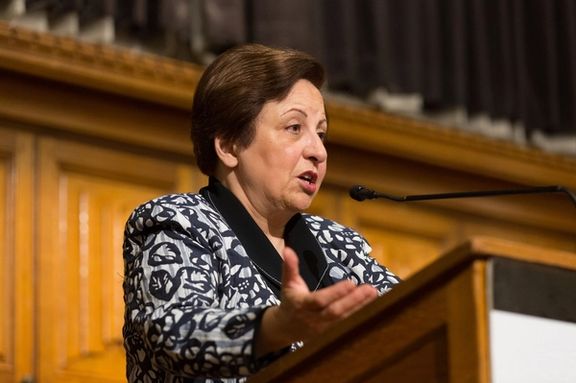
Shirin Ebadi, an Iranian Nobel Peace Prize laureate, reacted to the deaths of two judges on Instagram, writing: “Their murder today is the result of the judiciary’s behavior, practices, and repression. Those who sow the wind shall reap the whirlwind.”
Ebadi said that the deaths of Razini and Moghiseh have eliminated an opportunity to shed light on part of the establishment's crimes. She emphasized that the path taken by the Islamic Republic’s judiciary, amplified or directed by its security apparatus, inevitably leads to such incidents.
The human rights lawyer also noted that the Islamic Republic has already referred to Razini and Moghiseh as “martyrs” and added: “Justice for Moghiseh, Razini, and all those involved in the Islamic Republic’s crimes requires public, transparent, and fair trials — something they have always feared.”
Ebadi concluded by highlighting the judiciary’s history of increasing executions and carrying out mass arrests in response to actions by the United States and Israel. She warned that, in retaliation for the deaths of these two notorious judges, the regime may now intensify its crackdown on prisoners.









A day after Iran’s Supreme Leader urged officials to dismiss US demands, a conservative newspaper in Tehran advocated for negotiations, describing them as the only viable path to addressing the country’s economic crisis.
Jomhuriyeh Eslami (Islamic Republic) daily wrote on Thursday, “Officials must acknowledge that negotiation is the most effective solution for addressing the country’s challenges, a path that enjoys strong public support. Any hesitation in pursuing this approach would be unwarranted.”
Following the consecutive defeats of Iran’s proxies and allies in the region last year, coupled with a severe economic crisis exacerbated by a 33% drop in the value of the rial, many Iranian officials and media outlets have been urging for negotiations with the incoming Trump administration to ease sanctions.
However, Supreme Leader Ali Khamenei and his staunchest supporters, primarily within the military and hardline factions, have downplayed the setbacks, maintaining that the Islamic Republic remains strong and capable of overcoming all challenges.
In his speech on Wednesday, Khamenei warned officials against heeding any American demands, claiming that Washington is still bitter over losing Iran as an ally 46 years ago. "The United States has failed in Iran and is now seeking to compensate for this defeat," he said in a meeting with a group of his supporters from the city of Qom.
“The people have voted for officials to serve their interests, not those of the United States. Therefore, decision-makers…must focus solely on the interests of the Iranian nation and the Islamic Republic. They should not, under any circumstances, consider the interests of the United States or Zionists, as they are fundamentally hostile to our nation and the Islamic Republic, with their ultimate goal being the destruction of Iran,” Khamenei said.
Jomhuriyeh Eslami daily, however, made the opposite argument on Thursday, saying there should be no hesitation about negotiations, “nor should attention be given to the propaganda of extremist elements seeking to reject negotiations for their own specific agendas. Iran needs to resolve its economic crisis, which can only be achieved through reforms, and negotiations to lift sanctions remain the best path to reach this goal.”
As Khamenei called for steadfast opposition to the United States, three Revolutionary Guard officials said publicly that Tehran cannot respond to Israel’s October airstrike at this time.
Current member of parliament and IRGC General Esmail Kowsari, addressing why Iran has not retaliated against Israel, said this week that "If we were in a better financial position, we would have launched Operation True Promise-3 and even Operation 4." Highlighting the $921 billion US military budget, Kowsari acknowledged Iran’s financial and military limitations.
An Iranian activist based in the US, with 23,000 followers on X, responded to Kowsari’s remarks in a tweet, questioning why it took 45 years for the Islamic Republic to realize it is not capable of confronting the United States.
"After driving Iran into bankruptcy across economic, military, diplomatic, and geopolitical dimensions, leaving people without access to water, electricity, and gas, is it only now that you realize the importance of a strong military budget and economic capability? Have you just figured out that two plus two equals four and that taking on superpowers alone is not feasible?"
The sudden departure of Bashar al-Assad from Damascus to Moscow exposed deep divisions between Iran’s government and its people. While state loyalists viewed the event as disastrous, many ordinary Iranians rejoiced in it with renewed hope.
Criticism of Iran’s massive investments and military intervention in Syria is mounting, deepening the Islamic Republic's legitimacy crisis. Supreme Leader Ali Khamenei and the institution of Velayat-e Faqih are at the center of public discontent and protests over these policies.
The Islamic Republic's vulnerability has been highlighted by several setbacks since mid-September, including the weakening of Hezbollah and Hamas, and the degradation of Iran’s air defenses and ballistic missile production capabilities by Israeli strikes. The delayed retaliation to the Israel's attack (October 2024) has angered some hardliners.
For years, Khamenei’s supporters have seen Assad as a linchpin in their vision of a Shiite crescent stretching from Iran through Iraq and Syria to Lebanon. Assad’s Syria served as a buffer against Sunni extremism and a conduit for Iran’s influence via armed groups like Hezbollah. Losing it represents not just a geopolitical setback for Tehran, but the potential unraveling of the Axis of Resistance that Iran painstakingly cultivated over the past decade.
Disillusionment of loyalists
Many of Khamenei’s followers, who had invested ideological fervor in this alliance, are grappling with deep disappointment and a crisis of faith in their leadership.
One striking example came from Bisimchi Media, an outlet close to the intelligence unit of the Islamic Revolutionary Guard Corps (IRGC), which accused Khamenei of passivity in responding to Israel’s attacks. This was perhaps the first critical assessment of the leader’s actions. Although the criticism was swiftly retracted and the media outlet’s editorial board issued an apology, it revealed growing dissatisfaction among the states hardline supporters.
Following that unprecedented event, Tasnim News, a far more prominent IRGC outlet issued a warning against deviations and lapses of loyalty to Khamenei, emphasising the need to adjust with his pace and direction. That the warning went beyond an internal discipline and found its way into the public showed that tensions were becoming harder to contain even within the state’s closest ranks.
Prominent figures like Hadi Zarea, a member of the Quds Force in Syria, have publicly criticized Iran’s strategy, accusing IRGC leadership of exaggerating successes and creating additional challenges for the country. These critiques highlight an expanding rift among loyalists and further embolden the opposition.
Leader's rallying cries
To counter this, voices close to the supreme leader’s office have tried to inject optimism and raise spirits, echoing Khamenei’s advice to show resilience in defeat and humility in victory. Still, the despair is palpable among those who had believed the Iran-led Axis of Resistance was invincible.
Assad’s rule was presented as proof of Shiite resilience. Its collapse not only diminished Iran's territorial reach but forced its advocates to face the harsh reality that their strategic calculations may have been overly optimistic.
Moreover, the potential emergence of a semi-democratic or Sunni-led government in Syria could significantly alter the regional power balance, isolating Iran and its allies further. This scenario raises concerns about a resurgence of Sunni extremism, which could destabilize Iran internally.
Shift in domestic balance of power
Khamenei needs his loyal followers to quell unrest and prolong his rule. But many in those ranks are now grappling with disillusionment. Some are questioning Iran's foreign policy and call for introspection and reassessment. It remains to be seen if and how Khamenei would rally his base and address their growing concerns in the face of a rapidly changing regional landscape.
The fall of Assad has profound psychological implications for Iranian society. Millions of Iranians seeking structural change in Iran now perceive the state as weaker and less capable of imposing fear and repression. This perception erodes the government’s authority and helps dissidents to bolster resistance and collective identity. Activism may gain momentum as people grow more confident in challenging the state’s propaganda and misinformation.
Hope on one side, passivity and fragmentation on the other, could signal potential for more powerful uprisings and dynamic social movements that challenge the unjust, inept rulers of Iran.
While Iran is not yet a failed state, it exhibits characteristics of a failing state, including economic mismanagement, judicial misconduct, infrastructure decay, and inadequate social services. The weakening of the Axis of Resistance and continued foreign policy defeats have undermined public support for the government, eroding its ability to maintain control. As the rulers' authority deteriorates, citizens are more likely to act radically, further destabilizing the state.
Iraq’s prime minister is set to visit Tehran on Wednesday to discuss regional issues following the tumultuous events of 2024, including the overthrow of Syria’s Bashar al-Assad and the decline of Iran’s regional influence.
On Monday, Iran’s Foreign Ministry spokesperson, Esmail Baghaei, told reporters that Prime Minister Mohammed Shia al-Sudani will focus on discussing the situation with Syria’s new government. Both Iraq and Iran are navigating cautiously amid the radically changed dynamics in the region.
Arab media reported on Sunday that the commander of the Quds Force of Iran's Islamic Revolutionary Guard Corps (IRGC) was visiting Baghdad to meet the leaders of Tehran-backed Shia groups as well as the Iraqi prime minister, Arab media reported Sunday.
Esmail Ghaani (Qaani) and several of his advisers in the Quds Force arrived in Baghdad on Sunday morning to meet with the leaders of the Shia factions and the head of the Popular Mobilization Units (PMU), Falih al-Fayyadh, Erem News reported citing an Iranian source.
There have been recurrent reports and analysis about Iraqi government plans to restrict the Iran-backed Shia militia groups. In fact, as opposition forces were moving toward Damascus last month to depose Assad, the Iraqi militia did not cross the border to defend him.
A pro-Hezbollah newspaper in Lebanon reported last month that the Iraqi militias reached a deal with the government not to attack Israel. The move reflected concerns about escalating conflicts in the region and fears of Iraqi security being endangered after insurgents took control in neighboring Syria.
Some regional and Iranian media outlets speculate that al-Sudani’s visit to Tehran may aim to persuade the Islamic Republic to halt its support for Shiite militias. While it remains unclear whether the prime minister’s agenda is that bold, the role of these militias in Iraqi politics is likely to be a key topic of discussion.
The Iranian Rouydad24 website, citing Arab media, said that al-Sudani’s agenda is securing guarantees from Tehran to cease its support for militias and Iran-aligned groups in Iraq, urging Iran to respect the decisions of the Iraqi government, and ensuring Iraq's immunity from any military operations by the US or Israel launched from Iraqi territory are expected to be key demands.
It is believed that Israeli, and possibly US, warplanes could launch missiles at Iran using Iraqi airspace. Reportedly, Israel employed this tactic during its October airstrike on Iran.
Alaeddin Boroujerdi, an influential Iranian lawmaker, told local media last week that the Iraqi Prime Minister might be delivering a message to Iran, though he did not specify its source. The Tehran-based Etemad Online suggested that the message likely originates from Washington, urging Baghdad to curb Iranian-backed militias and Shiite groups.
An Iraqi journalist in Baghdad, speaking on condition of anonymity, told Iran International that significant developments are expected in January and February as President-elect Donald Trump takes office.
As economic protests take place in Iran, the government-sponsored rallies and those organized by its core ultra-hardliner supporters are garnering dramatically less support amid the country's mounting crises.
The turnout for an annual state-sponsored political rally, which took place on December 30, seemed notably lackluster compared to previous years, with reports showing much smaller turnout and a much more subdued tone.
The Islamic Republic finds itself hard pressed by multiple crises, both at home and abroad. Its national currency has fallen by almost 40% since September, while it has been expelled from Syria after rebels captured Damascus.
Dey 9 Rally in Tehran This Year
As in previous years, the state-controlled media claimed that millions attended the rallies in Tehran and other cities. However, despite tight media controls, a report by the Reformist website Ensaf News on December 30 painted a different picture, at least about the rally in the capital.
The report noted that the crowd at Tehran’s Emam Hossein Square, the primary venue for the show of force, filled only about 60 percent of the medium-sized city-center square. Additionally, many attendees reportedly left midway through the ceremony and speeches.
Several people who attended of their own volition, unlike others mobilized by the state and religious organizations, said they were unaware of what the event commemorated.
Looking Back to December 30, 2009
The annual rallies date back to December 30, 2009, when the Islamic Republic mobilized massive crowds nationwide to protest against the anti-establishment Green Movement and its leaders, showing support for Supreme Leader Ali Khamenei who endorsed a controversial decision to announce Mahmoud Ahmadinejad as the winner of the presidential election in June of 2009.
The authorities claimed that tens of millions participated across the country, Khamenei and the state media heralding the turnout as epic. However, the opposition alleged that the government had bussed in government employees, military personnel, students, and residents of smaller towns and villages to inflate the size and impact of the rallies in Tehran and other major cities.
Following the the pro-Khamenei show of force, Green Movement leaders—Mir-Hossein Mousavi, his wife Zahra Rahnavard, and Mehdi Karroubi—were placed under house arrest.
The events of December 30, 2009 marked the end of the harshly suppressed Green Movement protests, and Dey 9 (falls on December 29 or 30 in the Persian calendar) became an annual occasion for those wishing to affirm loyalty to Khamenei.
These state-sponsored rallies, like those on the anniversary of the 1979 Islamic Revolution, are consistently covered extensively by state media and presented as proof of the system's legitimacy.
Vigilantes struggle to organize protests
Ultra-hardliner vigilantes have long been among Khamenei's core supporters and a key part of state-sponsored rallies. However, in recent months, they have struggled to mobilize even small groups on their own to protest against President Masoud Pezeshkian, whom they accuse of deviating from the more conservative agenda of the Islamic Republic and contributing to the country’s economic troubles.
On December 24, only a handful of vigilantes showed up for a protest against the government's decision to unblock WhatsApp and Google Play.
Citizen’s protests and strikes growing under economic pressures
Meanwhile, strikes and protests over fair wages, better working conditions, and payment of overdue salaries have now become a regular occurrence involving workers, retirees, nurses, teachers, and even merchants in the capital, with the likes of the IRGC warning citizens against protesting.
Fearing arrest amid continued crackdowns on protests, demonstrators often avoid strong slogans and direct attacks on top authorities including the Supreme Leader and instead, mainly focus on their economic demands.
On December 29, protests erupted at the Grand Bazaar in Tehran over soaring foreign currency rates and the worsening economic crisis, prompting many merchants to strike.
The strike spread to the nearby Sepahsalar shoe market that same day. The next day, goldsmiths in the Grand Bazaar also went on strike in protest against the economic conditions. Notably, there were no reports of violence against protesters or arrests.
On December 31, labor and retirees protest were reported in several cities across the country.
Notably, despite the presence of security forces at all times, there have not been reports of violence against these protesters recently, reflecting authorities’ concern that cracking down on protesters could trigger a flare-up similar to the 2022 unrest.
The world is witnessing a period of significant regional setbacks and retreats for the Islamic Republic. After two decades of massive financial expenditures and international isolation, Tehran’s strongholds and allies are crumbling one by one across the region.
This phase began with the defeats of Hamas and Hezbollah, continued with the weakening of Bashar al-Assad and Iran’s diminishing influence in Syria, and is now advancing as Israel focuses on defeating the Houthis in Yemen.
Evidence suggests that even Iraq’s pro-Tehran Hashd al-Shaabi militia has scaled back its overt support for the Islamic Republic’s agenda, leaving Tehran increasingly isolated in the face of an alliance comprising the US, Israel, and even Europe. Domestically, severe economic challenges and widespread public dissatisfaction have created one of the most difficult periods in the history of the Islamic Republic.
In this context, the overall US policy is combining political, economic, and even military pressure to push the Islamic Republic to the negotiating table. The aim is to reach an agreement stricter than the JCPOA, either halting Iran’s nuclear and missile programs or exposing it to intensified pressure and even potential military action if it refuses to comply.
Despite its structural weaknesses and mounting international pressures, the Islamic Republic’s leadership remains defiant. Supreme Leader Ali Khamenei threatens nuclear weaponization and reclaiming Syria, while simultaneously sending signals of willingness to negotiate through diplomats like Mohammad Javad Zarif. However, it appears that the US, Israel, and even Europe are aware of the dangers of a resurgent Islamic Republic and are determined to prevent it from returning to a position of defiance and belligerence.
The chain of setbacks for the Islamic Republic began with Hamas’ attack on Israel in October 2023. Tehran mistakenly believed this assault would inflict an irreparable defeat on Israel.
Misguided analyses by the Islamic Republic’s leaders, particularly Khamenei and IRGC commanders, led to decisions that resulted in a series of defeats.
In response to the attack, Israel acted swiftly, strengthening its regional position within 15 months. This included large-scale military operations against Hamas, destruction of its military bases, and the assassination of senior leaders such as Yahya Sinwar, Saleh al-Arouri, and Ismail Haniyeh. Israel also ignored warnings from the US and the international community to launch an offensive in Gaza, leveraging force to reshape the Middle East.
The second major misstep by the Islamic Republic occurred when it urged Hezbollah to attack Israel’s northern borders in support of Hamas. Initially, Israel issued repeated warnings for Hezbollah to cease its aggression. When these warnings were ignored, Israel launched an operation dubbed New Order, which delivered surprising results. These included the destruction of Hezbollah’s command centers and equipment, as well as the killing of senior leaders, including Hassan Nasrallah. These developments fundamentally altered the region’s dynamics and demonstrated that, like Hamas, Hezbollah lacks the capability to withstand Israel’s extensive military campaigns.
On the international stage, the US and Europe, recognizing the Islamic Republic’s vulnerabilities, are now seeking to capitalize on this opportunity to drive significant changes in Iran’s regional policies. Meanwhile, Israel’s aggressive strategies aim to keep Tehran on the defensive.
Within Iran, widespread public dissatisfaction with the regime’s policies and economic mismanagement has deeply affected the country’s social and political landscape.
Popular protests and civil movements highlight the critical role of the Iranian people in shaping the nation’s future. The convergence of international, regional, and domestic pressures has created a historic opportunity to move beyond the Islamic Republic.