Iran's government has warned the country's ultra-hardliners and their vigilante groups of serious consequences if they continue to sow “discord” with their apparently growing protests against the President's new, more progressive policies.
Ali Zeynivand, the political deputy of Iran's Interior Ministry, told the Iranian Labour News Agency (ILNA) on Saturday that individuals behind recent protests against issues such as the easing of internet restrictions, have been summoned and cautioned.
“There have been discussions within the Ministry of Interior regarding the recent rallies,” Zeinivand said. Provincial governors have been instructed to take firm action against protests that could jeopardize national unity and solidarity. All rallies must have official permits in Iran, he added.
Zeynivand’s warning follows growing criticism from political figures and media outlets, who have pointed out that while political parties and groups are routinely denied permits for rallies, ultra-hardliner vigilantes continue to stage protests with impunity against the government whenever and wherever they wish.
It remains unclear whether the Interior Ministry’s move to curb the activities of vigilantes is driven by the President's admiinstration, a higher authority such as the Supreme National Security Council (SNSC), or is a direct directive from Supreme Leader Ali Khamenei whose policies guide Iran's key security ministries of interior, intelligence, and defense.
Ultra-hardliners have accused President Masoud Pezeshkian of colluding with Iran's enemies by advocating negotiations with the West to lift crippling sanctions that have devastated Iran's economy.
They also criticize him for what they say is undermining Islamic values by resisting demands to implement a new hijab law and for taking steps to ease internet restrictions.
The group of hardliners also hold Pezeshkian responsible for the lack of a military response to Israeli airstrikes on Iran in October, accusing him of delaying the so-called “True Promise 3” retaliation.
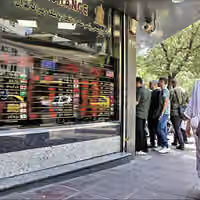
As they look to attribute blame, the president has also become the fall guy for the depreciation of the national currency and the ongoing power outages, which the government attributes to the previous administration’s failure to stockpile fuel for power plants adequately.
Vigilantes have a long record of attacking political meetings and universities, threatening and slandering top officials including presidents and government officials in street rallies and in their media over the years but their recent focus on Pezeshkian’s government has become particularly relentless now, the reformist Arman-e Melli newspaper wrote in an editorial Saturday.
The newspaper’s editorial referred to these actions as ultra-hardliners' “street maneuvers” to pressure the government.
Vigilantes, often linked to the Revolutionary Guards' Basij militia, were behind the high-profile attacks on the British embassy in November 2011 and the Saudi embassy in January 2016, both of which led to significant diplomatic crises for Iran.
Although the perpetrators were well-known to authorities, they were never held accountable for the extensive damage inflicted on Iran's international reputation and relations.
Ultra-hardliner protesters climbing over the gate of the UK Embassy in Tehran in November 2011
Earlier this week, ultra-hardliners linked to the Paydari (Steadfastness) Party and another group with close ties to the former nuclear negotiator Saeed Jalili announced plans to protest after Friday prayers on motorbikes against the government’s decision to unblock WhatsApp and Google Play. However, reports indicated that turnout for the protest was minimal, with only about a dozen participants.
“The question is, who has allowed them to have such power to be able to cause disruptions in the city, make baseless allegations against authorities, and to insult and threaten them,” the article asked while contending that Pezeshkian’s government will not be able to deal with ultra-hardliners and stop them from harming the system under the name of the revolution by talks and invitation to unity.
Iran's government is grappling with multiple crises, both domestic and international. Abroad, its military stand-off with Israel and the collapse of Bashar al-Assad's rule in Syria have thrown foreign policy into chaos. Direct attacks from Israel have seriously damaged Iran's defense systems while losing its stronghold in Syria has weakened its influence across the region.
Meanwhile, at home, economic challenges such as high inflation and the unprecedented depreciation of the national currency, serious energy shortages, and widespread popular discontent over issues like hijab enforcement and internet filtering still risk sparking further unrest.
An Iranian lawmaker backed Tehran's plans to target Israel and warned that any Israeli attack on Iran's nuclear facilities would legitimize Tehran advancing toward nuclear weapons development.
“If Israel conducts a military strike against Iran's nuclear facilities, it effectively grants us the permission to move toward developing nuclear weapons," Ahmad Bakhshayesh Ardestani, a member of the National Security and Foreign Policy Committee of Iran’s parliament, told Didban news website in Tehran.
Iran's ambassador to Muscat, Mousa Farhang, announced that Oman's Foreign Minister Badr bin Hamad Al Busaidi will visit Tehran soon, describing the trip as a milestone in Iran-Oman ties in the new year. He did not specify the exact timing of the visit.
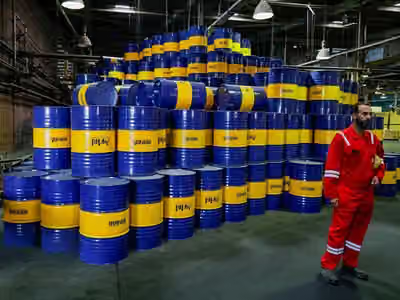
Fifty percent of Iran’s industrial parks have ceased operations due to power outages, according to the employers' representative in the Supreme Labor Council, as the electricity cuts further hamper the economy.
“Several power plants are out of operation, and some industries have shut down. We faced power issues in the summer, and now in winter, we are dealing with both electricity and gas shortages,” said Ali-Asghar Ahaniha in an interview with the Revolutionary Guards-affiliated Tasnim on Saturday.
The energy crisis, marked by widespread electricity shortages and gas deficits, has disrupted industries across the country. Aging infrastructure, international sanctions, and poor management have compounded the problem, leading to the shutdown of approximately 80 power plants.
During the winter, Iran faces a daily shortfall of at least 260 million cubic meters of gas, further straining the electricity supply.
Iran has vast oil and gas reserves, much of which it cannot tap due to US-led sanctions which stall investment and technology improvement.
Ahaniha highlighted the strain caused by the crisis, noting employers are under immense pressure during the year-end period due to bonuses and additional costs.
“In a year dubbed the 'Year of Production Leap,' the lifeline of production and industry must be preserved. When the wheels of industry turn, employment and people's income flourish,” he said, criticizing the ministry of energy for prioritizing residential consumption over industrial needs.
The crisis has caused significant losses in industrial regions, where power cuts have resulted in damages amounting to hundreds of billions of rials. Ahaniha also criticized recent electricity and gas price hikes, arguing that industries have filed complaints against the ministry of energy, saying the increases were unlawful.
Iran’s electricity shortage was estimated at 14,000 megawatts during the summer. Heavy state subsidies have encouraged inefficient energy consumption, while geopolitical tensions and sanctions have hindered infrastructure investments.
A suicide bomber attacked the front of a police headquarters in Bandar Lengeh in southern Iran on Saturday night, killing the head of the port city's military intelligence, the IRGC-affiliated Tasnim News reported.
Captain Mojtaba Shahidi Takhti succumbed to his injuries in the hospital, and one accompanying officer identified as Captain Javad Chatr-Sahar was also injured, the report said citing the local governor.
The bomber was positioned on the two police officers' exit route and triggered the explosion with a remote control, the report by Tasnim said.
Security forces promptly arrived at the scene after the incident and confirmed the attacker was also killed, governor Foad Moradzadeh said.
It was not immediately clear who was behind the attack.
Jaish Al-Adl militants who seek to break away from Iran operate more in Iran’s southeast rather than its central coast.
Radical Sunni Islamic State militants have also launched repeated deadly suicide attacks against state and military targets in the Shi’ite theocracy.
Shahidi Takhti and the other officer injured in the attack "were immediately transported to the hospital," governor Moradzadeh added. However, the former succumbed to the injuries despite the efforts of the medical team.
The condition of injured officer Chatr-Sahar is currently reported as stable, a local judiciary official was quoted as saying.
Iran’s defense minister announced a surprise series of military drills starting Saturday to show the Islamic Republic would not crumble easily like Bashar al-Assad's Syria.
"They are signaling that Yemen and Iran are next after Syria. But the truth is, it is their turn next, as these powers won’t leave them alone," Aziz Nassirzadeh said in remarks carried by Iranian media.
The United States, he said, employs Israel - a "70-year-old cancerous tumor" - to exploit the Middle East's resources, in familiar rhetoric for top Tehran officials.
“We have no issues on the hard warfare front. We are building power by all means and will remain prepared.” Nassirzadeh said, speaking on Friday during a ceremony commemorating Razi Mousavi, a Revolutionary Guards commander killed in Syria last year.
The drills, described as a display of Iran’s strengthened defensive capabilities, come in response to growing regional tensions and threats by Israeli officials to strike Iran directly if their Yemeni Houthi allies keep up missile attacks.
Earlier this week, Gholamali Rashid, commander of IRGC’s Khatam al-Anbiya Central Headquarters had mooted plans for “powerful defensive and offensive drills” in the coming weeks.
The announcement follows threats by Iranian officials that Tehran would launch True Promise 3, a third retaliatory attack against Israel in response to its October airstrikes on Iran.
However, after the fall of al-Assad’s in Syria, Tehran’s rhetoric on direct retaliation has subsided, with a focus now shifting to defensive readiness.
Nassirzadeh remarked: “We no longer have a presence in Syria, but even our statements instill fear in the enemy, leading them to issue warnings against us. Their fear stems from the strength of the resistance.”
Iranian Supreme Leader Ali Khamenei has previously vowed to reclaim Syria from opposition forces and encouraged Syrian youth to resist the new government. However, Syrian interim Foreign Minister Asaad Hassan Sheibani recently issued a warning to Iran, urging it to avoid interference in the country’s affairs.
The military drills starting Saturday are seen as part of Iran’s efforts to bolster its defensive posture as military setbacks abroad put the home front into focus.
Iran has plunged into multiple crisis in recent weeks, with energy shortages and a rapidly falling currency, creating a sense of weakness amid popular discontent.