A person holds up the flag adopted by the new Syrian rulers, celebrating the fall of Bashar al-Assad, Damascus, Syria
The sudden departure of Bashar al-Assad from Damascus to Moscow exposed deep divisions between Iran’s government and its people. While state loyalists viewed the event as disastrous, many ordinary Iranians rejoiced in it with renewed hope.
Criticism of Iran’s massive investments and military intervention in Syria is mounting, deepening the Islamic Republic's legitimacy crisis. Supreme Leader Ali Khamenei and the institution of Velayat-e Faqih are at the center of public discontent and protests over these policies.
The Islamic Republic's vulnerability has been highlighted by several setbacks since mid-September, including the weakening of Hezbollah and Hamas, and the degradation of Iran’s air defenses and ballistic missile production capabilities by Israeli strikes. The delayed retaliation to the Israel's attack (October 2024) has angered some hardliners.
For years, Khamenei’s supporters have seen Assad as a linchpin in their vision of a Shiite crescent stretching from Iran through Iraq and Syria to Lebanon. Assad’s Syria served as a buffer against Sunni extremism and a conduit for Iran’s influence via armed groups like Hezbollah. Losing it represents not just a geopolitical setback for Tehran, but the potential unraveling of the Axis of Resistance that Iran painstakingly cultivated over the past decade.
Disillusionment of loyalists
Many of Khamenei’s followers, who had invested ideological fervor in this alliance, are grappling with deep disappointment and a crisis of faith in their leadership.
One striking example came from Bisimchi Media, an outlet close to the intelligence unit of the Islamic Revolutionary Guard Corps (IRGC), which accused Khamenei of passivity in responding to Israel’s attacks. This was perhaps the first critical assessment of the leader’s actions. Although the criticism was swiftly retracted and the media outlet’s editorial board issued an apology, it revealed growing dissatisfaction among the states hardline supporters.
Following that unprecedented event, Tasnim News, a far more prominent IRGC outlet issued a warning against deviations and lapses of loyalty to Khamenei, emphasising the need to adjust with his pace and direction. That the warning went beyond an internal discipline and found its way into the public showed that tensions were becoming harder to contain even within the state’s closest ranks.
Prominent figures like Hadi Zarea, a member of the Quds Force in Syria, have publicly criticized Iran’s strategy, accusing IRGC leadership of exaggerating successes and creating additional challenges for the country. These critiques highlight an expanding rift among loyalists and further embolden the opposition.
Leader's rallying cries
To counter this, voices close to the supreme leader’s office have tried to inject optimism and raise spirits, echoing Khamenei’s advice to show resilience in defeat and humility in victory. Still, the despair is palpable among those who had believed the Iran-led Axis of Resistance was invincible.
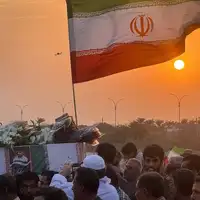
A soldier from Fatemiyoun brigade mourns at the funeral of a comrade killed in Syria, January 8, 2024
Assad’s rule was presented as proof of Shiite resilience. Its collapse not only diminished Iran's territorial reach but forced its advocates to face the harsh reality that their strategic calculations may have been overly optimistic.
Moreover, the potential emergence of a semi-democratic or Sunni-led government in Syria could significantly alter the regional power balance, isolating Iran and its allies further. This scenario raises concerns about a resurgence of Sunni extremism, which could destabilize Iran internally.
Shift in domestic balance of power
Khamenei needs his loyal followers to quell unrest and prolong his rule. But many in those ranks are now grappling with disillusionment. Some are questioning Iran's foreign policy and call for introspection and reassessment. It remains to be seen if and how Khamenei would rally his base and address their growing concerns in the face of a rapidly changing regional landscape.
The fall of Assad has profound psychological implications for Iranian society. Millions of Iranians seeking structural change in Iran now perceive the state as weaker and less capable of imposing fear and repression. This perception erodes the government’s authority and helps dissidents to bolster resistance and collective identity. Activism may gain momentum as people grow more confident in challenging the state’s propaganda and misinformation.
Hope on one side, passivity and fragmentation on the other, could signal potential for more powerful uprisings and dynamic social movements that challenge the unjust, inept rulers of Iran.
While Iran is not yet a failed state, it exhibits characteristics of a failing state, including economic mismanagement, judicial misconduct, infrastructure decay, and inadequate social services. The weakening of the Axis of Resistance and continued foreign policy defeats have undermined public support for the government, eroding its ability to maintain control. As the rulers' authority deteriorates, citizens are more likely to act radically, further destabilizing the state.