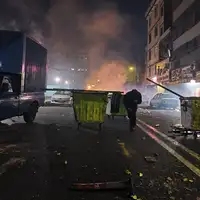
New Syrian leadership urges Iran to drop its hostility

Syria’s new government seeks no discord with Iran but demands that it not undermine Damascus, Foreign Minister Asaad al-Shaibani told Al Jazeera on Wednesday.

Syria’s new government seeks no discord with Iran but demands that it not undermine Damascus, Foreign Minister Asaad al-Shaibani told Al Jazeera on Wednesday.
“Iran is a neighboring country, and we do not wish to eliminate them, but we hope they reconsider their position and actions toward the Syrian people,” al-Shaibani said in an interview published Wednesday. He added that if Syria receives a positive response, it will “reciprocate and act accordingly.”
On the same day, Iranian Supreme Leader's special envoy Ali Larijani said on state TV that Iran’s relationship with Syria’s ruling faction depends on their actions.
“If their behavior is rational, we will have no issues with them,” he said. Larijani also expressed hope that Syria becomes a "democratic Islamic country capable of defending itself against Israel."
At the same time, Iranian Supreme Leader Ali Khamenei defended Iran's role in Syria’s civil war and its broader regional power projection. He dismissed criticism of Iran’s declining influence in the Middle East.
In December, the Bashar al-Assad government, a key pillar of Iran’s influence in the region, fell despite 13 years of Iranian military support.
Since the Syrian Civil War began in 2011, Iran invested heavily in keeping Assad in power, viewing his government as critical for maintaining access to Hezbollah and asserting power in the Levant. Assad’s fall disrupted these efforts, cutting Iran’s land route to Lebanon and weakening its ability to arm Hezbollah.
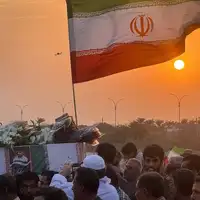
During a Wednesday ceremony marking the fifth anniversary of the death of Qasem Soleimani, Khamenei appeared to predict a revolt that would topple Syria's leaders.
“Do not be deceived by this false show; those who are strutting around today will one day be trampled under the feet of the faithful," Khamenei said. "Those who have encroached on the land of the Syrian people will one day be forced to retreat in the face of the power of Syria's youth.”
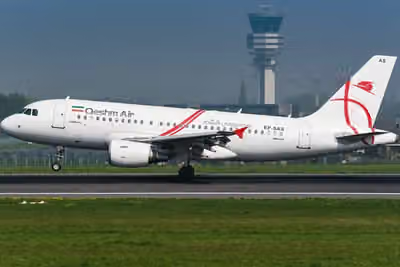

An Iranian detained in Italy who is wanted on terrorism charges by Washington was denied release on Thursday, signaling no quick end to the ordeal of an Italian journalist held by Iran for a likely prisoner swap.
Mohammad Abedini Najafabadi was arrested on December 16 at Malpensa Airport by Italian authorities after arriving from Istanbul and is currently held at Opera prison.
The attorney general of Milan, Francesca Nanni, rejected his conditional release citing a high flight risk.
The arrest of Italian journalist Cecilia Sala in Tehran is widely regarded as Iran's retaliation for Najafabadi’s detention.
Iran has officially confirmed Sala’s arrest. The 29-year-old works for Il Foglio and the podcast company Chora Media. She has been detained for "violating the laws of the Islamic Republic," with no further specifics given.
Iran's ambassador to Italy, Mohammad Reza Sabouri, on Thursday met with Italian Foreign Ministry secretary-general Riccardo Guariglia to discuss the cases of Abedini and Sala, according to Iran's official state media, IRNA.
US authorities allege that Najafabadi supplied materials for a deadly Iran-linked drone attack on American troops in Jordan.
Iran's consulate in Italy had requested Italian authorities to allow Abedini to leave detention facilities in return for guarantees that he'd stay in a known location.
Milan's attorney general on Thursday argued that Iranians' guarantees---including housing and financial assistance, potential travel restrictions and mandatory check-ins---would be insufficient to address the risk of flight for the individual sought by the United States for extradition.
She noted that the charges leveled by US authorities would undergo a comprehensive review once the necessary documentation is provided.

The US-led coalition against ISIS has begun constructing a military base in Kobani, northern Syria, as clashes continue between the Kurdish-led Syrian Democratic Forces (SDF) and Turkey-aligned rebel groups.
A convoy carrying construction materials and logistical reinforcements was seen heading to Kobani on Thursday, according to the SDF-affiliated North Press Agency.
The convoy included prefabricated structures, trench-digging machinery, surveillance equipment, and fuel tanks as reported by the New Region.
It comes amidst renewed violence in areas controlled by the SDF, following Turkey-backed forces' campaigns that began in late November which have resulted in significant casualties and displaced thousands of civilians.
The recent ousting of the Assad government, led by the Turkey-backed rebel coalition Hay’at Tahrir al-Sham, has reshaped the region.
The collapse of Assad on December 8 marked the end of his family's five-decade rule, presenting a strategic setback for Iran.
Syria has historically served as a key conduit for Iran to supply Hezbollah in Lebanon and bolster its military allies in the region. The loss of this corridor undermines Tehran's regional influence and disrupts its long-standing strategy in the Levant.
Iran’s deep military and financial commitments in Syria now face diminishing returns. Rival actors such as Turkey and Persian Gulf Arab states are poised to fill the void, further isolating Hezbollah and compelling Tehran to reconsider its regional posture amidst intensifying domestic economic pressures.
Turkey has intensified its efforts to capture strategic locations from the SDF, including Kobani and the Tishrin Dam on the Euphrates River. Backed by Turkish warplanes, these operations underscore Ankara's intent to neutralize what it views as a security threat posed by the Kurdish-led forces. Despite these efforts, the SDF has so far resisted the advances.
As the US's primary ally in the fight against ISIS, the SDF controls nearly a quarter of Syrian territory, primarily in the northeast and east. However, Turkey continues to press for the disarmament of the group, insisting that it poses a direct risk to its national security.

Italy’s Deputy PM and Foreign Minister Antonio Tajani announced on X that he’s ordered the Foreign Ministry to summon Iran’s ambassador over the arrest of journalist Cecilia Sala.
“We’re working tirelessly to bring Cecilia Sala home and demand her rights be respected. Cecilia and her family will never be left alone,” he wrote.
Earlier, Il Giornale reported that Milan's Attorney General Francesca Nanni is set to issue her opinion on the release of Mohammad Abedini Najafabadi, an Iranian citizen detained at Malpensa airport on December 16 at the request of the US government.
Three days after Najafabadi’s detention, on December 19, Italian journalist Cecilia Sala was arrested in Iran on vague charges of "violating Iranian law." Her arrest is widely seen as a direct retaliatory move for Najafabadi’s detention.

The 2020 assassination of Quds Force commander Qassem Soleimani set the Iranian government on the road to imminent collapse, a former UK security minister said.
“There are moments like now when the old era is dead, the old illusions are dead, and various things are killing it. And I suspect that the regime in Tehran will be gone in the next few years as well. So I think there’s a real opportunity for freedom to spread and for opportunity to spread,” he said, speaking on the Conflicted podcast on Wednesday.
He attributed the Islamic Republic’s weakening to the fallout from the 2020 US drone strike that killed Qassem Soleimani, a key Iranian military commander, calling it a pivotal moment that disrupted Iran’s influence across the Middle East.
“I’m always struck by how some people can be much more seminal, much more key, pivotal to an organization than you realize at the time. The reality is when Qassem Suleimani was killed in January 2020, he held in his head all the relationships, all the deals for everybody around the region,” he said.
“He was replaced, but he wasn’t really, because nobody could replace the personal 20-year relationships that he held. That’s really the unpicking. So I have to say, I know it’s not popular, but President Trump, effectively, was the trigger that began the fall of the Assad regime.”
Tugendhat highlighted growing dissent within Iran’s Revolutionary Guard Corps (IRGC), where younger members reportedly view the older leadership as corrupt and ineffective. This generational divide, he said, reflects broader frustrations with the Islamic Republic’s inability to maintain its standing both at home and abroad.
“Young members of the IRGC are saying two things. One, the old guard are corrupt and incompetent. That’s why Hezbollah has been hung out to dry and defeated. That’s why old allies like Assad have fallen ... The second thing they’re saying is that they’re hearing rumors, I don’t know how true they are, but they’re hearing rumors that the ayatollah and the government in Tehran wants to talk to the Americans to try and find a way out of this and perhaps hang on.”
He suggested that rumors of potential talks between Tehran and Washington about a new nuclear deal are further fueling tensions within the IRGC, with hardliners fiercely opposing any engagement with the US, particularly after Soleimani’s killing.
Since Soleimani’s death, Iranian officials, including Supreme Leader Ali Khamenei, have repeatedly vowed revenge against the US and those involved in the operation. However, the threats have largely failed to materialize into substantive action, underscoring what Tugendhat described as a diminishing capacity to project power regionally.
In Syria, where Soleimani played a crucial role in sustaining Assad’s government, the situation has shifted dramatically. Tugendhat argued that the West has a unique opportunity to help rebuild the country into a stabilizing force in the region.
“Frankly, if we get Syria right in 10 years, Syria could be absolutely not just a pole of stability but a fantastic economic powerhouse in the region, exporting stability and civilization, as it has done for quite literally tens of thousands of years, to the rest of the world again,” he said.

Tugendhat also criticized the West’s inconsistent policies in the Middle East, which he believes allowed adversaries like Russia to gain influence. He pointed to key moments, such as the US withdrawal from Afghanistan and inaction following Assad’s use of chemical weapons in 2013, as examples of missed opportunities to assert strategic leadership.

As economic protests take place in Iran, the government-sponsored rallies and those organized by its core ultra-hardliner supporters are garnering dramatically less support amid the country's mounting crises.
The turnout for an annual state-sponsored political rally, which took place on December 30, seemed notably lackluster compared to previous years, with reports showing much smaller turnout and a much more subdued tone.
The Islamic Republic finds itself hard pressed by multiple crises, both at home and abroad. Its national currency has fallen by almost 40% since September, while it has been expelled from Syria after rebels captured Damascus.
Dey 9 Rally in Tehran This Year
As in previous years, the state-controlled media claimed that millions attended the rallies in Tehran and other cities. However, despite tight media controls, a report by the Reformist website Ensaf News on December 30 painted a different picture, at least about the rally in the capital.
The report noted that the crowd at Tehran’s Emam Hossein Square, the primary venue for the show of force, filled only about 60 percent of the medium-sized city-center square. Additionally, many attendees reportedly left midway through the ceremony and speeches.
Several people who attended of their own volition, unlike others mobilized by the state and religious organizations, said they were unaware of what the event commemorated.
Looking Back to December 30, 2009
The annual rallies date back to December 30, 2009, when the Islamic Republic mobilized massive crowds nationwide to protest against the anti-establishment Green Movement and its leaders, showing support for Supreme Leader Ali Khamenei who endorsed a controversial decision to announce Mahmoud Ahmadinejad as the winner of the presidential election in June of 2009.
The authorities claimed that tens of millions participated across the country, Khamenei and the state media heralding the turnout as epic. However, the opposition alleged that the government had bussed in government employees, military personnel, students, and residents of smaller towns and villages to inflate the size and impact of the rallies in Tehran and other major cities.
Following the the pro-Khamenei show of force, Green Movement leaders—Mir-Hossein Mousavi, his wife Zahra Rahnavard, and Mehdi Karroubi—were placed under house arrest.
The events of December 30, 2009 marked the end of the harshly suppressed Green Movement protests, and Dey 9 (falls on December 29 or 30 in the Persian calendar) became an annual occasion for those wishing to affirm loyalty to Khamenei.
These state-sponsored rallies, like those on the anniversary of the 1979 Islamic Revolution, are consistently covered extensively by state media and presented as proof of the system's legitimacy.

Vigilantes struggle to organize protests
Ultra-hardliner vigilantes have long been among Khamenei's core supporters and a key part of state-sponsored rallies. However, in recent months, they have struggled to mobilize even small groups on their own to protest against President Masoud Pezeshkian, whom they accuse of deviating from the more conservative agenda of the Islamic Republic and contributing to the country’s economic troubles.
On December 24, only a handful of vigilantes showed up for a protest against the government's decision to unblock WhatsApp and Google Play.

Citizen’s protests and strikes growing under economic pressures
Meanwhile, strikes and protests over fair wages, better working conditions, and payment of overdue salaries have now become a regular occurrence involving workers, retirees, nurses, teachers, and even merchants in the capital, with the likes of the IRGC warning citizens against protesting.
Fearing arrest amid continued crackdowns on protests, demonstrators often avoid strong slogans and direct attacks on top authorities including the Supreme Leader and instead, mainly focus on their economic demands.
On December 29, protests erupted at the Grand Bazaar in Tehran over soaring foreign currency rates and the worsening economic crisis, prompting many merchants to strike.
The strike spread to the nearby Sepahsalar shoe market that same day. The next day, goldsmiths in the Grand Bazaar also went on strike in protest against the economic conditions. Notably, there were no reports of violence against protesters or arrests.
On December 31, labor and retirees protest were reported in several cities across the country.
Notably, despite the presence of security forces at all times, there have not been reports of violence against these protesters recently, reflecting authorities’ concern that cracking down on protesters could trigger a flare-up similar to the 2022 unrest.