Iranian MP: Stop American flags on clothing or risk Israeli flag tattoos

Iranian MP Mojtaba Rahmandoust warned Tuesday that if American flags on youth clothing are not stopped, young people will soon start tattooing the Israeli flag.

Iranian MP Mojtaba Rahmandoust warned Tuesday that if American flags on youth clothing are not stopped, young people will soon start tattooing the Israeli flag.
The MP expressed concern that Iran’s regional allies might view such behavior among the youth unfavorably, interpreting it as a reflection of poor judgment rather than an affinity for these nations.
“Should foreign photographers or international media outlets circulate images of our people wearing garments adorned with the American or Israeli flag, our standing in the Islamic world and among the members of the Axis of Resistance [Tehran-backed armed groups] would be severely compromised," he added. "It must be emphasized that many of the young individuals who bear tattoos of the American flag or don attire featuring it do so out of ignorance, and not from any heartfelt belief in the United States or Israel."
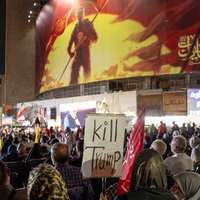
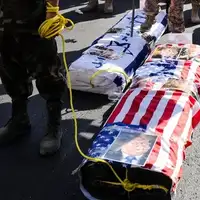
This sentiment comes as Tehran hardliners regularly burn Israeli and US flags during rallies, chanting "Death to Israel" and "Death to the US" They also paint these flags on pavements to encourage people to trample them. However, for years, many Iranians—particularly students at universities—have actively avoided stepping on the American and Israeli flags painted by agents of the Islamic Republic.

Three prominent centrist and conservative figures in Iran have suggested that the country’s political doctrine must change to address its ongoing problems, especially the economic impasse.
During a roundtable discussion hosted by Sazandegi newspaper, conservative politician and Expediency Council member Mohammad Reza Bahonar, former senior lawmaker and centrist politician Hossein Marashi, and Mahmoud Vaezi, a senior aide to former president Hassan Rouhani, carefully avoided directly naming Supreme Leader Ali Khamenei as the ultimate authority responsible for the country’s major shortcomings.
They spoke cautiously, as some of their critical remarks touched on highly sensitive topics, including constitutional changes and political reforms. The veteran political insiders would not have voiced such criticisms publicly two or three years ago, before Iran's regional influence began to wane and its economic situation reached a critical stage.
They highlighted issues including the government's lack of resources, largely due to massive expenditures in the Middle East aimed at undermining Israel—spending that was undertaken without the consent of the Iranian people or parliament (Majles), as they noted.
Marashi said, "Iran's priority should be addressing its economic crisis," and "politics in Iran should not be left to military organizations," likely referring to the central role the Revolutionary Guards play both in political and economic spheres.

He added: “The government’s priorities remain focused on outdated ideological issues, such as enforcing the hijab on women and restricting access to information on the Internet, rather than tackling the country’s pressing economic crises.”
These failures have left the nation struggling in darkness and cold since November, as the oil-rich country continues to fall short in producing sufficient natural gas and electricity in generating sufficient oil export revenues.
A huge part of the country's income from oil is kept outside the government's treasury and under direct supervision of the Supreme Leader and the Revolutionary Guard.
On December 16 all government offices and schools in 26 of the 31 Iranian provinces were shut down due to blackouts, power shortages and consumption of pollutant fuels in many power plants.
Without elaborating on what was wrong with the Iranian Constitutional Law, Bahonar said that “all the articles of the constitution can be revised except a few that are about the essence of Islam and the nature of the political system as a republic.”
His remarks likely implied that institutions such as the Guardian Council, which hinder free and fair elections, could be dismantled, and that articles granting extraordinary powers to the Supreme Leader could be revised. This would help curb unnecessary spending on religious institutions and costly military ventures abroad.
Elsewhere in their debate, the three politicians said that many of Iran's problems are caused by flaws in the structure of its political system. Without saying how the current system has led to a dictatorship under the Supreme Leader, they called for a democratic political system like those in Japan, Pakistan, Germany, France and the United States.
Marashi criticized Pezeshkian for taking pride in lacking a clear plan for his government or a political party to advance his ideas. He also pointed to the Islamic Republic’s core doctrine, which centers on its ongoing struggle against what it calls “arrogant powers”—a concept now largely synonymous with anti-Americanism.
He argued that “this doctrine cannot drive meaningful progress and must be reformed, much like how China abandoned its rigid ideological approach to achieve development.”
Marashi went on to question the extensive powers of Iran's Judiciary and the absence of judicial independence. He also criticized the current Majles for consistently obstructing the government’s ability to fulfill its responsibilities.
Additionally, he emphasized that Iran’s economy has been held hostage by its nuclear program for the past 19 years. Highlighting the fall of Bashar al-Assad in Syria, he said: “Even maintaining our allies in power depends on prioritizing the economy.”
At the same time, perhaps in an effort to absolve President Masoud Pezeshkian of responsibility for the current crises, three other conservative figures, in reports published by Nameh News website, emphasized that "the Pezeshkian administration has inherited the current economic and political problems from previous governments."

Two Romanian men arrested in Romania over the stabbing of Iran International presenter Pouria Zeraati have been extradited to Britain, where the attack took place in March 2024.
British police confirmed on Tuesday that the men, Nandito Badea, 19, and George Stana, 23, were taken into custody at Heathrow Airport after being detained by authorities in Romania earlier this month.
The pair face charges of wounding with intent to cause grievous bodily harm. They are set to appear in Westminster Magistrates’ Court on Dec. 18.
Zeraati, a British-Iranian, sustained leg injuries in the attack near his home in Wimbledon, southwest London. His case raised concerns over threats to critics of Iran's government, with British officials investigating whether Zeraati was targeted for his work.
Iran has denied any involvement in the case or attempts to target Iranian dissidents abroad.
Officials in Britain and the United States say Tehran recruits criminals to intimidate and attack dissidents.

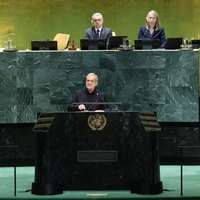
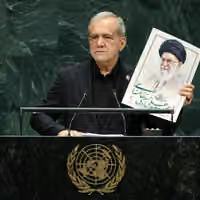
Iran's ambassador to the United Nations on Tuesday expressed openness to good relations with a new Syria, turning a page on over a decade of Iranian military support against the rebel groups which now run the country.
"Iran and Syria share historical and friendly relations which continue to grow based on mutual interest and international legal principles," Amir Saeid Iravani said during a United Nations Security Council session.
"Iran remains steadfast in its constructive role, working with United Nations regional partners and the Syrian people to achieve lasting peace and stability in Syria and the wider region."
The collapse this month of President Bashar al-Assad's government delivered a major blow to Iran's influence in the Middle East.
For years, Tehran poured resources into maintaining the Axis of Resistance—a regional alliance aimed at countering Western and Israeli influence. Syria under Assad served as a linchpin in this strategy, acting as a vital link for Iranian support to Hezbollah in Lebanon and a launchpad for Tehran's broader regional ambitions.
"The future of Syria must be decided solely by its people, free from external interference or imposition," Iravani added. "An inclusive, Syrian-led and Syrian-owned political process, facilitated by the UN ... is essential."
The rapid advance of rebel forces and their capture of Damascus on December 8, forced Assad into exile in Russia and upended Iran's regional role.
Iran's Revolutionary Guards and Quds Force operatives who had played a central role in bolstering Assad were forced to withdraw, stripping Tehran of its military and intelligence leverage.
Armed rebels stormed and looted the Iranian embassy, and a truck parked outside was photographed toting away a large golden chandelier.
Iravani described Iran's military intervention in the country as vital to defeating militants from Islamic State, referred to as Daesh in Arabic.
"For years, Iran has provided legitimate support to Syria in his fight against terrorism, acting upon the formal and lawful request of the then Syrian government," he said. "Without Iran and Hezbollah's decisive efforts and sacrifices, Syria would have fallen entirely under the control of Daesh and its affiliated terrorist groups."
The remarks stood in contrast to those of Iran's ultimate decider of domestic and foreign policy, Supreme Leader Ali Khamenei, who said in a speech last week that the Syrian rebels would be pushed out.
“By God’s blessing, the territories occupied in Syria will be freed by the brave young people of Syria,” Khamenei said. “Have no doubt that this will happen.”
Iravani said on Tuesday that preserving Syria's institutions is key to preventing further chaos, warning of the consequences if governance structures collapse.
"Maintaining Syrian governmental institutions is vital for stability... Institutional collapse risks further fragmentation, humanitarian suffering, and exploitation by extremists," he said.

At home, Iran's regional setbacks have heightened scrutiny of Iran’s foreign policy priorities, with critics questioning the allocation of resources to wars abroad while economic conditions deteriorate domestically.
Khamenei in his speech attributed Assad’s downfall to a plot by the United States and Israel and also ascribed blame to Turkey without explicitly naming it.
As Tehran grapples with the fallout, its regional strategy may see significant changes, including a potential push to advance its nuclear program as a means of restoring deterrence. However, the loss of Syria as a strategic ally represents a major challenge for Iran, signaling a significant realignment in regional geopolitics.

Israeli officials announced the arrest on Tuesday of a 23-year-old Jerusalem resident on suspicion of spying for Iran and plotting what they called terrorist attacks inside Israel.
Erdler Amoyal was contacted in October via social media by an agent identifying as Ariana, before being introduced to another handler, John, according to the Israel Security Agency (Shin Bet).
“This investigation once again reveals the efforts of Iranian intelligence agencies in attempting to recruit Israeli citizens for the purpose of promoting espionage and terrorist activities,” a Shin Bet official said.
Despite knowing the operatives represented a hostile state, Amoyal agreed to carry out tasks, including surveillance and writing graffiti in Tel Aviv and Jerusalem, featuring phrases such as We Make Peace and Sinwar.
The Shin Bet said that Amoyal sought bomb-making materials, watched tutorials on constructing explosives, and attempted to acquire a firearm with a silencer.
He also proposed attacks targeting Israeli infrastructure, including setting a police vehicle on fire and cutting electricity to the Jerusalem light rail.
Payments for these missions were made through cryptocurrency, authorities said.
The announcement follows several arrests in recent months tied to alleged Iranian plots.
Earlier this month, three northern Israel residents were detained on similar charges.
In October, seven Arabs from East Jerusalem were arrested by security forces on suspicion of plotting to assassinate scientists and senior Israeli officials on behalf of the Iranian government.
In September, Moti Maman, a 73-year-old Jewish businessman from the southern coastal city of Ashkelon, was arrested on allegations of meeting with Iranian intelligence operatives and aiding them in planning high-profile assassinations, including that of Israeli Prime Minister Benjamin Netanyahu.
According to the Shin Bet, Maman even traveled to Iran twice this year, where he requested $1 million as an advance payment for a series of missions.
The longstanding enmity between Iran and Israel has deepened in recent months, marked by a series of escalating confrontations across multiple fronts.
Iran's support for proxy groups like Hezbollah in Lebanon, Hamas in Gaza, and militias in Syria has heightened tensions, as Israel continues to carry out targeted strikes against Iranian-linked assets in the region to curb Tehran's influence.
The two regional powerhouses have also exchanged direct blows in two rounds of tit-for-tat attacks that carry the risk of all-out war.
Iran has intensified its rhetoric and expanded its cyber and covert operations targeting Israeli interests.

The US Justice Department on Monday charged two Iranians with conspiring to export sensitive US technology to Iran’s Revolutionary Guards, including navigation systems used in military drones that killed three US service members.
Dual US-Iranian national Mahdi Mohammad Sadeghi, 42, a resident of Natick, Massachusetts, and Mohammad Abedininajafabadi, 38, of Tehran, were charged with violating US export control and sanctions laws.
Abedini is also accused of providing material support to a foreign terrorist organization — the Islamic Revolutionary Guard Corps (IRGC) — resulting in the deaths of three American soldiers in a January drone attack on a military base in Jordan.
The US defense department indicated at the time that an Iranian-backed Iraqi militia, Kata'ib Hezbollah, was responsible for the strike. It was the deadliest attack on US troops since the Oct. 7 Hamas attack on Israel sparked a sprawling conflict pitting Israel - long armed and supported by Washington - against groups loyal to Tehran.
Sadeghi was arrested in Massachusetts, while Abedini was detained in Italy at the request of US authorities. Both face up to 20 years in prison, with Abedini also facing charges that could result in life imprisonment.
“The Justice Department will hold accountable those who enable the Iranian regime to target and kill Americans and undermine the national security of the United States,” said US Attorney General Merrick Garland.
According to court filings, Abedini founded San’at Danesh Rahpooyan Aflak Co. (SDRA), an Iranian company that produces the Sepehr Navigation System, used in IRGC military drones, cruise, and ballistic missiles. Sadeghi, a former founder of a Massachusetts technology company, allegedly conspired to procure US-origin components through illicit channels for SDRA, violating export laws.
The investigation revealed that SDRA’s navigation systems were integral to the Shahed drones used in the January 28 attack on the Tower 22 base in Jordan, which killed three service members and injured more than 40 others.
The US government is now seeking Abedini’s extradition from Italy.