Israel conducts over 300 airstrikes on Syrian military infrastructure
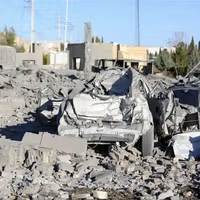
The Israeli military has been pounding military infrastructure in Syria in attacks they say aim to ensure Syrian and Iranian weapons and facilities don't fall into the hands of extremists.
Around 300 airstrikes have taken place in Syria, in the wake of the fall of the Assad government, with attacks intensifying on Tuesday.
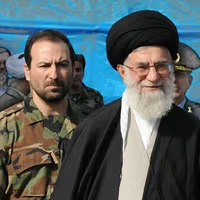
Iran's ruler Khamenei meeting with IRGC forces fighting in Syria. November 2022
As images of brutality and prison abuses flood the internet following Bashar al-Assad’s fall, Iran’s tightly controlled media has cautiously criticized the deposed leader, hinting that a similar fate could befall the Islamic Republic.
“The lesson we should take is to be mindful so that [our] people do not get fed up and weary of the country and its circumstances and maintain their hope in the future,” conservative politician and journalist Naser Imani told Rouydad news website Monday.
While distancing Iran from Syria’s experience, he cautiously added, “The situation in the Islamic Republic is not comparable to Syria at all. Nevertheless, one should take note of the public opinion.”
Iran’s Supreme Leader, Ali Khamenei, has consistently praised Bashar al-Assad as a key figure in the “Axis of Resistance” and maintained unwavering support for him against adversaries. In 2019, during a meeting with the deposed Syrian president, Khamenei called him “the hero of the Arab world.”
Any strong criticism of Assad or Iran’s support for him could be interpreted as a challenge to Khamenei’s views, risking serious consequences for media outlets and public figures expressing such opinions.
The restrictions on criticizing Assad became apparent when several prominent public figures deleted critical social media posts soon after Assad’s ouster, often without explanation. These deletions were likely the result of pressure from security forces.
A commentary on the moderate conservative Asr-e Iran website suggested that foreign conspiracies may have played a role in Assad’s downfall, citing his support for the “Axis of Resistance.” However, it noted that Assad did not appeal to Syrians for support because he knew he would not get any.
“The question is should a government not be wise and discerning and treat its people with love and tolerance to protect itself if it is facing so much hostility from the outside?” the commentary asked, adding that ignoring the “views of the majority and the public’s demands” could be “the most damaging and fatal mistake a politician and a government can make,” as did Assad.
The Islamic Republic faces multiple crises at home and abroad, including Israeli strikes on its regional allies, economic devastation from Donald Trump’s “maximum pressure” campaign, setbacks in relations with Europe, and widespread corruption and decades-long human rights violations that have eroded public trust. Additionally, there is growing demand for greater social and political freedoms.
Ultra-hardliners dominating the Parliament have been pushing for the enforcement of a very controversial new hijab law, which even many conservatives and prominent clerics view as deeply damaging given the current circumstances.
Despite extensive moderation and the removal of “unpublishable” comments, some remarks published by the conservative Alef news website regarding recent events in Syria reveal that many ordinary Iranians are drawing parallels between Assad’s rule in Syria and the situation at home.
“A country’s power lies in its people, not its military force and the nuclear weapons,” a reader commented on an editorial Monday titled “Why Doesn’t the Syrian Army Fight [for Assad]?” The comment received 97 likes and only three dislikes, reflecting strong agreement among readers.
Another reader remarked, “There would be no civil war in Syria and not so much damage and loss of life if Assad had given its people some degree of political freedom and invited all political groups to participate in the government ten or fifteen years ago.”
This comment garnered 149 likes, with only six readers disapproving.
Similarly, readers gave strong approval to comments on another article, “Why Did Assad Fall?” published Sunday on the same website. The article attributed Assad’s downfall to his failure to reform the government.
One comment noted that Assad had claimed the backing of 95 percent of Syrians in elections held three years ago and emphasized, “social capital [is] the biggest asset of a government.”
Nearly 300 readers agreed with the comment, with only three expressing disapproval.
The Israeli military has been pounding military infrastructure in Syria in attacks it says aim to ensure Syrian and Iranian weapons and facilities don't fall into the hands of extremists.
Around 300 airstrikes have taken place in Syria, in the wake of the fall of the Assad government, with attacks intensifying on Tuesday.
Reuters reported that they targeted military installations and airbases across Syria overnight, destroying dozens of helicopters and jets, as well as IRGC assets in and around Damascus.
Israeli strikes are also believed to have targeted suspected chemical weapons depots in Syria, the country’s foreign minister told reporters on Monday, in addition to the Al Mezza military airport.
Gideon Sa’ar, said: “The only interest we have is the security of Israel and its citizens that’s why we attacked strategic weapons systems, remaining chemical weapons, long range missiles and rockets, in order that they won’t fall in the hands of extremists.”
A scientific research center in Damascus, which operated under the Syrian Defense Ministry and was the target of Israeli strikes, has been completely destroyed, according to the French news agency AFP.
The center, which the US has identified as being linked to Bashar Assad's chemical weapons program, was already the focus of joint strikes by the US, France and Britain in April 2018.
On Tuesday, Israel denied reports that it has entered deep inside Syria, after it was claimed that troops were edging closer to the capital, Damascus.
Avichay Adrey, the Israeli military’s Arabic spokesman, wrote on X: “Reports circulating in some media outlets claiming that IDF forces are advancing or approaching Damascus are completely incorrect. IDF forces are present inside the buffer zone and at defensive points close to the border in order to protect the Israeli border.”
The Israeli military seized the buffer zone in southern Syria after insurgents infiltrated the UN-monitored zone on Saturday.
Israel says it is only taking control of the buffer zone for “limited and temporary measures" following the infiltration, in a defensive move while it is under fire across its borders from Iran-backed militias in Iraq, Yemen, Lebanon, Gaza and the West Bank.
However, Reuters reported the military reached just 25 kilometers from Damascus, according to multiple Syrian sources speaking to the news agency.
Former Prime Minister Naftali Bennett, likely to stand in the next elections in the hopes of a second term, said on X: "Contrary to reports, the IDF is not advancing on Damascus. Israel is doing exactly what is necessary, destroying advanced Syrian military capabilities before they fall into the hands of radical Jihadists."
While the uncertainty as to the future of Syria remains, he said creating a buffer zone is critical, not least since last year's October 7 attacks when Iran-backed Hamas killed over 1,100 and took 250 more hostage. "We do not know what are the motivations of the various players, but we CAN deny them of certain lethal weapons. October 7th teaches us to focus on capabilities rather than on motivations," he added.
On Monday, the Israeli military released a statement saying that on Sunday, forces of the 210th Division “took steps to proactive ensure the defense of Golan in light of internal events in Syria”.
A statement said: “Paratroopers’ forces, joined by other troops, are conducting defense activities in the field to prevent any threat and are deployed in key positions within the buffer zone.
“Additionally, engineering, infantry, and armored forces are operating under the command of the 474th and the 810th regional brigades, and are stationed along Israel’s border with Syria to secure the area.”
Syrian insurgent strongman Abu Mohammed al-Golani (Jolani) in Damascus.
And now, with Syria’s more than 50-year Assad dynasty in ruins, Israel, and other Western nations, are concerned for the next steps as Islamic extremists have taken over. The US also carried out airstrikes on Monday targeting ISIS camps and terrorists.
Syrian chemist, Hamdi Ismail, has also been killed in his home in Damascus though there are no reports as to who is behind the killing.
Syrian Mzahem Alsaloum, who owns a private intelligence agency, was in favor of the strikes, while others have been quick to condemn, including Hezbollah in Lebanon.
“As a Syrian seeking a brighter future for our country, I support the Israeli airstrikes targeting the Syrian regime's army to dismantle their so-called "SAA Strategic Capabilities." … We are facing a precarious situation with two potential outcomes," he wrote on X.
"The first is a Libya-like scenario, where militias and terrorists take control, and we certainly don't want these weapons used against innocent civilians. The second is a new, promising Syria that must be demilitarized, with small, highly developed units capable of addressing minor national security threats, such as disarming militias, countering terrorism, and preventing mafia activities, in collaboration with major NATO allies.”
The main rebel commander leading an array of groups in Syria, Ahmed al-Sharaa, widely known as Abu Muhammed al-Golani, has spoken openly about his anti-Israel stance.
In a 2021 interview with PBS, the ex-Al Qaeda fighter said that the bloody second intifada which saw Palestinians commit a series of attacks in Israel, killing nearly 1,000 Israelis between 2011 and 2004, inspired him. “I was strongly influenced by the Palestinian intifada [uprising] which was taking place in neighboring Palestine.
“I was still a young man; I was 18 or 19 years old. I started thinking at that time about how I can pursue my duty of defending the nation, which was being persecuted by the occupiers and invaders,” he said.
A senior Iranian figure has warned of imminent attacks in Iraq following Assad’s fall, urged vigilance to protect regional stability, and accused Western powers of exploiting and weakening other nations.
“Terrorists are currently preparing to launch attacks on Iraq,” Mohsen Rezaei, a former IRGC chief commander, said Tuesday. “Any reduction in regional security will inflict irreparable damage on countries, so everyone must remain vigilant. The United States and its accomplices seek to weaken nations and plunder their wealth."
“We must learn from history,” he continued. “History has shown that the West shows no mercy even to its own proxies, and that plundering other countries’ resources is one of its main priorities.”
The Iranian government spokesperson suggested on Tuesday that leaders who ignore public sentiment and refuse dialogue risk facing the same fate as Bashar al-Assad.
“One analysis of Bashar al-Assad’s fall is that he failed to understand the power of the people. His refusal to engage in dialogue, along with the army’s inaction, brought him down. We believe we must speak with the people and act alongside them,” Fatemeh Mohajerani said during a press conference.
On Tuesday, an Iranian MP said that the country’s forces remained in Syria until just before the Assad government neared collapse, and that it still holds full power over its enemies’ vital interests.
“The Islamic Republic’s military forces remained in Syria until the very last moment—just before the fall of Bashar al-Assad’s government—and currently, there are no Iranian forces in that country,” Ahmad Naderi said following a meeting with IRGC commanders.
He also quoted the commander of Iran's Revolutionary Guards, Hossein Salami: “Not an iota of Iran’s power has diminished, and we maintain full dominance over all the enemy’s vital interests.”