Iran’s panic over Syria’s developments is natural – Analyst
Rouhollah Rahimpour, a political analyst, told Iran International that there is clearly no comprehensive and systematic analysis of the events in Syria in the Islamic Republic's media.
Referring to the approach of some newspapers like Kayhan, he said, "Some of these media outlets consider the situation a victory for Israel, while others reduce the issue to internal Syrian matters."
According to Rahimpour, the Islamic Republic's calculations regarding Syria have been thrown into such disarray that they are unable to consolidate an analysis of the situation and their current position.
Donald Trump on stage for his victory speech on November 6, 2024
Donald Trump’s victory in the 2024 US election has sent a palpable wave of desperation, masked by defiance, rippling through Iran and its regional proxies.
The President-elect has pledged to leap into action between his election on November 5 and inauguration on January 20, 2025. Traditionally, this “lame-duck” period has been one of inaction, yet the pressing military crises—one in Eastern Europe, the other in the Middle East—compel both the outgoing Biden and incoming Trump administrations to coordinate with a shared sense of urgency.
Trump’s return could signal an era of decisive US diplomacy. He has vowed to stand resolutely by Israel while assuring America’s Arab allies of their security against Iran’s regional ambitions. The ongoing conflict, ignited by Hamas’s assault on Israel on October 7, 2023, has dragged on into its thirteenth month. Trump’s pledge to “end the conflict” has left all actors, save perhaps Israel’s Netanyahu, in a state of suspense, watching keenly to see how his foreign policy could reshape the volatile dynamics of this troubled region.
Indeed, the possibility of Trump’s return to the White House has been on the minds of all factions involved in this conflict. Analysts, too, have speculated on what Trump might achieve in the Middle East. In my previous piece, What Would a Re-elected Trump Do with Iran?, I argued that his handling of the “Iran Question” would require a strategy of global engagement, one that enlists cooperation from Russia and China. Now, the key question is: How would Trump tackle Iran and its proxies in his first hundred days?
The Middle East since 2016
When Trump first took office in 2016, Iran enjoyed unmatched ascendancy in the region. Under Obama, conciliatory policies and efforts to establish the JCPOA allowed Iran to consolidate regional power, expanding influence in Iraq, Lebanon, Syria, and Yemen under the guise of fighting ISIS. By Trump’s departure in 2020, the Middle East, though not fully at peace, was on a trajectory shaped by his policies: Iran and its proxies faced sanctions and the threat of decisive strikes, such as the killing of Qasem Soleimani. The Abraham Accords, spearheaded by Trump, brought Arab states like Bahrain and the UAE into peace with Israel.
Biden’s term, by contrast, focused on attempts to negotiate with Iran and address Israeli-Palestinian tensions, with no success. Iran exploited lax sanctions enforcement to arm proxies like the Houthis, Hamas, and Hezbollah with drones and missiles. Biden’s mediation of a Saudi-Israeli accord, rooted in the Abraham Accords, showed diplomatic promise but was undermined by Hamas’s October 7 attack, backed by Iran.
A year later, Israel’s efforts to dismantle Hamas and Hezbollah have inflicted heavy damage on their resources, leaders, and infrastructure, dealing a significant blow to Iran’s regional ambitions, if more gradually than desired.
Between Biden’s lame duck period and Trump’s first 100 days
Trump’s re-emergence is an unsettling development for Iran and its proxies, while it can embolden certain leaders who, until now, were wary of Tehran’s wrath. Khamenei and his associates have responded by exhibiting a curious blend of defiance and indifference. Among Iran’s proxies, the reaction has varied: Hezbollah’s new Secretary-General, Naim Qassem, has pledged to continue the struggle against Israel while hinting at indirect ceasefire talks. Meanwhile, Iran’s IRGC deputy chief renewed Iran’s vow to retaliate recent Israeli strikes, irrespective of Trump’s victory. In the days leading up to November 5, reports emerged of Iran moving ballistic missiles to Iraq, seemingly in preparation for attacks on Israel from Iraqi soil.
Trump’s return may also inspire leaders in nations where Iran’s influence has rendered governance nearly impossible. His firm support for Israel and conservative Arab monarchies may offer vital backing to those in Iraq and Lebanon striving to throw off Iran’s yoke. Senior Shia cleric Ayatollah Ali Sistani in Iraq has issued a powerful declaration stating that only the Iraqi army has the right to bear arms, effectively rebuking Iranian-backed militias and denouncing Iran’s use of Iraqi soil to target Israel. In Lebanon, as of three weeks ago, the Lebanese Prime Minister had already rebuked Iran’s interference in Lebanese affairs, and some in the Lebanese political establishment have called for enforcing UN Security Council Resolutions 1701 and 1559, which mandate the disarmament of all militias—implicitly challenging Hezbollah’s powerful presence.
Should Trump follow through on his promise, and if the Biden administration remains committed to counter any Iranian escalation, the united resolve of both administrations may well give Iran pause. Khamenei, though far from an ideal rational actor, understands Biden’s outgoing team has little to lose by striking Iran decisively if provoked. Indeed, Iranian officials have reiterated Tehran’s ability to produce nuclear weapons at short notice.
If Khamenei were to gamble on developing and deploying nuclear weapons in the coming months, Trump would face a grave dilemma. On one hand, he has promised the American people to avoid foreign entanglements; on the other, he has vowed to prevent Iran from acquiring nuclear weapons and has assured security for Israel and Arab allies. Trump has both diplomatic and military options at his disposal, including pressuring Iran via Russia to dismantle any nuclear weapons or turn them over to Russian custody, or use advanced bombers equipped to penetrate Iran’s nuclear bunkers. However risky, such measures could likely gain Congressional support, especially from a Republican-led majority.
In conclusion, although irrational reprisals from Iran’s mullahs or their Hezbollah allies cannot be ruled out, Trump stands poised to act. With Congress behind him and the potential to broker peace between Russia and Ukraine, Trump is a formidable foe—one whom Khamenei would be wise not to underestimate. Trump’s greatest weapon remains his unpredictability, a force he wielded against Iran before and may once again deploy with lethal precision. Should Khamenei persist in his antagonism, Trump shall see him stand corrected, and in this contest, it may well be game, set, and match.
This opinion article was submitted on Nov. 6. Opinions expressed by the author are not necessarily the views of Iran International.
The remnants of an Iranian ballistic missile downed on October 1, 2024
April to October 2024 may well be recorded by historians as the critical months when the simmering shadow war between Iran and Israel erupted into open conflict, reshaping the Middle East irreversibly.
As analysts work to interpret Israel's decisions and the growing challenges it faces, President Joe Biden and some Western allies have criticized Prime Minister Benjamin Netanyahu’s hardline approach toward Iran's proxies. They describe this stance as "unhelpful," attributing part of the ongoing attacks from Iran and its allies, which have intensified since October 2023, to Israel's own actions.
Nearly a year since Hamas’s attack on October 7, 2023, it is ever more apparent that even those in the highest seats of power require a sobering reminder of the events that have plunged the Middle East into chaos. Let there be no ambiguity: circumstantial evidence and irrefutable facts make plain that any perceived obstinacy on Prime Minister Netanyahu’s part in the drawn-out ceasefire talks is a necessary answer to crises not of Israel’s making. These dire circumstances have been thrust upon Israel, the Palestinians, the Lebanese, and the Iranians alike by the malevolent machinations of Iran’s mullahs and their armed henchmen. It is they who have brewed this bitter draught, imperiling the peace of the Middle East—and indeed, the world.
The road to escalation
The present crisis was unleashed in the early hours after Hamas's brutal assault upon southern Israel on October 7, 2023. As Israel moved swiftly to repel and extinguish the invaders in the south, Hezbollah—Iran’s foremost armed proxy in the region and Israel’s northern neighbor—opened a barrage of projectiles on October 8 upon northern Israel, forcing the nation into a multi-front struggle against Iran’s sprawling web of armed proxies. By the dawn of 2024, the flames of conflict, fanned by these proxies, had set the entire region ablaze.
Over the past year, and most markedly since February 2024, the Biden administration has sought to fortify its military might in the region, deploying a formidable fleet—several aircraft carriers, an attack nuclear submarine, and a host of air squadrons—all with the declared purpose of deterrence. Yet, whilst thus brandishing its strength, it has exerted ever-mounting pressure upon Israel to curtail its operations in Gaza and assume a more flexible stance in ceasefire talks with Hamas. Accompanying these efforts has been a tireless shuttle diplomacy led by the administration’s foremost emissaries—Secretary of State Anthony Blinken, CIA Chief William Burns, National Security Advisor Jake Sullivan, and, as of March 2024, Special Envoy for Lebanon Amos Hochstein. However, this flurry of diplomatic ventures has, thus far, yielded but scant fruit and remains barren of tangible success.
In the spring of 2024, the IRGC and Hezbollah, hand in glove, fortified their forces and missile sites along Israel’s northern frontier, with the express aim of forcing Israel's hand in the faltering ceasefire talks with Hamas. To secure full coordination and devise new schemes—including the rumored audacious incursion into northern Israel, mirroring Hamas’s brazen October 7 assault on the south—Tehran dispatched several of its IRGC high command, led by General Zahedi, to Damascus.
On April 1, in a bold pre-emptive strike, Israel eliminated General Zahedi and his lieutenants within the very walls of the Iranian embassy compound in Damascus—an act swiftly condemned by some as a breach of international law but vindicated by the exposure of Iran's exploitationof diplomatic immunity, flouting the 1961 Vienna Convention on Diplomatic Relations.
Iran’s reprisal came on April 13, unleashing a slow-motion barrage of hundreds of projectiles upon Israel. Six days later, on April 19, Israel struck back, dismantling a critical anti-aircraft radar system within an airbase deep in the Iranian heartland. This was merely the prelude to what followed. On July 31, Israel struck down Hamas’s political chief, Ismael Haniyeh, in Tehran—a blow that disgraced Iran's intelligence and marred President Masoud Pezeshkian's inauguration. And on September 27, Israel eliminated Hezbollah’s Secretary General, Hassan Nasrallah, in Beirut, marking a decisive shift in the balance of power.
On the very day that Iran unleashed nearly 200 projectiles upon Israel on October 1, 2024, Israel commenced its limited ground incursions against Hezbollah in southern Lebanon. At this moment, not just the region, but the entire West, stands confronted with a stark and ominous reality: A nuclear threshold state—Iran—has openly demonstrated its resolve to strike at Israel, for a second time, employing ballistic missiles that stands but a few short strides away from being armed with nuclear warheads. Furthermore, Iran’s formidable proxy, Hezbollah, however hitherto somewhat decapitated, bruised, battered, and on its backheels, holds an arsenal of tens of thousands of rockets and precision-guided missiles, poised and ready to be hurled upon Israel at any given moment.
Dilemmas and options
Those who strive to prevent a region-wide conflict would be wise to confront the stark realities of the Middle East as they truly are. It is not simply a matter of averting a conflict that looms on the horizon—for that conflict is already upon us. Rather, their task is to prevent the entire region from spiraling into total war—a total war overshadowed by the specter of nuclear proliferation, driven by a Shia fundamentalist theocracy whose professed aim for the past 45 years has been the destruction of the State of Israel, and whose leaders have openly threatened to accelerate their march towards nuclear armament as of May 8, 2024.
Indeed, as the world held its breath, anticipating Iran’s reprisal for the elimination of General Zahedi by Israel, the author of this very piece observed on April 10, 2024, that Iran might hasten its march toward nuclear armament, seeking to wield such weapons as a deterrent against Israel and the United States. Israel has sounded the alarm to the world since at least 2004, but those warnings have all too often fallen upon deaf ears.
In this grave hour, it is certain that the majority of Israelis stand as one, ready to support their government should it act to vanquish any threat to the very existence of the Jewish State. Of all perils upon the horizon, none is more immediate than the specter of Iran's nuclear program. Its destruction—whether partial or total—is not merely a strategic aim but a matter of survival. Equally vital is the crippling of Iran’s military-industrial capabilities. Let there be no delusion: Iran has become a purveyor of military drones, missiles, and munitions, threatening the peace and stability of the Trans-Atlantic world, and proving itself a menace not just to the region but to the global order.
Israel faces the delicate task of navigating the goodwill of Iran and Lebanon, nations it may need to strike. Yet, solace lies in the deep bitterness harbored by millions of Iranians and Lebanese against the Shia clerics and their armed minions, who have brought years of turmoil and economic ruin. The recent deployment of anti-riot forces across Iran—to quash any celebration after Hassan Nasrallah’s elimination—reveals the depths to which the regime has fallen in the eyes of Iranians, who valiantly rose in 2022 to cast off the mullahs, though in vain. A similar sense of relief resounds in Lebanon, Nasrallah's own land, exposing the growing chasm between the people and their so-called protectors.
Netanyahu, keenly attuned to this discontent, directly addressed the Iranian and Lebanese peoples, urging them to rise and shatter the chains imposed by Hezbollah and the Islamic Republic of Iran—appeals that resonated deeply. Thus, Israel would be wise to wield its might with utmost precision, striking at the military-industrial sinews of both the Iranian regime and Hezbollah. If Israel chooses to target Iran’s petrochemical plants—lifeblood of revenue for the ruling echelon and the IRGC—and their refineries, it would deliver a grievous blow to a regime already struggling to provide petrol to its own citizens, despite its status as an oil-exporter. Such a crippling of economic power would shake the very foundations upon which the regime's dominion rests.
On a final, yet vital note of protocol, Israel has, throughout its history, scrupulously refrained from the assassination of heads of state or government, even amidst its most formidable foes. As the fog of war clouds the judgment of many, any such speculation that Israel intends to strike down Ali Khamenei verily appears as naught but a far-fetched fancy.
The fallout
Israel must brace itself to weather condemnation from both friend and foe, should it unleash devastating blows upon the Islamic Republic of Iran and Hezbollah in the coming days and weeks. Such rebuke, though it may ring loud and strident, shall, in all probability, dissipate into the ether, drowned by the manifold crises with which humanity now grapples. From a contested US presidential election to the grim intensification of the Russo-Ukrainian War, and any unforeseen calamities that may yet darken our shared destiny, these cries of censure shall become mere whispers, lost to the winds of time.
In the final reckoning, Israel’s strikes may prove fatal to Hezbollah, dismantling it as a paramilitary behemoth—a state within the Lebanese state—and reducing it to a mere political faction. The twin blows of military decimation and economic ruin upon Iran’s economic and nuclear infrastructure may well mark the beginning of the end for a regime that has held sway over Iran for nearly half a century. Yet, let none forget that such regimes seldom relinquish power without a sanguinary struggle, as they stare into the abyss of their own collapse.
Opinions expressed by the author are not necessarily the views of Iran International
Last week, exiled Iranian Crown Prince Reza Pahlavi outlined his vision for a prosperous Iran post-revolution, but it requires further refinement and expansion to address key aspects of the country's political economy.
As the keynote speaker at the "Iran Conference 2024," hosted by NUFDI, a US-based nonprofit promoting democracy and human rights in Iran, Prince Reza Pahlavi addressed several key economic challenges that any post-Islamic Republic government must confront.
The presentation began with a comparison of Iran's economy to other developing nations, both past and present. Pahlavi explained how Iran's economy has deteriorated since the inception of the clerical Islamic government and how the Islamic Republic has worsened the lives of Iranians, before outlining 10 principles for rebuilding the economy after the potential fall of the current Islamist government.
In his "Iran’s Prosperity Project" vision, while Prince Pahlavi outlined missed opportunities and the path forward, he offered little on the dominant economic role of the government and military, which have stifled private sector growth and investment.
In discussions on Iran’s economic revival, it is essential to consider the governance system and social structures shaping the current economy. Key areas for analysis should include the role of state-owned banks and companies, resource allocation, subsidies, and the impact of a state-controlled economy on social capital—factors that greatly influence the feasibility and sustainability of economic reforms.
Breaking down Pahlavi’s 10-principle plan
The ten clauses outlined by Pahlavi in this project fail to address these fundamental questions, as they overlook the elephant in the room.
The plan needs to be enhanced by clear ideas on how to finance a smaller government, and how to distribute huge potential revenues from oil and gas, once a more capable government is able to remove sanctions and expand its vital fossil fuel sector. Should the government continue to keep energy export revenues and finance development projects, or find ways to involve the private sector in a liberal economy?
Where does the national income come from, and how is it spent? How can the most pressing concerns of the Iranian people—waste, corruption, and incompetence—be effectively addressed?
The following outlines the ten principles mentioned in Pahlavi’s remarks, along with their key issues:
1. "Trusting citizens to make decisions based on their interests"
The crucial question of how remains unanswered. The most effective form of trust would involve depositing national income directly into people's pockets. How can individuals make decisions based on their own interests if they lack access to their own resources?
2. "Creating opportunities by the government for all citizens to thrive"
What does "opportunity for all" really mean? It refers to giving individuals the ability to invest directly in retirement plans, college funds, the stock market, and businesses—rather than having economic affairs controlled by state-run companies managed by government-appointed officials. With these opportunities, people would be more motivated to invest in their children's education, stocks, and retirement, fostering greater personal financial empowerment.
3. "Policies to empower individuals by fostering personal responsibility and innovation"
Individual responsibility is impossible without active participation in the economy. While innovation and responsibility are essential, they cannot be achieved without access to banking resources and national income.
4. "Respect for private property"
Genuine respect for private ownership requires enabling its practical implementation. The centralization of national resources and their revenues under government control presents a significant barrier, limiting the development of a robust private ownership framework.
Market mechanisms cannot function effectively when the state controls over 80% of the nation's resources. A key question is how this figure could be reduced to 60% or even 40%, which would require significant structural reforms.
6. "Removing barriers and fostering conditions for domestic entrepreneurs and a business-friendly environment"
Entrepreneurship is not possible if aspiring entrepreneurs cannot rely on people's accumulated capital in banks or expertise. What mechanisms could funnel capital to new enterprises?
7. "Inflation control with financial discipline and an independent central bank"
The independence of the central bank cannot be guaranteed when 80% of the economy is controlled by the state. With such dominance, the government inevitably turns the central bank into a tool for advancing its monetary policies. True independence is driven by the circulation of money within the private sector, which compels the central bank to make autonomous decisions. This independence cannot be assured merely by orders or legislation.
8. "Eliminating barriers to women's participation in the labor market"
Women cannot start small businesses without access to capital. To address the centuries of inequality resulting from unequal inheritance and low female employment, a portion of public income should be allocated directly to women.
9. "Productivity driven by enhancing human capital and adopting technology to fuel economic growth"
Productivity and human capital diminish under a large, and therefore corrupt, government. Reducing the government's and military's role in the economy leads to greater human capital development and lower levels of corruption.
10. "Rejoining the global economy and attracting foreign investment"
Government-controlled economies that retain most resources and lack a strong private sector struggle to attract foreign investors. In contrast, foreign investment flows more readily into economies with a reduced government presence and a more robust private sector.
Three major issues in Pahlavi's economic vision
Based on Pahlavi’s proposed plan, three clear conclusions emerge.
If the plan is to be implemented one day, then it is impossible with a state-controlled economy. The proposed policies can be easily ignored in practice, yet still repeatedly included in five-year economic plans without any real intention of implementing them.
Without a clear strategy to prevent the government from monopolizing resources, even a national framework risks funneling wealth into the hands of a small, insider elite—leading to corruption and the formation of mafias. Curbing this by limiting government spending through taxation offers a crucial safeguard.
Finally, if the true goal is prosperity and public welfare, revenues from national resources should be directed to individuals, rather than being funneled into the treasury. Large development projects do not need to be controlled by government bureaucracies. Although the government can offer loans financed by taxes on oil and gas exports, development projects can be funded primarily through bonds and private bank investments.
Editorial note - Opinions expressed by the author are not necessarily the views of Iran International
Iran's foreign minister Abbas Araghchi speaks to reporters in New York, 22 September 2024
The circus is back in town. A new Iranian president arrives at the United Nations as a smiling mask to an undeterred adversary of the United States and too many credulous media and policy elites in this country cheer on the pageant. This needs to stop.
United Against Nuclear Iran (UANI) has obtained a video in which Iranian foreign minister Abbas Araghchi tells the UN Special Envoy Geir Pedersen that he met with “old friends” from American think tanks the previous evening.
From 2013 to 2021, when he was chief nuclear negotiator, Araghchi – an affiliate of the designated terrorist group Islamic Revolutionary Guard Corps (IRGC) – was part of a core network of officials cultivating individuals and entities in the West to promote the Islamic Republic’s narrative, influence policy debates, and infiltrate key institutions without any public disclosure.
Araghchi indicates that he met these think tankers in the past and seems keen on reviving the relationships now that he has regained power. The United States and its allies must be ready to counter this renewed Iranian regime lobbying campaign aimed at easing international pressure, at a time when the IRGC plots terror attacks on American soil and Tehran interferes in the U.S. election.
This sets the scene for the arrival in New York of the Islamic Republic’s new President Masoud Pezeshkian for the opening of the U.N. General Assembly (UNGA).
Iran follows a well-worn playbook to promote its new presidents in New York: they place an op-ed by a senior official in a major U.S. newspaper, pledging engagement and mutual respect while seeking sanctions relief to enable its malign activities. Tehran offers an interview with the new president to ‘safe’ television networks and anchorsin exchange for such access.
Additionally, the regime schedules meetings with former policymakers, think tankers, and others to influence their analyses of Iran’s policies, banking on these individuals using their media platforms to amplify these exclusive connections.
Inevitably, some participants in these discussions will become champions of a “golden opportunity” for rapprochement between the U.S. and Iran. Like Pezeshkian and Araghchi, whom they will label as “moderates,” these Western voices will use this narrative to express Iran’s desire for renewed nuclear talks and ultimately advocate for sanctions relief for the regime.
Araghchi and his Foreign Ministry cohort Javad Zarif and his deputy, Majid Takht-Ravanchi, played starring roles in leaked email correspondence revealing a significant information operation, dubbed “the Iran Experts Initiative,” to influence American and European policy to better serve the Islamic Republic’s interests.
This modus operandi is not restricted to UNGA or America. While passing a warning from an Iranian embassy to one of the authors of this article that they should not be so outspoken, a European think tanker described how they always attain sign-off from an Iranian ambassador prior to publishing content on Iran – a process they recommended to avoid any future warnings. Iranians who live in the West are uniquely susceptible to such threats from Tehran.
A broader circle of academics and former officials in Iran, backed by its intelligence apparatus, also engage leading Western think tanks under the guise of Track II diplomacy, which the regime greenlighted resuming in early 2023.
In fact, the Islamic Republic’s Foreign Ministry has allocated resources for Track II initiatives with the aim to create a “lobby” in the West for relations with Tehran. These are written into Iranian government documents. One Track II participant is Nasser Hadian, a professor at the University of Tehran and known for having extensive ties to the sanctioned Intelligence Ministry.
The Iranian Mission to the United Nations will ensure that aspects of Pezeshkian’s personal biography are showcased during his program in Manhattan to make him more accessible and sympathetic to an American audience. Specifically, that he is a cardiologist and a widower, whose wife and child died in a car crash—mirroring President Joe Biden’s life story. There will be a heavy emphasis on Pezeshkian the “reformist,” despite widespread electoral suppression and his own role in suppressive hijab enforcement
Pezeshkian’s speech before the U.N. General Assembly this week will likely feature the hallmarks of the Islamic Republic’s foreign policy—seeking to further stoke an international consensus against Israel in its war against Hamas He will also resurrect and repackage concepts that previous Iranian presidents championed like a “World Against Violent Extremism” and “a Middle East free of weapons of mass destruction.”
This is all gaslighting to provide space for the IRGC to continue the advancement of the regime’s nuclear program and regional aggression, including via its terrorist proxies, while thwarting international coercive measures in the delusional hope of empowering so-called “moderates” in Iran.
But the regime in Iran won’t just export smiles to UNGA. Last year, members of the Islamic Republic’s delegation threatened and physically attacked U.S.-based Iranian journalists in New York. It was later revealed that one of the perpetrators – granted a visa to attend UNGA by U.S. authorities - was a longstanding member of the Intelligence Ministry, which supports Iran’s terrorist operations abroad.
These aggressive and intimidatory actions are common tactics the Islamic Republic uses against its critics when it travels across the West.
During a Track II diplomacy conference in a European capital, one of the authors of this article had surveillance conducted on him by regime operatives after the Islamic Republic’s delegation was made aware of his presence by participants closely aligned with Tehran.These acts of transnational repression on Western soil cannot be ignored.
The Iranian regime’s nefarious information operations in the U.S. are on a par with China’s and Russia’s. Last week’s joint statement from U.S. authorities revealed Iran’s regime has escalated its efforts to interfere in November’s presidential elections with intent to “stoke discord and undermine confidence in the U.S. electoral process.”
The statement described these efforts as a “direct threat to the U.S.” that “will not be tolerated.” Yet, instead of denying the Iranian delegation entry to the U.S., Tehran is receiving red-carpet treatment in New York.
The Biden administration should issue a similar statement warning about the influence operations happening this week in New York and immediately deport the visiting Iranian officials.
Recent explosions of Hezbollah communication devices in Lebanon and Syria have triggered a complex web of reactions among Iranians, whose government is the primary backer of the armed group.
On September 18 and 19, a suspected Israeli cyber operation caused the explosion of thousands of pagers and hand-held radios used by Hezbollah fighters, resulting in scores of deaths and injuries to more than 3,000 people. Hezbollah immediately blamed Israel and vowed "unique and bloody vengeance" in response. While this event stirred international attention, many Iranians showed a striking lack of compassion toward Hezbollah members. This reaction is deeply rooted in Iran’s internal strife, its government’s ties with Hezbollah, and the brutal repression of dissent in Iran.
Hezbollah, a Tehran-backed militant group based in Lebanon, has long been an extension of the Islamic Republic of Iran's influence in the region. Since its inception in the early 1980s, Hezbollah has received financial, military, and logistical support from the Iranian regime, becoming a key player in Tehran's regional strategy. Many Iranians view Hezbollah as a tool used by the Islamic Republic to pursue its geopolitical interests at the expense of both Iranian citizens and other populations in the Middle East.
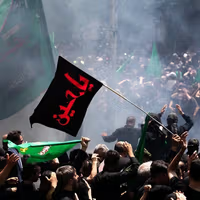
Funeral of a Hezbollah member in Lebanon on September 19, 2024
Hezbollah's actions have gone beyond mere regional politics. The group has been involved in suppressing dissent in Lebanon, Syria, and even Iran. During the Syrian civil war, Hezbollah fighters actively supported the Assad regime, known for mass atrocities and human rights violations. Furthermore, many Iranians believe that Hezbollah operatives aided in suppressing protests in Iran, particularly during the 2022 "Woman, Life, Freedom" movement. The crackdown on these protests involved violent tactics, including shooting protesters with shotgun birdshots, resulting in numerous injuries and deaths.
The "Woman, Life, Freedom" protests in 2022 were a pivotal moment in Iran, marking widespread dissent against the regime's oppressive policies, especially those targeting women. Iranian security forces used brutal measures to suppress the movement. According to reports, at least 138 individuals lost their eyesight. In addition to this brutal repression, at least 46 children were killed by Iranian security forces during the protests, targeted by birdshots, long-range precision weapons, and baton blows. Many protesters, including these children, were systematically targeted, with security forces aiming for their eyes and faces, leaving deep psychological scars on the Iranian populace.
Considering this history, many Iranians perceive Hezbollah's recent losses not as an isolated tragedy but as part of a broader narrative of retribution against those who have supported or enacted state violence. Social media reactions have been telling in this regard. For example, one commenter sarcastically remarked about the Hezbollah members blinded by the pager explosion, recalling how the regime had blinded numerous protesters in Iran without showing any compassion. The underlying message is that those who have caused pain and suffering are now experiencing a taste of their own medicine.
Two young Iranian protesters blinded by shotgun birdshots in 2022
This sentiment is further fueled by the violent tactics historically employed by the Islamic Republic and groups like Hezbollah and Hamas. Suicide bombings, the use of ambulances and civilian planes to transport weapons and militants, kidnappings, and even the use of rape as a weapon of war have been present in the militant Islamist strategy. For decades, these brutal methods have been used to instill fear and maintain control, both within Iran and across the region. Many Iranians now view Hezbollah's current troubles as a form of reckoning—a reflection of the very violence they once helped spread.
There is also a prevailing sentiment among Iranians that sympathy for groups like Hezbollah and Hamas is a "first world luxury." For many in the West, the complex dynamics of the Middle East can often be viewed from a distance, focusing on geopolitical analysis rather than the personal and collective traumas experienced by those directly affected. Many Iranians argue that Western observers sometimes fail to grasp the extent of the suffering caused by these groups, which are not just abstract entities but have actively participated in violence, oppression, and the perpetuation of authoritarian rule.
Iranians also see hypocrisy in Islamists, who wish to impose ancient, draconian laws while simultaneously benefiting from modern technology. These groups preach ideologies that advocate practices from 1,400 years ago, such as polygamy, public flogging, and amputations. Yet, they readily use advanced communication devices, military technology, and even social media to further their cause. Many Iranians argue that those who wish to live by medieval laws and values should not have access to modern technology. This perceived contradiction further fuels the disdain towards groups like Hezbollah, as they are seen as using the advancements of the modern world to perpetuate archaic and violent ideologies.
The difference in reactions between those who have lived through the violence and those who view it from afar is stark. For many in the Iranian diaspora, celebrating the recent attacks on Hezbollah is seen as a celebration of resistance against a network of oppression that has inflicted pain and loss on their communities. They draw a clear distinction between this and the October 7 attack on Israel, which targeted civilians and involved acts of terror against civilians.
The recent pager explosions and the subsequent reactions from Iranians highlight the complexity of violence and justice in the Middle East. While any loss of life is tragic, the reactions among Iranians are shaped by decades of oppression, personal losses, and a struggle for freedom against a political system that they believe leverages groups like Hezbollah to maintain its grip on power.
For many Iranians, Hezbollah's suffering is viewed as poetic justice. It serves as a grim reminder that the tools of violence and repression can turn against those who wield them. The lack of compassion is not from a disregard for human life but from a deep-seated desire for justice and accountability for the countless acts of brutality inflicted upon them.
Opinions expressed by the author are not necessarily the views of Iran International