Cabinet choices signal dark days ahead for Iran’s academia
Hossein Simayi Sarraf, President Masoud Pezeshkian's pick for Ministry of Science
President Masoud Pezeshkian's nomination of Hossein Simayi Sarraf as Minister of Science, Research and Technology, is unsettling academics who are concerned that he will continue the university purges witnessed in recent years.
Sarraf’s nomination is particularly significant given the recent history of Iran’s universities as hotbeds of political dissent. The Woman, Life, Freedom uprising, sparked by the death of Mahsa Amini in 2022, reignited a wave of student activism that shook the foundations of the Islamic Republic.
Protests erupted across more than 130 universities, with students and professors standing in solidarity against the government. These acts of defiance were met with crackdowns, including arrests, judicial rulings, and the mass dismissal of dissenting faculty members.
Given this backdrop, the choice of Sarraf—a figure with years of clerical training and deep ties to Iran’s conservative establishment and a history of involvement in the system’s ideological purification of universities—sends a clear message: the Islamic Republic is doubling down on its efforts to stifle academic freedom and silence opposition.
Simayi Sarraf’s background is a testament to his alignment with the system’s hardline ideology. Born in Mashhad, he was groomed from a young age to follow in the footsteps of the clerical rulers.
His father’s close ties to Supreme Leader Ali Khamenei and his own military involvement in the Iran-Iraq war set the stage for his rise within the government. After two decades of seminary education, Sarraf transitioned into the academic sphere, where he pursued studies in Islamic jurisprudence and law. His work, steeped in conservative Shia thought, has produced over 50 publications advocating for the integration of Islamic principles into Iran’s legal system.
His tenure in various governmental roles, including his time as Director General of the Legal Office of the Ministry of Science and as Deputy for Legal and Parliamentary Affairs, has been marked by his efforts to align the country’s academic institutions with the system’s ideology.
During Rouhani’s administration, he played a key role in the purge of universities, targeting faculty members who dared to challenge the status quo.
The appointment of such a figure to the ministry of science is an indication that the system intends to continue its assault on academic freedom. The ministry, under Simayi Sarraf’s leadership, is likely to intensify efforts to Islamize universities further, pushing out any remaining voices of dissent and reinforcing the control over Iran’s educational institutions.
Hossein Simayi Sarraf, President Masoud Pezeshkian's pick for Ministry of Science
The revelation comes after the early exit of Mohammad Javad Zarif, a key figure in Pezeshkian’s circle, an event that continues to make waves. Scrutiny has intensified over the cabinet nominees in which candidates, some holdovers from Ebrahim Raisi’s administration and others relatively obscure figures, seem unlikely to bring the meaningful change that Iran’s sectors, particularly its universities.
Instead, the list of nominees reflects a continuation of the status quo rather than the progressive change that many had anticipated.
Students stage protests following the killing of Mahsa Amini in police custody in 2022
It is particularly alarming in light of the recent purges that began under President Ebrahim Raisi’s administration. Following the widespread protests that erupted after Mahsa Amini’s death, the government launched an aggressive campaign to root out opposition within universities.
Observers believe that the appointment of Simayi Sarraf signals a renewed commitment to silencing dissent and erasing any remnants of academic freedom in Iran and that its academic purges are far from over.
US Vice President Kamala Harris is stonewalling a congressional inquiry into her national security adviser Phil Gordon's ties to an Iranian government influence network in the US, according to the Washington Free Beacon.
Last month, Sen. Tom Cotton (R-Ark.) and Rep. Elise Stefanik (R-N.Y.) initiated an investigation into Gordon’s ties. The inquiry focuses on Gordon’s longstanding association with Pentagon official Ariane Tabatabai, a senior Department of Defense official involved in an Iranian government operation to expand Tehran’s influence in the United States.
Harris did not respond to an August 9 deadline from Cotton and Stefani to explain Gordon’s ties to Tabatabai and the pro-Tehran network.
"You failed to respond by my deadline or to appropriately address this threat to national security emanating from your staff," Cotton wrote in a letter to Harris on Thursday.
"The presence of such an obvious security risk in your inner circle should have elicited your utmost attention. It raises the question of whether you've been aware of Mr. Gordon's possible links to the Iranian regime and simply find your policies aligned enough with Tehran's interests that ties to that regime don't concern you."
Earlier this month, top lawmakers overseeing US foreign policy threatened to subpoena the State Department following the agency’s failure to provide information about suspended Iran envoy Robert Malley.
In a letter to Secretary of State Antony Blinken, US Senate Foreign Relations Committee Ranking Member Jim Risch and House Foreign Affairs Committee Chairman Michael McCaul expressed deep frustration with the State Department's lack of transparency regarding the suspension of Robert Malley's security clearance.
Malley was appointed by President Joe Biden in early 2021 to revive the 2015 Iran nuclear deal, advocating for sanctions relief in exchange for nuclear restrictions. Despite efforts, the deal has not been reinstated since Trump's 2018 withdrawal. In April 2023, Malley was placed on leave and had his security clearance suspended. Iran International first reported the incident two months later, but the State Department blocked all attempts to find more information about Malley’s case.
As the US elections approach and Iran-Israel tensions rise, the Biden-Harris administration is under increased scrutiny regarding its handling of national security matters.
The unresolved questions about Gordon’s ties to the Iran Experts Initiative and the State Department’s lack of information on Robert Malley’s suspension are drawing attention, highlighting the administration’s approach to sensitive foreign policy issues during a critical period.
The US Treasury Department issued sanctions targeting Houthi and Hezbollah trade networks on Thursday as Washington seeks to increase pressure on Tehran and its terror groups.
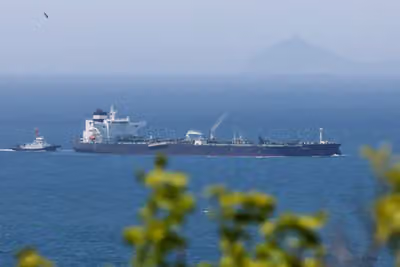
The new sanctions targeted companies, individuals and vessels involved in the shipment of Iranian commodities, including oil and liquefied petroleum gas (LPG) to Yemen and the UAE on behalf of a Houthi financial official's network.
“Today’s action underscores our continued commitment to disrupting Iran’s primary source of funding to its regional terrorist proxies like Lebanese Hezbollah and the Houthis,” said Acting Under Secretary of the Treasury for Terrorism and Financial Intelligence Bradley T. Smith in a statement Thursday.
“Our message is clear: those who seek to finance these groups’ destabilizing activities will be held to account.”
In addition to targeting the network of Sa’id al-Jamal, OFAC is also designating Hong Kong-based Kai Heng Long Global Energy Limited for its role in "shipping Iranian LPG worth tens of millions of dollars" for Iran-backed Hezbollah.
The sanctioned entities include Palau-flagged LPG tankers LPG OM and RAHA GAS, owned by Marshall Islands-registered companies KDS Shipping Limited and Arafat Shipping Company, respectively, which the Treasury said have been linked to illicit shipments for the Sa’id al-Jamal network.
The RAHA GAS, captained by Indian national Arif Ibrahim Khot, falsely labeled shipments as originating from the UAE and delivered them to Yemen.
UAE-based ONX Trading FZE facilitated payments for the operations. The DIVINE POWER, owned by DP Shipping Limited, also shipped fuel oil for al-Jamal’s network, including a transfer with the US-sanctioned MEHLE.
These entities, along with Malaysia-based Transmarine Navigation and UAE-based K F D General Trading, are now sanctioned by the US for supporting the al-Jamal network. Additionally, Hong Kong-based Kai Heng Long Global Energy Limited who managed multiple LPG tankers linked to Iranian LPG shipments was sanctioned on Thursday.
The OFAC designated Sa’id al-Jamal in 2021 for having supported the Houthis and its illegal trading network in order to fund Iran’s Islamic Revolutionary Guard Corps Qods Force (IRGC-QF), which was designated by the US in 2007 for its support of terror groups.
The Houthis were re-designated by the US in January after three months of a blockade by the terror group saw US shipping targeted with a series of attacks. The blockade began in November after orders from Iran’s Supreme Leader, Ali Khamenei, to blockade the trade route, targeting Israeli-linked ships in support of the Iran-backed Hamas war in Gaza.
In retaliation to the Houthi blockade, the US and UK have launched direct attacks on Houthi infrastructure in Yemen with the US leading a more than 20-nation coalition to battle Iran’s proxy armed with state-of-the-art missiles and drones. In February, the action led the Houthis to declare both the US and UK targets in its blockade which began against Israel.
The University of Tehran has announced an increase in the admission of members of Hashd al-Shaabi, the Iranian-backed Shiite militia in Iraq, without the need for entrance exams.
Mohammad Moghimi, President of the University of Tehran, announced Thursday that these students do not receive military training at the university and instead study management though it is widely known that Iraqi militias are trained in Iran.
The Hashd al-Shaabi, or Popular Mobilization Forces (PMF), was established in 2014 following a religious decree to combat ISIS, which at the time had taken control of four Iraqi governorates and threatened Baghdad.
While the Iraqi state-sponsored umbrella organization is largely composed of Shia Muslim groups, it also includes Sunni Muslim, Christian, and Yazidi factions with an estimated 128,000 fighters across 67 different armed factions.
Iraqi Shiite Muslims from the Popular Mobilization Units (Hashd al-Shaabi) march during a parade marking the annual Quds Day, or Jerusalem Day, in Baghdad, Iraq, June 23, 2017.
The University of Tehran's decision to welcome the militia members without standard academic requirements signals a concerning trend. Official reports last year highlighted a "cooperation and agreement" between the Hashd al-Shaabi and the University of Tehran to facilitate the education of these fighters.
Moghimi disclosed in his Thursday interview with the IRNA news agency that Iraqi officials have expressed dissatisfaction with the "insufficient quality" and low standards of some Iranian universities educating PMF students. To address the concerns, Iraqi authorities have requested the University of Tehran step in and help "repair this reputational damage."
Iraqi Prime Minister Mustafa al-Kadhimi during a military parade by Iran-backed Shiite militia Hashd al-Shaabi, in the town of al-Khalis, Diyala province, eastern Iraq, on July 23, 2022
He said the influx of the Hashd al-Shaabi members into Iranian universities, particularly the University of Tehran where admission for Iraqis has doubled, is part of a broader plan.
These students, according to Moghimi, many of whom are relatives of active, deceased, or wounded militia from the so-called "resistance front," are being groomed with the help of substantial Iraqi government funding to assume leadership roles back home.
Moghimi paints a rosy picture of the Hashd al-Shaabi members, describing them as deserving individuals committed to "advancing Islamic ideals."
Moghimi claims that there are also economic benefits behind admitting the Hashd al-Shaabi members, stating that they pay almost 1,200 euros per semester for undergraduate studies, compared to 80 to 90 million rials (130-150 $) for Iranian students.
Hashd al-Shaabi militias
In late July of last year, a group of student activists at the University of Tehran issued a statement condemning the presence of the Hashd al-Shaabi forces and similar individuals at Iranian universities as a "military invasion of the university."
They vowed to resist such admissions, emphasizing that the university has already been emptied of genuine students through "dismissals, suspensions, and repression," and turned into a stronghold for "so-called affiliated professors and Basij militia members."
Last year, Moghimi dismissed protests against the admission of the Hashd al-Shaabi members as "the anger of traitors." Now, he tries to justify these admissions by pointing out that "the education of individuals, managers, and regional officials" has always been a practice at the university, citing Nechirvan Barzani, the Prime Minister of the Kurdistan Region and an alumnus of the University of Tehran, as an example.
Vice-President Mohammad-Reza Aref has been accused of ‘misogyny’ after saying the Iranian society is not ready to give women leadership roles.
“Our society is not yet psychologically ready for women’s leadership,” Aref remarked in a video clip released by several media outlets during a ceremony bidding farewell to outgoing Women’s and Family Affairs Deputy Ensieh Khazali and introducing her successor, Zahra Behrouz-Azar.
The controversial remark was made in response to Khazali who criticized the reform-oriented Pezeshkian’s government for nominating only one female minister although there had been no female ministers in Ebrahim Raisi’s hardline-dominated government.
Some media and social media users interpreted Aref’s remarks as an excuse not to use more women in the higher echelons of Pezeshkian’s government that was supposed to be more reform oriented. Many also accused him of ‘misogyny”.
A longer version of the speech was later released, which suggested that Aref was actually criticizing the limited role of women in the government, rather than endorsing it. “Look at the indicators of girls versus boys’ academic progress. I’m sure our girls are ahead in most areas,” he stated, adding that the government's ideal is "no discrimination between men and women."
Aref also appeared to be expressing a concern that hardliners may not accept Farzaneh Sadeghi-Malvajerd, Pezeshkian’s only female cabinet nominee. “Let us get a vote of confidence for this one and later use [more women in such posts],” he says in the fuller version.
Sadeghi-Malvajerd, 55, who Pezeshkian has nominated to lead the Ministry of Roads and Construction is currently a deputy minister. In his speech, Aref said those opposed to her appointment ask whether a female roads and construction minister will be required to visit road construction sites.
If approved by the parliament, she will be the second female minister in the more than four-decade-long history of the Islamic Republic where not only politicians but also some influential Shia religious ‘sources of emulation’ strongly oppose giving women leading roles in the government.
Many, including the so-called ‘Islamic feminists’ oppose ‘patriarchal interpretations of Sharia’ which they say prevent women from running for president or female judges from presiding in courts of justice and the unwritten rules that do not allow women to be appointed to positions of power in the government.
Iranian women have also been fighting for decades against highly discriminatory laws, including family and inheritance laws, that are based on Sharia or only Shia tradition.
Some critics such as journalist Elahe Khosravi who believes Aref is oblivious to the Woman, Life, Freedom movement say the Vice-President has unjustly blamed the “society” and accused people of prejudice instead of admitting that it is the ruling establishment that has deprived women of their rights and opposes their progress.
“Aref is right. Our society is not prepared for women’s leadership because we are still stuck with the Islamic Republic and the repugnant absolute rule of the Islamic jurist,” student and women’s rights activist Motahare Goonei tweeted. A woman who demands more than what the “patriarchal system allows” is considered a criminal and punished, she said.
Another critic on X accused Aref of lying about the Iranian society. “Who says the society does not accept women’s leadership? He has put forth a false premise and lied about the people and the society. It would be okay if he said clerics oppose it as the society and people have no objection to women’s leadership.”
During the presidential debates, Pezeshkian criticized hardliners in the parliament of blocking a Rouhani administration bill to stop violence against women, discrimination against women, and harsh enforcement of hijab and promised to use more women in his government.
The family of Arezou Badri, a 31-year-old woman shot by Iran’s police on July 22 for allegedly violating mandatory hijab laws, is under intense government pressure to withdraw their complaint.
Badri, a mother of two, was left paralyzed after the shooting, an incident that has ignited outrage both within Iran and on the international stage.
The family's complaint regarding Badri, who suffered severe spinal cord injuries and remains hospitalized at Valiasr Hospital in Tehran, was heard in a court this week. However, the family remains dissatisfied with the outcome and the judicial process.
Iran International has learned that she underwent another surgery on Wednesday to remove fluid accumulated in her lungs, and her condition remains critical.
According to our sources, the Badri family members have been summoned by intelligence and security agencies, pressured to stay silent, and urged to withdraw their complaint.
Sources revealed that the family, including Badri's sister, is under intense pressure from security agencies to deliver a coerced confession on camera regarding Badri's situation.
The attack on Badri took place when she was stopped at a police checkpoint while returning home with her sister after work in Noor, Mazandaran province.
According to reports and images obtained by Iran International, the police opened fire after stopping the car on a dirt road, striking Badri in the back.
A warrant for the confiscation of Badri's vehicle over an earlier alleged hijab violation led police to open fire from the rear driver's side. Sources told Iran International that Badri was initially taken to a hospital in Noor before being transferred to Imam Khomeini Hospital in Sari. Since then, her family has faced intense pressure from security forces to stay silent about the shooting and her condition.
After several days, plainclothes security officers moved Badri to Tehran for further treatment, where her spinal condition remains critical. During visits, security officers reportedly confiscate the Badri family’s mobile phones to prevent them from taking photos or videos.
The Information Center of the Mazandaran Police Command confirmed the police shooting at the car in which Badri was a passenger, stating that the driver "continued to flee despite police orders, prompting the police to shoot at the car according to the law on the use of firearms."
Sources informed Iran International that despite police claims that Badri’s car had tinted windows, they were down at the time of the incident due to the heat and lack of air conditioning in the vehicle.
Amnesty International on Wednesday called for a thorough investigation into reports that Badri was shot and left paralyzed by police while enforcing compulsory veiling laws in Iran. The organization urged that "those responsible be held to account," highlighting the urgent need to abolish veiling laws and address Iran’s "impunity crisis."
Prominent Iranian activist and journalist Masih Alinejad denounced the attack on Badri, writing on X that "the morality police shot this woman and paralyzed her over a hijab." Alinejad stressed that "regardless of who is president" in Iran, women continue to suffer for simply showing their hair, urging others to "be her voice."
Israeli Foreign Minister Israel Katz also weighed in, describing the attack on Badri as a reflection of Iran’s Supreme Leader Ali Khamenei’s “murderous dictatorship,” which he said oppresses citizens and enforces “radical Islam.”
The incident is reminiscent of previous cases, such as that of Armita Geravand, a 16-year-old who was injured and went into a coma after being attacked by hijab enforcement officers at Tehran's Shohada Metro Station on October 1 of last year. She died on October 27 after 28 days in Fajr Military Hospital.
Similarly, in September 2022, Mahsa Zhina Amini, a 22-year-old woman, fell into a coma after being arrested by Iran’s morality police. Amini was reported dead on September 16 at Kasra Hospital which sparked nationwide protests, leading to the "Woman, Life, Freedom" uprising.