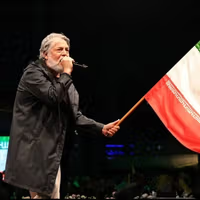
Israeli sonic booms rattle Lebanese capital as Hezbollah leader delivers speech
Israeli warplanes swooped low over the Lebanese capital Beirut on Tuesday, setting off a series of sonic booms that rattled windows across the city minutes before the head of Lebanon's Hezbollah was set to give an address.
The loud booms sent residents rushing to open their windows to prevent the glass from shattering, or standing on their balconies to get a glimpse of the planes flying over.
In the capital's southern suburbs, a Hezbollah stronghold, members and supporters of the Lebanese armed group had gathered to watch a televised speech by its leader to mark the one-week anniversary of Israel's killing of a senior military commander, Fuad Shukr.
As he began, Sayyed Hassan Nasrallah said the sonic booms were intended to provoke those gathered for the memorial.
Supporters listen to the speech of Hezbollah leader Sayyed Hassan Nasrallah via a video display on screen, during a commemorative ceremony marking the first week since the killing of Hezbollah's top commander Fuad Shukr, in Beirut, Lebanon August 6, 2024.
A Tuesday NOTAM (Notice to Airmen) posted on the US Federal Aviation Administration warns pilots that there is a risk of gun firing activities in western Iran on August 7 and 8. It has set the danger zone up to an altitude of 12,000 feet above mean sea level.
The announcement comes amid escalating tensions over Iran and its proxies' imminent attack on Israel in response to the assassination of Hamas leader Ismail Haniyeh in Tehran last week. According to the warning, the gun fire activity is scheduled to take place between 11:30 AM and 2:30 PM (local time) on Wednesday, and between 4:30 AM and 7:30 AM on Thursday.
The CEO of Imam Khomeini International Airport rejected earlier reports that Iran issued the warning. "The news of issuing a NOTAM, a flight safety warning for western Iran by the country's Civil Aviation Organization, is incorrect," said Saeed Chalandari.
Iran's uranium enrichment machines called centrifuges
The latest report from the US Office of the Director of National Intelligence accuses Iran of becoming ever bolder in boasting about its nuclear weapons as the chances of a return to the JCPOA nuclear deal look to be fading away.
"There has been a notable increase this year in Iranian public statements about nuclear weapons, suggesting the topic is becoming less taboo,” the report stated.
In May, Iranian MP Ahmad Bakhshayesh Ardestani said openly that Iran might already possess a nuclear weapon. It followed closely on the heels of remarks by Kamal Kharrazi, senior foreign policy advisor to Supreme Leader Ali Khamenei, who had said that Tehran will change its nuclear doctrine if its archenemy Israel were to attack its atomic facilities.
For years, the Islamic Republic has insisted that its nuclear program is entirely peaceful, despite enriching uranium to 60-percent purity, which can only have a weaponization purpose.
"Since 2020, Iran has repeatedly stated that it is no longer constrained by any Joint Comprehensive Plan of Action (JCPOA) limits, expanded its nuclear program, reduced International Atomic Energy Agency (IAEA) monitoring, and undertaken activities that better position it to produce a nuclear device, if it chooses to do so,” the US intelligence report noted.
However, it comes in stark contrast to the report released just last year in which it wrote that “Iran is not currently undertaking the key nuclear weapons-development activities that would be necessary to produce a testable nuclear device”.
That assessment rang hollow after it was revealed recently by the UN’s nuclear chief, Raphael Grossi, that Iran is “weeks not months” away from a nuclear weapon.
The latest report, under the Iran’s Nuclear Weapons Capability and Terrorism Monitoring Act of 2022, acknowledges the imminent threat the program poses as Iran continues to increase the size of its uranium stockpile, its enrichment capacity, and development, manufacturing, and operation of advanced centrifuges.
“Tehran has the infrastructure and experience to quickly produce weapons-grade uranium, at multiple facilities, if it chooses to do so,” the report noted.
The country’s nuclear capabilities have become a bargaining chip on the global stage, noted the report, which states that “Iran uses its nuclear program for negotiation leverage and to respond to perceived international pressure,” which has included hostage diplomacy with nations including Sweden and the US.
In line with UN inspectors, the report warns that “Iran probably will consider installing more advanced centrifuges, further increasing its enriched uranium stockpile, or enriching uranium up to 90 percent in response to additional sanctions, attacks, or censure against its nuclear program,” as global sanctions fail to stem the tide of armament.
It notes that Iran has the largest inventory of ballistic missiles in the region and the government continues to emphasize improving the accuracy, lethality, and reliability of these systems.
As the program continues, the unclassified report notes that “Iran probably is incorporating lessons learned from its missile and unmanned aerial vehicle attack against Israel in April”.
The first ever direct attack from Iran to Israel saw over 350 missiles and drones fired towards Israel, most of which were intercepted by Israel and a US-led coalition. It was in retaliation for an alleged Israeli strike on the Iranian consulate in Damascus in which two IRGC commanders were killed along with several other senior personnel.
But the intelligence suggests Iran’s armament development continues to gain pace in spite of global sanctions not only for Iran's nuclear program but for human rights abuses at home and its support of Russia's war on Ukraine. Iran has been supplying suicide drones to Russia used on civilian targets.
“Iran’s work on space-launch vehicles—including its Simorgh—probably would shorten the timeline to produce an intercontinental ballistic missile, if it decided to develop one, because the systems use similar technologies,” the report stated.
In yet another move in its war on women's freedom of choice, Iranian authorities have introduced the Tuba Plan to promote and enforce the country's mandatory hijab laws amid widespread defiance.
In a report on Sunday, the ‘reformist’ newspaper Shargh revealed it will be rolled out in three phases, culminating in the training of 1,500 "missionaries" tasked with promoting "the culture of chastity and hijab" with a particular focus on schools and education centers.
Citing Mohammad Hosseinzadeh, director general of Culture and Islamic Guidance of Khorasan Razavi province, Shargh reported that the project is mainly aimed at teenagers and youth with 400 individuals registered to become its missionaries.
"Our goal is to promote an Iranian-Islamic culture, of which the hijab is one of its examples,” Hosseinzadeh said.
When asked about whether the individuals taking part in the course would also be involved in the Nour Plan , an initiative that began in April this year to enforce mandatory hijab laws, Hosseinzadeh said it had not been finalized.
“I don't have any information about whether or not people will be allowed to participate in Nour Plan or Headquarters for Enjoining the Good and Forbidding the Evil after completing this course, but our field of activity is advertisement and promotion," he said.
However, Shargh highlighted that the Tuba Plan's ultimate goal seems to be staffing the hijab division within the Headquarters for Enjoining the Good and Forbidding the Evil, a government institution that shapes and enforces Iran's morality laws.
Led by Seyyed Mohammed Saleh Hashemi Golpayegani, the institute also referred to as the Headquarters for the Promotion of Virtue and Prevention of Vice was sanctioned in January 2023 by the European Union for being “responsible for serious human rights violations in Iran.”
Last week, Naimeh Islamlou, director of Kheybar Institute announced the commencement of registration for the Touba National Project in Karaj, near the country’s capital in Tehran.
She stated that the free "hijab and chastity promotion” training course will run for 60 hours, training people at three levels and awarding them a “reputable” degree upon completion.
Shargh noted that according to Kheybar Institute’s website, their main role appears to be in staffing and implementation of chastity and hijab projects for Headquarters for Enjoining the Good and Forbidding the Evil.
A unit within Kheybar Institute which they refer to as the 'Fatemi Mujahedan' appears to be aligned with the Tuba Plan, as pointed out by Shargh.
Kheybar Institute's 'Fatemi Mujahedan' Unit logo
According to the institute's website, the unit runs training courses for hijab promoters at three levels, with 124 courses conducted so far, involving participants from all over the country.
To train, individuals must visit the "Chastity Virtual Specialized University." The so-called university is described as "a training barracks and an ammunition depot for cultural officers of the frontline of chastity and hijab."
One of the registration officials in these courses told Shargh: "We have been holding training programs in the field of chastity and hijab at three levels for nearly 20 years. We took Plan Tuba to the Ministry of Culture and Guidance and got their support so that applicants who want to participate in these courses can have a free training course without spending money."
The registrar, whose name was not mentioned in the Shargh report, said there is no guarantees of employment for those enrolling, "but if they reach level three, they can work in schools, and if they earn, they will be paid with a gift or a gift card."
The official Tuba Plan poster
Ehsan Ahangar, director general of the Ministry of Guidance in Mazandaran Province, announced on July 28 that the Tuba Plan will indeed be focusing on public spaces and schools.
"After completing the course and receiving their certificate, participants will be deployed to promote hijab and chastity, particularly in neighborhoods and schools, which are our main target communities," Ahangar said.
For over four decades, the Islamic Republic has tried to impose mandatory hijab laws on Iranian women through various projects and its crackdown on women who defy its stifling rules continues.
Following the nationwide Women, Life, Freedom uprising sparked by the death of Mahsa Amini in morality police custody in September 2022 for an alleged hijab violation, women's protests against the Islamic Republic’s oppressive laws have become one of the most significant challenges facing the authorities.
Despite the government's violent suppression, which saw hundreds killed by state security amid the 2022 protests, many Iranian women have continued to defy and resist the Islamic Republic’s hijab laws, appearing unveiled in public places over the past two years.
These acts of civil disobedience however come at a heavy price. Women risk severe penalties and even their lives in the fight for freedom and equality as the battle against what the UN termed "gender apartheid" continues.
Unveiled women have been banned from public spaces, education, workplaces, and even jailed amid the government's fight in the face of nationwide hijab rejection.
Russian President Vladimir Putin has called on Iran's Supreme Leader Ali Khamenei to respond with restraint to the assassination of Hamas leader Ismail Haniyeh.
The appeal was delivered by Sergei Shoigu, a close Kremlin ally, during meetings with Iranian officials in Tehran on Monday, Reuters quoted two sources with knowledge of the matter.
The Kremlin has not commented on the matter, though Shoigu reportedly discussed Haniyeh's death during his visit.
Moscow has condemned the assassination as "a very dangerous" act, urging caution to avoid a wider conflict in the Middle East.
Iranian officials have not issued an immediate response but emphasized the need to address Israel's actions to prevent further instability.
Russian President Vladimir Putin attends a meeting with service members at the Kremlin in Moscow, Russia, June 27, 2023.
Mohammad Saleh Jokar, head of the Iran's Parliamentary Commission on Internal Affairs, says the Islamic Republic's response to the assassination of Ismail Haniyeh in Tehran "won't take long."
He stated that the armed forces of Iran "will certainly respond to the assassination of Ismail Haniyeh and Israel's acts of aggression in the coming days."
He also added that the Resistance Front has its own plans for retaliation, and the response from the Islamic Republic will be "firm."
"If the United States and European countries support Israel, their forces will become targets of the Resistance."