Western media struggles to grasp the reality of Iran
Supreme Leader Ali Khamenei casting his ballot in Tehran
As Iran’s new president, Masoud Pezeshkian, was elected, most Western media outlets not only reported the news but willingly accepted the veracity of the election, once again provoking criticism from many Iranians.
Last Friday's presidential election in the Islamic Republic of Iran (IRI) serves as a stark reminder that the country’s electoral process is neither free nor fair.
While the Islamic government promotes participation as voluntary and democratic, a closer examination reveals a system riddled with coercion, manipulation, and inherent inequality.
Iran’s elections are often portrayed as a contest between fundamentalists and reformists, suggesting a choice for the electorate. However, this dichotomy can be considered highly misleading, as it oversimplifies the political landscape and obscures the underlying complexities.
The real power lies not with the elected president but with the Supreme Leader and the unelected bodies that serve him. The Guardian Council, an unelected body, vets all candidates and can disqualify any deemed insufficiently loyal to the regime.
This ensures that only those who align with the Supreme Leader’s vision can run for office, transforming the election into a controlled charade rather than a genuine democratic exercise – as experts have often noted.
The 12-member un-elected Guardian Council headed by a 97-year old ayatollah loyal to Supreme Leader Ali Khamenei..
The people's vote becomes meaningless when an unelected individual, the Supreme Leader, holds the power to nullify their decisions.
According to Article 110, Clause 9 of the Iranian Constitution, the Supreme Leader's endorsement is required for the presidential decree to take effect. This endorsement signifies that until the Supreme Leader approves the elected president, the president has no legal authority over the executive branch.
This mechanism underscores that the legitimacy of the people's vote is contingent upon the Supreme Leader's signature, which confers power to the president.
Furthermore, the Supreme Leader's endorsement serves a supervisory role throughout the president's term. If the president deviates from prescribed principles, the Supreme Leader can withdraw his endorsement, voiding the president's authority and legitimacy.
Thus, the system structurally ensures that ultimate power remains with the Supreme Leader, thereby significantly diminishing the impact of the popular vote and perpetuating the state’s autocratic framework.
Even if a candidate emerges victorious from this skewed process, their power remains severely constrained.
The Supreme Leader, who holds ultimate authority, can override presidential decisions, rendering the office of the presidency largely ceremonial.
The parallel institutions created by the Supreme Leader, including the Islamic Revolutionary Guard and various councils, wield significant power over key aspects of governance and policy, further diluting the president’s influence.
Khamenei handing his decree to President Raisi empowering him to take office. August 3, 2021
Contrary to the Islamic Republic’s claims, participation in elections is far from voluntary. Voting habits are closely monitored, and individuals who do not participate often face severe repercussions.
Access to higher education, government jobs, and even basic civil rights can be contingent upon one’s voting record. Those who abstain from voting are frequently punished, directly or indirectly, when seeking employment or educational opportunities.
This coercion ensures a high voter turnout, which the regime uses to claim legitimacy while masking the underlying lack of genuine freedom.
Additionally, the high number of void votes indicates that many people go to the voting polls only to receive the associated benefits but refuse to actually vote for any candidate.
This phenomenon further underscores the disillusionment and lack of genuine choice faced by the electorate, many of whom likely participate under duress rather than as an authentic exercise of democratic will.
The system’s deep-seated discrimination
The discriminatory nature of Iran's political system extends beyond the electoral process, influencing all aspects of governance.
The constitution of the IRI primarily categorizes people into seven distinct groups, assigning different rights to each.
This hierarchical structure starts with a gender divide, privileging men over women, and extends to religious discrimination, where Muslims are prioritized over non-Muslims. Among non-Muslims, those whose religions are mentioned in the Quran are given more rights than those that are not, who face even greater discrimination.
Muslims are further divided into Shia and Sunni, with Shia Muslims, particularly those of the Twelve-Imam sect, enjoying the most privileges. Within this sect, there is an additional distinction between ordinary believers and mujtahids (Islamic scholars qualified to interpret religious law), with mujtahids holding significantly more power and rights.
For example, Iran's ten key decision-making institutions, including the Supreme Leader, the Council of Experts, the Guardian Council, the head of the judiciary, the head of the Supreme Court, and the Attorney General, are exclusively reserved for mujtahids.
This structure excludes more than 99% of the Iranian population, including all women, non-Muslims, and non-mujtahid Muslims, from participating in these critical roles.
The laws of the IRI are steeped in practices that violate basic human rights. These include stoning, retribution, dowry, polygamy for men, and whipping. Women’s rights are severely curtailed, with their legal status considered half that of men. Women are deprived of rights to divorce and child custody, while Baha'is and Sunnis face severe restrictions on their right to study, work, and travel. During Eid celebrations, Sunnis are prohibited from having mosques or conducting congregational prayers in major cities.
These practices are part of a broader system of discrimination and oppression that has persisted for the past 45 years under the Islamic Republic.
The path to freedom and democracy
The constitution of Iran, the gender-apartheid system of the Islamic Republic, religious governance, and Islamic ideology have all contributed to the human rights abuses perpetrated over the past four decades.
Thus, true freedom and democracy in Iran may only be achievable by transitioning to a secular government based on the principles outlined in the Universal Declaration of Human Rights.
The political system’s portrayal of a choice between fundamentalists and reformists serves as a tactic to force people to choose between bad and worse. Even this false choice was absent in the latest election, as candidates openly pledged loyalty to the Supreme Leader and made no promises of genuine reform. They offered hollow promises of economic improvement, despite a historical pattern of rising inflation, unemployment, and housing prices.
Under the current system, addressing Iran's structural problems is practically impossible, as real power resides with the Supreme Leader and the parallel institutions he controls. The outcomes for past presidents and prime ministers—many of whom have been imprisoned, sidelined, or died under suspicious circumstances—highlight the difficulties of achieving reform within the existing framework. This suggests that significant change is seemingly impossible without altering the concentration of power within these established structures.
Critics and opponents of the Islamic Republic insist that Iran's presidential election last Friday was not an exercise in democracy but a stark reminder of the regime's authoritarian nature. They argue that the only apparent path to genuine freedom and democracy lies in dismantling the current system and establishing a government that respects the rights and dignity of all its citizens.
Supporters of Mohammad-Bagher Ghalibaf and Saeed Jalili are fiercely blaming each other for the defeat of the so-called ‘revolutionary front’ in the elections against Masoud Pezeshkian backed by reformists.
Ghalibaf, who came third in the first round of the snap elections with nearly one-third of Jalili's votes, was eliminated, with Jalili representing 'revolutionaries' in the final round. He urged his supporters to vote for Jalili in the July 5 runoff to avoid dividing the votes of the 'revolutionary front.'
However, some of Ghalibaf’s supporters and campaign members openly endorsed Pezeshkian instead of Jalili who they said had no executive experience or viable plans for running the country.
Jalili’s supporters on social media accuse Ghalibaf of “hypocritically” announcing that he would vote for Jalili but refusing to mobilize his campaign capabilities including social media networks in his support.
Journalist Abdolrahim Ansari who supported Jalili scolded Ghalibafin a tweet on Sundaytelling him that he made no attempt to help Jalili by shifting his votes to him.
“We must not allow their treachery to be forgotten … This revolution should no longer be harmed by mudslinging and division,” he wrote.
Jalili and Ghalibaf’s supporters had fought an intensive media and social media battle for months, particularly before the parliamentary elections of March 1 during which both sides extensively made allegations of corruption and fraud against each other.
Since the announcement of his defeat, some Jalili supporters have also defiantly slammed the ultra-hardliner election watchdog, the Guardian Council, whose members are appointed by Supreme Leader Ali Khamenei.
They say the Council paved the way for Pezeshkian’s victory by pitching him against at least four hardliners and one conservative, causing the revolutionary front’s votes to be divided between the candidates.
Mohammad Mannan-Raisi, a lawmaker from Qom charged that the make-up of the approved candidates could not have been more “in reformists’ favor” to guarantee their candidates’ win.
Jalili supporters’ anger against the Guardian Council was also reflected in a tweet on the day of the runoff elections by Mohammad-Mehdi Fatemi-Sadr, a well-known Qom-based cleric and ardent Jalili supporter.
The Guardian Council should expect repercussions,he tweeted in a highly defiant language. Such open defiance of the Guardian Council could be interpreted as defiance of Khamenei. However, these hardliners never mention that the Council barred key candidates in the 2021 election, all but guaranteeing a win for their favorite man, Ebrahim Raisi.
Jalili who is not an official member of any political party or group was backed by the ultrahardliner Paydari (Steadfastness) Party led by Sadegh Mahsouli, a business tycoon and interior minister under populist Mahmoud Ahmadinejad as well as the recently established Jebhe-ye Sobh Iran. The latter, often referred to as MASAF, is a political group led by hardliner politician and theorist Ali-Akbar Raefipour.
The Paydari (Steadfastness) Party has its appendages in all government institutions including the parliament where their members formed a very influential minority in the past few years. They have often taken a leading role amid the weak presence of established conservative and reformist parties.
Paydari and MASAF are believed to have considerable influence among the Basij militia of the Revolutionary Guards (IRGC). The top brass of the IRGC, however, are widely claimed to have been behind Ghalibaf, a former commander of the IRGC’s air force.
Many of the top figures in the Paydari Party were Ahmadinejad allies who denounced him following his eleven-day standoff with Supreme Leader Ali Khamenei in 2011. They and other Khamenei loyalists dubbed Ahmadinejad and those who remained loyal to him “deviant” after the incident.
“It’s still the beginning. We will not let you be until we disgrace the Paydari grouplet and MASAF. You and your group are dangerous for the Revolution,” a Ghalibaf supported tweeted Monday.
With a new president nearly in office in Tehran, there is much speculation about the direction of the new Iranian government's foreign policy.
Supreme Leader Ali Khamenei, who is widely believed to have the final say on foreign policy and other matters in Iran, has assured domestic and foreign audiences that no change is likely to take place in Iran's foreign policy with the change of president. However, the specter of Trump’s re-election is not a pleasant prospect for Khamenei and the veneer of a more “moderate” government might be one of the few effective tools he can employ to deflect more sanctions and pressures.
Nonetheless, to respond to the demands of the nation whose patience is running thin in the face of serious and long-standing economic problems, the new president has vowed to do whatever in his power to improve the country's relations with the outside world in a bid to have the paralyzing US and other international sanctions on Iran lifted.
The most severe sanctions on Iran were imposed following the 2018 US withdrawal from the JCPOA nuclear deal. These sanctions have significantly impacted Iran's oil sales and international banking. As a result, Tehran's ability to sell oil on international markets has been restricted, and it faces challenges in repatriating the proceeds, having to sell the oil at discounted prices almost exclusively to China.
Newly election Pezeshkian with former foreign minister Zarif during his election campaign.
It remains unclear who will be the country's new foreign minister. Traditionally, however, Iran’s so-called moderate governments have relied on disagreements between the United States and Europe, leveraging divisions to weaken a united front against the Islamic Republic’s nuclear program and its regional interventions.
Some of the latest reports from Tehran indicatethat the new government is keen to follow an approach of less tensions with West. For instance, a report in proreform Fararu website says that Iran's new government, which has not been officially formed yet, is likely to review the country's domestic and foreign policies.
Fararu reminded that hardliners who oppose better ties with the West have lost the election, but they have not lost political power. This serious challenge, according to the website will affect every decision to be made by the new government.
The new government will inevitably face several challenges, including securing approval for its cabinet ministers from the hardliner-dominated parliament. Some observers note that Pezeshkian has friendly ties with Majles Speaker Mohammad Bagher Ghalibaf. However, the key question is whether Ghalibaf can influence the hardliners in parliament. The answer to this will determine how easy or difficult it will be for Pezeshkian's cabinet ministers to win a vote of confidence from the Majles.
Putting foreign policy on the right track is the next challenge. The unknown factor is Supreme Leader Ali Khamenei’s plan. Does he want a meaningful change or just a façade of a “reformist” government? Then comes Pezeshkian’s task of dealing with hardliners if he ends up trying to make any concessions to the United States.
The next challenge will be striking a balance between relations with and dependency on the East and the West. Radicals in Iran refuse to accept that even China and Russia must engage with the United States and Europe as both trade partners and political rivals. People like Jalili have often been more anti-West than even Russia and China.
Leaving behind these challenges is not easy considering the weight and might of hardliners' media fleet led by the state radio and television and the backing of the Revolutionary Guard.
However, Pezeshkian may have a counterbalance that could silence the hardliners: potential support from Khamenei. Iranians will see within a few months if this backing materializes. Even if it does, Pezeshkian might abandon his promise to end the crackdown on women who defy the compulsory hijab. This is an area where Khamenei is likely to allow the radicals free rein, assuring them that they are not entirely marginalized.
With Masoud Pezeshkian announced as the winner of Iran’s snap election, which followed the sudden death of President Ebrahim Raisi, uncertainties remain about when he will assume office and form the new government.
The inauguration of new presidents in the Islamic Republic typically occurs in early August, although no specific date is set. However, since there is currently no incumbent in office, there is some debate about when the new administration will officially begin.
The only timeframe that applies in case of the death of a president is 50 days until a new one should be elected. Raisi died in a helicopter crash on May 19, and the election was held on June 28 and the runoff on July 5.
There are several steps until the president-elect can be called Iran’s President.
After the election, the Guardian Council should confirm the validity of the results, ensuring that the election process followed legal precepts. Then, it issues a certificate of appointment for the president-elect. This document should be signed by the members of the Council and then sent to the Supreme Leader, who would announce the date for Tanfiz, when he officially endorses the election results and ratifies the new president. It is followed by Tahlif, or the swearing-in ceremony, which usually happens within a few days.
During the Tanfiz, Ali Khamenei hands over a decree, known as the "decree of confirmation" or "decree of validation", to the president-elect, formally recognizing him as the legitimate president. Without the Supreme Leader's approval, the president does not have the authority to assume office. During Tahlif, the newly elected president takes an oath before the Parliament (Majlis) in the presence of the head of the judiciary and the members of the Guardian Council, promising to uphold the constitution and faithfully execute his duties as the head of state. Both ceremonies are essential in the transition of presidential power, ensuring both legal and symbolic legitimacy for the incoming president.
Mojtaba Yousefi, a member of the parliament's presiding board, said this week the inauguration ceremony for Pezeshkian is scheduled for August 4 or 5. The president will then have 15 days to present his proposed ministers to the parliament for a vote of confidence, which is reportedly set to be held on September 5.
There is controversy about why the parliament, dominated by hardliners whose candidates lost to Pezeshkian, would not vote on the proposed cabinet sooner, given that fact that the country does not have a president and is run by interim Mohammad Mokhber, Raisi’s first vice president.
Mohammad Mokhber, the acting president, along with the members of late President Ebrahim Raisi's cabinet during a meeting with Supreme Leader Ali Khamenei, July 7, 2024
According to Abbas-Ali Kadkhodaei, the former spokesman of the Guardian Council, until the new government assumes office, members of the former cabinet can make decisions or appointments that could have financial implications for the next government.
This comes despite Mokhber’s directive in June that called on all executive bodies to “refrain from any changes to organizational structures, personnel reassignments, transfer of government property, implementation of new regulations, changes in tariffs and fees, and any actions outside the rules and regulations until the establishment of the fourteenth government.”
However, Kadkhodaei noted that unless there is a specific legal provision that states otherwise, the incumbent officials can make such decisions, implying that Mokhber’s directive may not be binding. “These are customary practices and have never been subject to legal debate,” he said.
Hossein Mirmohammad Sadeghi, a former lawmaker, said that there is no regulation for setting a date for the vote of confidence on the new cabinet, explaining that such dates are primarily based on considerations of different factors. These include the parliament's summer recess ending on July 21st and upcoming calendar events, like the observance of the Shiite mourning period, Ashura, on July 14th in Iran.
Hamid Aboutalebi, a former deputy chief of staff for political affairs of the office of Iran’s president under Hassan Rouhani, wrote a commentary on his X account on Monday, stressing the legal necessity of holding the endorsement ceremony as soon as possible. He said the president-elect should assume office by the 50th day after the death of the incumbent. He argued that according to the constitution, until the new government is formed, the parliament cannot impeach ministers or pass a vote of no confidence, leaving the body with no oversight capability in case of negligence or errors by the ministers.
Aboutalebi said this would present a serious constitutional challenge if the country would be without an incumbent president at the end of the 50-day period and would be governed by an unelected first vice president, with ministers who are not subject to parliamentary oversight.
Immediately following Masoud Pezeshkian's victory over Saeed Jalili in Iran’s heavily manipulated presidential election, most Western media outlets and news agencies labeled him as a “reformist” and “moderate.”
The media also described Jalili as a “hardliner,” “conservative,” or “ultraconservative.”
But do these labels, often used to dramatize politics and create a "devil and angel" narrative, accurately describe these two individuals and their supporters? Many Iran observers would say no.
Like Jalili, Pezeshkian announced during the campaigns that he fully adheres to the Supreme Leader, Ali Khamenei’s, policies and has "melted into Khamenei’s leadership."
To most, there is no doubt that both of them are staunch Islamists.
On certain issues, it would appear challenging to portray Pezeshkian as a libertarian and individualist politician who respects individual rights.
First, considering the “reformist” label: Pezeshkian has neither claimed to be a reformist nor been a member of reformist parties or groups in the last three decades.
During the debates, he referred to himself as a "principlist reformist," which was seen by many as merely spin.
Pezeshkian was a minister in former President Mohammad Khatami's cabinet two decades ago, but that was a multi-party and multi-sectarian government, including participants from across the political spectrum.
Pezeshkian’s membership in Khatami's administration, can therefore not be seen as evidence that he is a reformist.
Additionally, during the campaigns, he did not mention any of the reformist programs and policies from the Khatami era, such as media freedom, increasing the power of elected institutions compared to appointed ones, empowering civil society institutions, and canceling the Guardian Council’s power to disqualify candidates.
And, when it comes to being a “moderate”, Pezeshkian’s track record has shown that he is no different from Jalili and the other candidates.
He has been a strong advocate of compulsory hijab and cancel culture, even stating that he enforced these policies in a hospital and university under his management right after the 1979 Islamic takeover, before they were mandated. His complaints about officials being harsh on women are inconsistent with his voting record for laws restricting women's rights during his tenure in the parliament (Majles).
Saeed Jalili meeting Fidel Castro in 2005
Another issue discussed in the 2024 election was internet filtering. During the debates, Pezeshkian repeatedly defended shutting down the internet, as was done for a week during the repressions of November 2019, and filtering social networks in the context of public protests. Security forces killed at least 1,500 civilians during that week, as the government shut off the Internet to prevent news of the atrocities reaching the outside world.
In the case of the murder of Iranian-Canadian journalist Zahra Kazemi in 2003 while she was in custody in Evin prison, Pezeshkian, as an investigating physician, did not describe her death as unusual. This was despite the fact that her body was buried without her family's knowledge, and her grave was completely cemented to prevent an autopsy and subsequent investigations.
To many, Pezeshkian is as conservative as Jalili and cannot be portrayed as a liberal or libertarian.
In the Iranian context, being conservative or ultra-conservative typically means believing in Sharia law and implementing its verdicts in society using the government’s coercive power.
During the Khatami and Hassan Rouhani administrations, Western media also described these two leaders, who were Islamists committed to implementing Sharia law like Khomeini, as liberal and moderate, thereby misleading their readers.
Khatami and Rouhani sought de-escalation with the West to preserve the Islamic system and implement Sharia laws within it; for this reason, they can be considered non-anti-Western. However, in their stance on erasing Israel off the map, anti-Semitism, anti-Bahá'íism, negating the rights of the LGBT community, limiting women's rights, and denying social and cultural freedoms, they believed and acted like the founder of the Islamic Republic.
For this reason, using the term "liberal" to describe them or their administrations could be considered a form of deception of Western public opinion.
Given the context and political background of Muslim-majority societies, particularly those with Islamists in power like Iran and Afghanistan, using labels such as left and right, conservative and liberal, and moderate and radical can be misleading and problematic.
Labeling high-ranking officials, whose government engages in torturing opponents, imprisoning writers and journalists, violating the basic rights of Jews and Christians, and supporting the killing of street protesters, as "liberal" or "moderate" misrepresents their actions and undermines the experiences of victims of totalitarian regimes.
Pezeshkian's political, social, and cultural positions are closely aligned with those of Hassan Nasrallah, the leader of Lebanon's Hezbollah; otherwise, he would be rejected by the Guardian Council.
The new president aligns himself closely with Hezbollahi principles – some might even call him a Hezbollahi personified.
If one considers Hassan Nasrallah and Hezbollah to be moderate and reformist, the same descriptors could be applied to Pezeshkian.
This alignment is further evidenced by Nasrallah's congratulatory message to Pezeshkian: "We are by your side and, God willing, we will continue this way until we reach the final victory, the axis of which is the mighty, dear, and powerful Iran."
Using terminology that fails to apply to Iran’s complex political landscape, the vast majority of news media appeared to miss the significance of this moment in the country’s history and neglected the voice of the Iranian people.
For many years, Western media have grappled with the reality that the facade of democratic elections in Iran, orchestrated by the Islamic Republic, cannot be reported in the same manner as an election in a Western country.
Reports, however, quickly began to parrot the numbers provided by the Iranian state’s propaganda networks—the same networks that have been sanctioned over aiding in the denial of the state’s plethora of human rights violations and run forced confessions of dissidents.
The portrayal of voter turnout and election results without context further obscures the true nature of Iran's electoral processes, which are heavily controlled by state authorities.
Few reports addressed the crucial fact that the President, significantly subordinate to the Supreme Leader, wields no real power over critical issues like foreign policy or the mandatory hijab enforced on Iranian women.
Pezeshkian (R) with former foreign minister Zarif
Few—if any—outlets mentioned that Iranian citizens from various cities and towns, including Tehran, sent dozens of videos and photos of empty polling stations to Iran International TV or posted them on social media. There are no independent media, journalists, or election monitors inside Iran.
In any other context, the media would likely highlight the unverifiable accuracy of these numbers rather than leading with misleading headlines. Of 61.5 million eligible voters, state-controlled media claimed that 16 million Iranians voted for Pezeshkian. Accepting these numbers at face value would suggest that roughly 26% of those who allegedly voted supported Pezeshkian.
While the reported figure already seems low, there are indications it may be inflated. Some sources, including the Think Tank of Iranian Affairs, suggest statistical manipulation of voter turnout and candidate votes, with actual numbers potentially being tripled.
Yet, the Wall Street Journal’s headline read: "Iran’s Voters Elect Their First Reformist President in Two Decades"—suggesting a resounding yes-vote by the Iranian populace craving a reformist candidate. Another headline claimed that the “fear” of a hardline alternative drove “higher turnout” for Pezeshkian.
To be fair, CBS News did include a line in its report saying that online videos “purported” to show some polls empty while a survey of several dozen sites in Tehran saw light traffic amid a heavy security presence. Protesters from the Woman Life Freedom movement within Iran have also publicly voiced their stance on boycotting the election, deeming it a farce.
One New York Times journalist, who has faced substantial criticism from the Iranian diaspora and prominent dissidents in Iran for previous coverage, alleged in a post on X that there was "voter apathy." The same terminology was used in Canada in 2021 when the country experienced one of its lowest voter turnouts at approximately 60%, with the most frequently cited reason for not voting being a lack of interest in politics.
But applying this term to Iran's context is not just misleading; it's a gross mischaracterization. While it is true that Iranians no longer have faith in an electoral system widely believed to be engineered and predetermined, can this be attributed to a lack of political interest? Since the inception of the Islamic Republic 45 years ago, Iranians have repeatedly taken to the streets at great personal risk to demand their basic human rights, only to face brutal crackdowns, murder, sexual violence, and torture. This is not a sign of political apathy; it is a clear indication of an intense desire for real political change.
This raises the question of whether this simplistic view and approach by the media is intended to make stories on Iran more comprehensible for a Western audience. Or do Western media believe their audience is incapable of understanding the complexities of Iran's political landscape?
The labeling of Pezeshkian as a "reformist"
Labeling him a “cautious reformer,” the Wall Street Journal was among many to hastily apply this tag to Iran’s new President-elect. However, Masoud Pezeshkian, an unaffiliated political member of parliament, has never identified himself as a reformist nor officially belonged to any reformist faction.
Yet, the characterization persisted. Many Iranians immediately voiced their outrage, criticizing the notion propagated by Western media that the election of a so-called "reformist" or "moderate" president in Iran would lead to significant changes in their daily lives.
But what is reform, and what does “reform” look like in the 45-year-old Islamic Republic?
Unlike the era of former President Mohammad Khatami, whose presidency ended 19 years ago and is widely regarded as a genuine period of potential reform, the current political landscape in Iran has changed drastically.
The vast majority of Iranians no longer believe in reform—a sentiment that has accelerated since 2017, as frequently highlighted by prominent intellectual Majid Tavakoli, who is currently imprisoned for the "crime" of contemplating regime change.
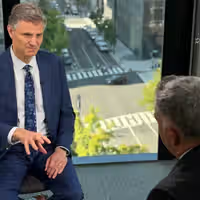
CNN anchor Jim Sciutto weighed in on the issue, noting the frequent use of terms like “moderate” and “reformist” when discussing Iran. He observed that these labels often refer to different shades of the same hardliners.
Today's small collection of "reformists," predominantly consisting of educated individuals from the upper and middle classes, seem to prioritize better economic relations with the global community while refraining from addressing the human rights issues faced by their compatriots. These reformists are not advocating for regime or systemic change. Their efforts are typically limited to what they deem safe, including what they believe will improve Iran's economic outlook.
However, achieving such improvements would necessitate substantial changes in foreign policy and a reduction in domestic oppression—objectives that again fall under the influence of the Supreme Leader, not the President.
Despite the immense risks faced by dissidents, including Bahareh Hedayat—who, while on medical furlough from her jail sentence, condemned the so-called reformists for abandoning the Iranian people during the presidential election and aiding the government in boosting turnout—Western media largely disregarded the voices of the population. Iranians have tirelessly tried for years, and more vocally since 2022, to make it clear to the media that they are not merely disillusioned or apathetic about voting. They fundamentally reject the notion of reform, often viewing those who promote this supposed agenda as traitors.
The illusion of changing women’s rights under the Islamic Republic
As many pointed out, Pezeshkian's presidency is all but certainly not a response to the Iranian people's demands but instead could be a tactical move by the state to facilitate its diplomatic interaction with the West.
According to the Economist, however, Pezeshkian wants “women to have the right to dress as they choose.”
In response to this narrative, Iranians published a video of Pezeshkian bragging about being one of the first to enforce the mandatory hijab onto Iranian women—before it was even made into law after the Islamic revolution.
As the WSJ itself suggested, Pezeshkian being allowed to run at all suggests that the Iranian establishment considered him to be a safe choice.
A “safe choice” in the context of the Supreme Leader’s ideology would imply maintaining the pillars of the Islamic Republic—of which the mandated hijab is a key element. Without mandating the Islamic dress code on women and allowing women freedom like those in the West, the Islamic Republic would no longer exist.
UN Special Rapporteur Javaid Rehman also recently said that due to systemic issues within Iran's judicial system, a change in presidency is unlikely to improve the country's human rights situation.
Some have also pointed out that despite the media's focus on a vague campaign promise from Pezeshkian to "do what he can in support of women's rights," his past statements reveal a different stance.
Pezeshkian, who served as health minister and was involved in covering up the brutal murder and torture of Iranian-Canadian journalist Zahra Kazemi in 2003, also insisted that women in his classes adhere to "proper hijab" as a professor.
He has also previously blamed the regime for failing to make women accept the veil and instead of speaking out against the actual mandatory law of the hijab – has criticized the brutal enforcement of it.
The establishment, however, headed by the Supreme Leader, has shown no indication that the hijab or the many other restrictions that women face will change.
CNN noted that Pezeshkian is taking the “helm” of a country that has “internal discontent” among other issues, while burying much lower the fact that the final say lies with the Supreme Leader.
And while experts say a more moderate face in the presidency could facilitate dialogue between Iran and Western states – primarily alluding to another nuclear deal which could potentially see sanctions lift –
Many Iran observers, basing their assessment on the state’s past behavior, believe it is unlikely that Iran will cease its nefarious and terrorist activities in the region and abroad, which originally led to the imposition of sanctions.
Ahead of the elections, however, Supreme Leader Khamenei condemned those seeking improved relations with the West and Pezeshkian has publicly stated that he would defer to Khamenei on matters of foreign policy, so Zarif’s appointment is far from assured.
Tehran’s nefarious activities and terrorism in the region and abroad will not cease – as indicated by Pezeshkian’s pledge of allegiance to Hezbollah just days into his presidency.
The West, however, will find a more "agreeable" partner in Tehran compared to the mass-murder-embroiled cleric Ebrahim Raisi – should Khamenei decide to make some small concessions to keep the cash flowing for the Islamic Revolutionary Guards.
These concessions for a new nuclear deal will, in all likelihood, fail to benefit the Iranian people or significantly improve the mismanaged economy. Even if inflation marginally drops or living costs stabilize slightly, it will be far from sufficient for the populace to forgive the immense crimes committed by the regime.
The Iranian people have consistently voiced their demands for freedom, justice, and a secular society—not to be abandoned in exchange for minor economic relief under continued Islamist rule. Meanwhile, Western media will undoubtedly continue to cover these potential superficial changes at length, while the true voices and desires of the Iranian people are drowned out once again.