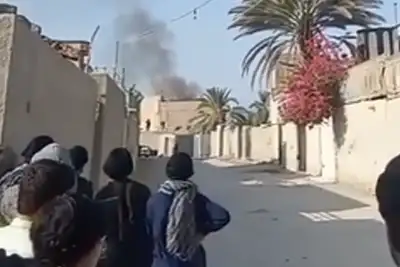
A photo released by the authorities shows a group of detainees. May 17, 2024
Iranian authorities arrested over 260 people, including three Europeans, at what authorities called a "Satanist" gathering near Tehran on Friday, the semi-official Tasnim News Agency reported.
•
The report stated that 146 men and 115 women were arrested, and authorities seized alcohol, banned under the Islamic Republic’s laws, along with psychedelic drugs.
Those detained had “signs and symbols of satanism on their clothes, head, face, and hair,” according to Tasnim which is linked to the Islamic Revolutionary Guards (IRGC).
The media outlet also published photographs showing masks, model skulls, and T-shirts depicting skulls. The report did not specify the nationality of the Europeans, and there is no independent confirmation of the nature of the gathering raided by the police.
The raid comes amid a nationwide crackdownby Iranian authorities on women accused of violating the strict Islamic dress code.
Across Iran, there have been increasing reports of young people being detained for participating in "mixed parties" and refusing to wear hijabs.
As the regime’s “morality police” intensify their operations, many detainees are being whipped with lashes as punishment.
Activists are warning that a Jewish-Iranian man may face execution after an act of self-defense resulted in the death of an Iranian Muslim in the southwestern city of Kermanshah.
Nethanel Ghahremani, in his early 20s, received a Qisas ruling, or “retributive justice,” after allegedly defending himself against a knife attack two years ago.
In Iran's Islamic courts, "Qisas" is the principle of retributive justice under Sharia law, where the punishment matches the severity of the crime, particularly in cases of homicide or bodily harm.
In this case, the victim's family is entitled to seek retribution.
Ben Sabti, an expert on Iranian Jews at the Israeli National Security and Strategy Institute, told Iran International that the Jewish community has repeatedly requested forgiveness from the family but has not been successful.
This news comes against the backdrop of Iran having the highest execution rate worldwide, second only to China.
An Amnesty Internationalreport last month revealed that Iran executed an unprecedented 853 people in 2023, including a significant number of minorities.
Iran trains proxies directly inside its borders through the Imam Ali Unit, as detailed by Iranian state media, exposing a once clandestine wing of the Islamic Revolutionary Guard Corps (IRGC).
The IRGC-linked Tasnim News Agency has published a series of interview articles about the life of Quds Force deputy commander Mohammad-Hadi Haji-Rahimi, who was killed in an apparent Israeli attack on Iran's consulate in Damascus on April 1. The destruction of the building triggered unprecedented aerial attacks on Israel by Tehran.
Tasnim has dubbed Haji-Rahimi the "Commander Without Borders," providing details about his life and crediting him with pioneering certain military tactics.
Haji-Rahimi is introduced as the commander of the Imam Ali Unit, about which little public information is available. Tasnim, however, claims it is the largest unit within the Quds Force.
It is mentioned that Haji-Rahimi played an active role in training militias for Afghanistan, Syria, Iraq, and Lebanon.
“He also went to Afghanistan to set up a training center, which was very successful. When he returned, he looked very muddled due to poor living conditions. However, it did not bother him, as he took all the hardships to fulfill his mission,” an ex-commander reportedly told Tasnim.
“The core of Lebanese Hezbollah forces were trained in Imam Hossein Garrison in Iran,” an ex-Imam Ali Unit commander told Tasnim.
Lebanese Hezbollah, sanctioned by Western governments including the US and regional states like Saudi Arabia, is part of the "Axis of Resistance." This group consists of Tehran-sponsored militias in the region, including Hamas, which attacked Israel on October 7, the Houthis in Yemen, and various Shiite militias in Syria and Iraq.
According to another interview, “Even during the first round of training Iraqi militias in Iran, thousands attended.”
“Martyr Haji-Rahimi had forces everywhere in Syria. The unit under his command was present from Damascus to the front line of the battle in Hama and Aleppo and carried out missions. They were present with the army commanders and gave them military advice,” another commander told Tasnim.
Quds Force Modeled After US Army’s Green Berets
Farzin Nadimi from the Washington Institute notes that the IRGC Quds Force was largely modeled after the US Army’s Green Berets.
“The Green Berets' motto is the Latin 'De Oppresso Liber,' which means to free the oppressed around the world. They were also called soldier-diplomats,” the security and defense analyst told Iran International.
Providing a more complete picture, Nadimi elaborated that, like today's Quds Force, the Cold War-era Green Berets aimed to train, organize, and advise guerrilla wars against communist enemies worldwide, including foreign internal defense, security force assistance, and unconventional warfare.
“Haji-Rahimi was an influential figure in Quds Force; some would argue that he was Qasem Soleimani’s right-hand man. He had a significant role in training and organizing proxy forces,” the analyst specializing in Iran's security and defense affairs explained.
Former IRGC Quds Force commander Qasem Soleimani (middle) and Quds Force deputy commander Mohammad-Hadi Haji-Rahimi
Former IRGC Quds Force commander Soleimani was killed in a US drone strike near Baghdad International Airport in January 2020, under the order of then-President Donald Trump. Washington stated at the time that Soleimani was planning attacks on US diplomats and service members in the region.
Nadimi explained that the Quds Force functions more like an umbrella organization rather than a typical military structure.
"It possesses the skeleton of an organization with units and commanders, but you can't confidently say that it has X number of forces. It could sometimes recruit forces from Basij and the army for specific missions," he said.
Qasem Soleimanidescribed the force in 2018 saying that while “it has a structure, statutes, rules, and regulations” it is “an intellectual system” in reality.
Tasnim’s Portrayal of Haji-Rahimi as a ‘Pioneer’
According to Tasnim's chronicles about Haji-Rahimi, he was a pioneer in airdropping in Iran and Syria.
But, Nadimi debunks that fact.
“Airdropping in Iran started during the Mohammad Reza Shah era when Lockheed C-130 Hercules was introduced to Iranian service in 1962. In the region, including in Syria, the US was the first to initiate dropping aid,” Nadimi said.
As part of the 1991 mission to aid Kurdish refugees in northern Iraq, the US and the international community conducted humanitarian airdrops. In 2014, the US and UK airdropped aid to Yazidis fleeing IS forces on Sinjar Mountain in Iraq. A few months later, supplies were airdropped to Iraqi military forces near the town of Bayji in northern Iraq. Additionally, between 2014 and 2015, the US airdropped tons of weapons and ammunition to Kurdish and other anti-regime troops in northern Syria, according to the Washington Institute.
In response to Tasnim's portrayal of Haji-Rahimi as a pioneer in using drones for artillery spotting, Nadimi expressed skepticism.
Quds Force deputy commander Mohammad-Hadi Haji-Rahimi
“Using drones for artillery spotting is nothing new, but specifically in the Syria region, was it common? It’s hard to say,” Nadimi said.
Even so, this does not qualify as pioneering the tactic, as British forces used drones for reconnaissance and artillery spotting during the Gulf War in 1991.
Timing of Haji-Rahimi’s Profile in Iranian State Media
According to Tasnim, “Haji-Rahimi's name and face were never revealed before,” but they are being publicized now to “analyze the various aspects of the personality and management of this ‘great’ commander.”
Experts say the decision to reveal details about a previously clandestine wing of the IRGC aligns with a recent shift in the commanders' approach, marked by more public warnings and boastful statements.
Initially, the strategy to keep details about IRGC officials secret was designed to protect officers and help them evade responsibility. However, this recent shift appears to be part of a broader communication tactic.
In a sign of this change, IRGC commanders have recently intensified their direct threats to Western nations and leveraged the US position to their advantage.
Esmail Qaani, the commander of Iran's Quds Force, issued a threat on Wednesday against France, Germany, and the UK for supporting Israel to intercept Iranian missiles and drones.
“The American president, who is devoted to defending the Zionist regime, officially announced to the Israelis, ‘I will not enter the conflict,’” Qaani said. He urged regional leaders "who rely on America" to be "more sensible." "Will America defend them more than the Zionist regime?"
Prominent conservative politician Mohammad Reza Bahonar says that government funds are scarce and oil sales alone cannot meet the country’s basic needs, adding to the recent criticism of President Ebrahim Raisi's economic policies.
On Thursday,Bahonar, a member of the influential Expediency Council, an advisory body to the Supreme Leader, highlighted the country's severe deficits in energy, government budgets, and banking systems. He also stressed the "untapped economic potential."
"The government does not have money to invest, and the oil market does not provide enough for our basic needs," he said. “Gone are the days when governments could sell oil and develop the country.”
Bahonar is the latest politician to express concern about the economy while decrying Raisi's economic policies.
Last week, Iran's top clericsvoiced concern about high inflation and fluctuating exchange rates, blaming the government for these issues. This week, the parliamentseemingly voted for a two-day work week, with the apparent hope that it could aid some of the country’s economic struggles.
The Raisi administration and its hard-line policies have traditionally been supported by conservative figures, who are now voicing concerns about inflation. Iran's Central Bank reported 52.3% inflation for 2023 last month, while gasoline continues to be in short supply.
While President Raisi and his predecessors have often been blamed for the country’s current economic woes, it is the Islamic Republic’s Supreme Leader, Ali Khamenei, who is the top decision maker for domestic and foreign policy.
Khamenei’s leadership and legitimacy are heavily tied to the Islamic Revolutionary Guards’ (IRGC) – whose control over the Iranian economy extend across virtually every sector of the Iranian market.
Yemen's Iran-aligned Houthis said they downed a US MQ9 drone on Thursday evening over the southeastern province of Maareb, the group's military spokesman said on Friday.
The Houthis said that they had targeted the drone using a locally made surface to air missile.
The US military has not issued any statement confirming or denying the Houthi claim at the time of this publication. In February, another US military drone crashed in Yemen, that later officials said it appeared to have been shot down.
Houthis are armed with Iranian weaponry, including anti-air missiles. Some observers claimed on social media that on Thursday Houthis used an Iranian model 358 anti-drone missile.
The United States and Britain have targeted Houthi military installations numerous times in recent month, after the Iranian backed group began targeting commercial vessels in the Red Sea from mid-November.
Iranian authorities have implemented drone surveillance on Kish Island in the south to enforce the country’s mandatory hijab laws, as shown in a video released by Iranian media.
The footage shows law enforcement agents confront and stop women in public areas, escalating the enforcement of compulsory hijab.
The news of the surveillance has sparked significant backlash on social media, with many users condemning the government's tactics.
Critics have drawn parallels between the use of Iranian drones for military purposes in Ukraine and against Israel – and, their current domestic use against women now for the enforcement of dress codes.
The enforcement of the hijab is part of a broader initiative dubbed the Noor plan, at the directive of the Supreme Leader, which Iranian police claim responds to "national and public demand" for stricter adherence to hijab.
The physical presence of the "morality police” has intensified, particularly in Tehran’s central districts, following a period of reduction after the death of Mahsa Jina Amini in 2022. Amini's death in “morality police” custody, which resulted from severe head injuries, ignited the most substantial protests against the regime since the establishment of the Islamic Republic in 1979.
The resurgence of strict enforcementoccurs as the controversial "Hijab and Chastity Culture" bill lingers in legislative proceedings.
Although awaiting final approval, authorities have already started to implement its strict regulations. Women are increasingly threatened with severe punishments, including arrest and travel bans, for non-compliance with the mandatory hijab.
The bill initially passed the Iranian parliament in September 2023 but was sent back for further review by the Guardian Council, the ultimate legislative authority in Iran, signaling ongoing contention and enforcement challenges within the country.