Iran To Mark Attack On Israel As 'National Remembrance Day'

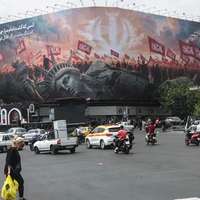
Iran's government plans to mark the day of the Revolutionary Guard’s missile and drone attacks against Israel in the Iranian calendar as a national "Remembrance Day."

Iran's government plans to mark the day of the Revolutionary Guard’s missile and drone attacks against Israel in the Iranian calendar as a national "Remembrance Day."
The minister of culture, Mohammad Mehdi Esmaeili, announced the news on Tuesday as the government desperately tries to turn the failed operation into a success story.
During the unprecedented military assault on April 13, Iran launched over 350 missiles and drones at Israel in retaliation for what Tehran claims was an Israeli airstrike on its consulate in Damascus, which allegedly killed a senior Quds Force commander and several officers.
Despite the majority of the projectiles being intercepted by Israeli air defenses and a US-led coalition, Iranian government and military officials have consistently described the April 13 attack as a success. They claim it demonstrates Iran's military capability and deterrence.
The move is part of broader efforts by Iranian authorities to use state-controlled media to shape public perception, focusing on their portrayal of military actions as victorious without acknowledging any operational or diplomatic setbacks.
Esmaili had previously said that the day of Iran-backed Hamas' attack on Israel. October 7, the trigger for the current Gaza war, will be recorded in the Iranian calendar as "The Day of the Epic of Palestinian Youth."

The Iranian Writers' Association (IWA) has called for the unconditional release of all imprisoned workers and labor activists on the eve of International Workers' Day, May 1st.
The statement released Tuesday noted that over 1,600 strikes and protests occurred last year, emphasizing that "such a large number of demonstrations shows both the extent of the looting of the labor force and the rampage by those in power."
IWA expressed concern that "bread, housing, meat, clothing, and fruit are not the only things that are disappearing from people's tables and becoming a dream of their minds, but their culture is disappearing as well, including education, books, cinema, theater, and music... Every day is Workers’ Day in Iran,” the statement read.
International Workers' Day commemorates the concerted protests of American workers on May 1, 1886, when they called for a nationwide strike for the first time, demanding an eight-hour workday instead of a fourteen-hour workday.
Many countries worldwide observe this day by holding street demonstrations organized by trade unions.
In Iran, unlike many countries, May 1st is not an official holiday.
Even though Iran's constitution appears to allow the formation of independent trade union organizations of workers, the Labor Law lists specific organizations that workers may only join, like the Islamic Labor Council. In essence, it has denied workers the right to form independent and free unions.
Nevertheless, several calls were made on Tuesday for nationwide strikes and protests, including from student organizations, women's groups, and youth groups under the collective name of “the national network women's revolution, life, freedom."
In this appeal, the general public was asked to participate in a strike on May 1 in protest of "the death sentence of dissident rapper Toomaj Salehi, the new hijab and chastity plan, and the poverty and misery that has been imposed on society."
Majid Mohammadi, a sociologist and political analyst, described these calls as "a low-cost way to protest" in an interview with Iran International.
According to him, the wider the strikes, “the slower the government blade will be.”
The latest strike in the country began two days ago when truck owners across Iran started a strike in protest of the reduction of fares and fuel quotas.
Iranian truck owners have engaged in similar strikes in recent years due to fuel shortages, rampant inflation, and the devaluation of the Iranian currency.
Iran has experienced no economic growth for more than a decade. In 2018, the US withdrew from the JCPOA nuclear deal, further aggravating the situation. During the past six years, Iran's national currency, the rial, has fallen 15-fold, resulting in inflation and poverty for millions of Iranians.

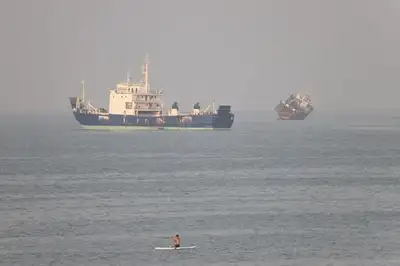
The deputy director of Iran's Ports and Maritime Organization announced that the crew of the seized Portuguese-flagged container ship MSC Aries is "in perfect health."
The ship, linked to an Israeli-owned company, was intercepted by the Revolutionary Guard in the Strait of Hormuz on April 13 amidst heightened tensions with Israel.
Ali Akbar Marzban claimed, "all 24 crew members of the ship are in perfect health, and there is no concern regarding their health, hygiene, welfare, and safety." One female crew member from India, initially part of the crew, has been allowed to return home.
On Saturday, Iran’s Foreign Minister Hossein Amir-Abdollahian told his Portuguese counterpart, Paulo Rangel, that consular access has been granted and the crew is expected to be released soon and turned over to their ambassadors in Tehran.
The IRGC claims the MSC Aries was violating maritime laws and maintains its seizure was due to the vessel's associations with the country's archenemy, Israel. The ship is reportedly leased by MSC from Gortal Shipping, connected to Zodiac Maritime, which is partly owned by Israeli businessman Eyal Ofer.
The seizure coincided with an escalation in regional tensions, occurring on the same day Iran executed its first direct assault on Israel, and following a suspected Israeli airstrike in Damascus at the beginning of April.
The incident comes alongside the Iran-backed Houthis' Red Sea blockade which began in November in efforts to force a ceasefire on Israel amid the Gaza war, launched by Iran-backed Hamas on October 7.
Since then, in the wake of Israel's relentless bombardment in a bid to quash Hamas and release the remaining 133 hostages still held in Gaza, the Houthi militia, under the command of Iran's supreme leader, has implemented a blockade begun on Israel ships, but since extended to global shipping.
In November, the Galaxy Leader was the first ship to be taken hostage by the Houthis, who are still holding 25 crew hostage hailing from all over the world.

A regime insider once hailed as Iran's richest man, Babak Zanjani, who was previously sentenced to death for corruption, is getting ready to walk free.
But, who is Babak Zanjani?
As the founder of the largest enterprise in Iran's contemporary history, Zanjani was involved in many business ventures. From transport services to construction, from owning football clubs to selling oil, he has become a tycoon both within Iran and abroad.

During ultra-hardliner populist Mahmoud Ahmadinejad's presidency in the early 2010s, he was tasked with exporting oil to evade international sanctions.
Once hailed as Iran's richest man, he called himself the soldier of the Islamic revolution working on the economic front to facilitate the country's escape from crippling sanctions.
What was the source of his wealth?
Zanjani was a middleman who sold Iranian oil through companies mainly affiliated with the Islamic Revolution Guards Corps (IRGC), helping it boost its influence in Iran’s politics far beyond its military remit.
Amid international sanctions, the ultraconservative President Mahmoud Ahmadinejad allowed the private sector to sell oil internationally; to that end, Zanjani and other individuals set up elaborate networks and laundered money around the globe, including in Turkey, the United Arab Emirates, Indonesia, and Central Asia, aided by a mystery team.
The former tycoon once valued himself at approximately $13.5 billion, a staggering amount in a country where the majority of the economy is owned by the state. Today, one third of Iran’s population is living below the poverty line.
How did he get into trouble?
By evading the sanctions, Zanjani was subject to international penalties, including those from the European Union in December 2012 and the United States in April 2013.
However, the punishments were not only international but also domestic.
When Hassan Rouhani was elected president after Ahmadinejad’s second term (2009-2013), Zanjani was arrested and convicted. According to the new government's Ministry of Oil, Zanjani owed them $1.9 billion in oil revenues.

The shifting political environment in Iran transformed Zanjani into a figure facing legal scrutiny and international sanctions, forcing him into a highly publicized legal battle.
He was subsequently sentenced to death in 2016, but following an appeal for clemency, the penalty was reduced instead to 20 years behind bars on Tuesday.
Could he now walk free?
He has always denied all the allegations of corruption and has pledged to repay all the money he owes if he is released from prison and allowed access to his business network.
The judiciary on Tuesday said the reason behind his reduced sentence was that he “cooperated” and that “his properties abroad were identified and confirmed by experts."
According to Rasul Kohpayehzadeh, Babak Zanjani's attorney, given that more than 10 years have passed since his prison term, his client may be eligible for parole, and “his prison term could be over.”

The International Atomic Energy Agency (IAEA) has confirmed that its Director-General, Rafael Grossi, will travel to Iran on May 6 to engage with high-ranking officials.
He will attend the International Conference on Nuclear Science and Technology during the visit, taking place in Isfahan, just months after officials in Iran claimed to be within reach of nuclear weapons. Grossi just days ago also claimed Iran was “weeks not months” from a nuclear weapon.
Im February Grossi admitted a "drifting apart" in relations between the agency and an increasingly defiant Iran.
Grossi noted in the same month that although the rate of uranium enrichment in Iran had decreased slightly since the previous year's end, Iran continued to enrich uranium at a significant rate of approximately 7 kg per month to 60 percent purity, near weapons grade.
Under the terms of a 2015 agreement with world powers, Iran was only permitted to enrich uranium up to 3.67 percent.
However, after former President Donald Trump withdrew the United States from the agreement in 2018 and reinstated sanctions, Iran exceeded the limits. As a result, the IAEA has stated that the 2015 nuclear deal has "all but disintegrated".

The medical community in Iran has been shaken by another suicide as physician Zahra Maleki Ghorbani reportedly took her own life amid a growing trend.
Social media posts prior to her death showcased her objections to the dire working conditions at her hospital, hers the latest case among many amid Iran’s medical crisis.
The event adds to a rising trend among medical professionals in the country committing suicide, or being found dead under suspicious circumstances.
Just days ago, Samira Al-e-Saeedi, a rheumatology specialist and professor at the University of Tehran, took her own life.
Colleague Mehdi Abdous shared on social platform X that Al-e-Saeedi had discussed her plans for suicide with peers the day before she acted on them. Abdous noted the exceptionally high levels of stress and tension doctors face compared to other professions.
The suicide of Parastoo Bakhshi, a 34-year-old cardiovascular specialist, at Noorabad Delfan Hospital in Lorestan Province, also underlined the ongoing issue.
Found by hospital staff in the dormitory, her death has been linked to "excessive workplace pressure," according to the Medical Council of Iran.
Reports reveal a 200% increase in doctors applying for immigration compared to five years ago as professionals flee to better working and living conditions amid Iran’s economic and social crisis.
The Iranian Psychiatric Scientific Association has highlighted an increase in suicides among medical professionals, noting that 16 medical residents took their own lives last year alone.