IRGC Naval Commander Threatens More Oil Tanker Seizures
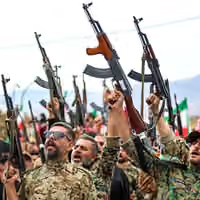
Alireza Tangsiri, the commander of Iran’s Revolutionary Guards naval forces
The commander of Iran’s Revolutionary Guards naval forces has again warned that Iran will seize oil tankers in case of any further seizures of Iranian oil vessels in the context of ongoing US sanctions.
During a speech at the National Day of the Persian Gulf ceremony, asserted, "The time when they could seize our oil tankers has passed," indicating that Iran would retaliate against such actions. "Our enemies know that if they take an oil tanker from us, we will retaliate. They took our oil tanker, and in response, we seized one of theirs, forcing them to release it," he added.
•
Alireza Tangsiri
The Iranian Navy seized an oil tanker in the Sea of Oman in January. The regime said the act was a retaliation against the previous seizure of a large cargo of Iranian crude oil by the US government in 2023, involving the same vessel now recaptured by Iran.
According to the Iranian Navy, the operation was conducted under a court order with the approval of the Ports and Shipping Organization, framed as a response to "oil theft" by the United States.
The vessel, previously known as Suez Rajan, was seized by the US last April while carrying 977,000 barrels of sanctioned Iranian crude oil.
To secure its release, the owner paid a fine of $2.46 million after lengthy legal proceedings. The previously seized Iranian crude oil was sold off by the US for $83.4 million after deductions for substantial logistical costs.
Babak Zanjani, an Iranian oil sales intermediary who was previously sentenced to death for embezzling billions in oil revenue, will instead now serve a 20-year prison sentence.
The judiciary said a clemency request was approved by both the judiciary chief and the Supreme Leader.
Zanjani, known for his vast wealth and deep ties within the regime, was originally tasked with circumventing international sanctions to export Iranian oil during Mahmoud Ahmadinejad's presidency.
Despite his efforts, he failed to repay approximately $3 billion, leading to his arrest in 2013 after Hassan Rouhani took office. The intricacies of his operations suggest that he had significant insider support, yet his accomplices within the government remain unidentified.
After more than a decade in prison, the Iranian judiciary claims Zanjani's cooperation with authorities and the successful identification and repatriation of his foreign assets were key factors in his sentence being commuted.
His assets abroad, initially withheld, were estimated to be worth between $4 to $5 billion. Following their sale, about $2 billion was deposited into Iran's central bank.
Zanjani, who once claimed a net worth of $13.5 billion, had built an empire spanning numerous industries including hospitality, aviation, and real estate. His business activities involved an elaborate network of black-market dealers and money launderers across the UAE, Turkey, and Malaysia, enabling him to transfer $17 billion from oil sales back to Iran by 2013.
This high-profile case has been closely linked to various economic scandals and has seen Zanjani face international sanctions, including those from the European Union in December 2012 and the United States in April 2013.
Islamic scholar Sedigheh Vasmaghi was released from Tehran’s notorious Evin Prison on Monday after having since lost her sight and suffered life-threatening heart issues.
Vasmaghi's health deteriorated during her imprisonment, prompting her release after being arrested in March for criticizing Supreme Leader Ali Khamenei, labeling him a dictator, and condemning the compulsory hijab laws.
Prior to her release this week, Vasmaghi penned a letter to the United Nations Fact-Finding Mission and various international human rights organizations detailing the abuses she endured personally, and the broader systemic oppression enforced by Iran, particularly targeting women.
In her appeal, Vasmaghi stressed the need to free Iranian women from the country's oppressive hijab laws. "The result of my research on women's clothing is that religious women are not required to cover their hair under Islamic Sharia and some independent researchers in the field of religion have come to the same conclusion," she stated in the letter.
“Many Iranian women have been against the mandatory hijab law for decades, and I have removed my headscarf in opposition to this law and to protest against the oppression of women and their dignity.”
The mandatory hijab has been a central issue in the Women, Life, Freedom movement ignited by the death of Mahsa Amini, who died in the custody of Iran’s morality police in 2022, mass rebellion against the laws imposed since the founding of the Islamic Republic in 1979.
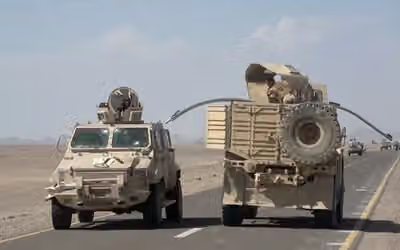
Iran-backed Houthis said they launched three separate attacks in the Red Sea and the Indian Ocean Monday, including on two US warships, in what seems to be a clear uptick in the group’s operations.
The Yemen militants have targeted dozens of vessels since November in support of Palestinians in Gaza. The attacks had subsided for a few weeks following US and UK strikes against Houthi interests inside Yemen. But the calm ended last week with an attack against a British oil tanker.
And on Monday, there were yet more attacks: on two commercial vessels and two US warships, as confirmed by the US military.
“At 7:49 a.m., US Central Command (USCENTCOM) forces successfully engaged and destroyed one Houthi launched airborne unmanned aerial vehicle (UAV) on a flight path towards USS Philippine Sea and USS Laboon in the Red Sea. There were no injuries or damages reported by US, coalition, or merchant vessels,” CENTCOM posted on X.
The Houthis also targeted MV Cyclades, a Malta-flagged, Greece-owned vessel. There were no injuries, according to CENTCOM. They also attacked the container ship MSC Orion container in the Indian Ocean, Orion is owned by Zodiac Maritime, which is partly owned by an Israeli businessman called Eyal Ofer.
The Houthis’ military spokesman, Yahya Saree, delivered a televised statement early hours of Tuesday local time, claiming responsibility and “success” for all the above operations.
“The Yemeni Armed Forces… continue to carry out their military operations in support of the oppressed Palestinian people and in defense of dear Yemen,” Sarea said. “These operations will not stop until the lifting of the siege and cessation of aggression against the Palestinian people in Gaza Strip.”
With their Iranian drones and missiles, the Houthis have managed to disrupt maritime trade, forcing shipping giants to take much longer and much costlier routes around the southern tip of Africa.
It remains unclear whether the resumption of attacks last week –and now its escalation– is related to the heightened tensions between Iran and Israel. There are suggestions that Israel would in the very near future invade Rafah in southern Gaza and strike deep into Lebanon. The Houthis’ recent attacks could be an attempt to distract Israel from those operations, both of which could end up being costly for Iran.
The Houthis have expanded their area of operation since March, venturing east from the Red Sea and Gulf of Aden to towards the Indian ocean to attempt to block vessels headed for Israel from passing through the Ocean toward the Cape of Good Hope.
To deal with the disruption and neutralize the Houthi threat, the US (alongside the UK) have carried out several attacks on Houthi targets inside Yemen. In response, the Houthis have declared that they will attack any vessel that they believe is linked to the US and UK.
It remains to be seen if (and how) the ongoing conflict between Iran and Israel would influence Houthi operations. Iranian officials have always maintained that the Houthis make their own decisions. It is beyond doubt, however, that Houthis are more than happy to make such decisions as would help their main sponsor, whenever required.
The Iranian government's ongoing crackdown against non-governmental charitable organizations has struck another blow, resulting in the closure of the Mehre Shams Afarid NGO safe house.
The NGO, vital for supporting and empowering vulnerable women, which strives to mitigate social and familial challenges faced by women and children in Iran's West Azarbaijan Province in Urmia, has become the latest victim of the government's clampdown.
This closure, reminiscent of previous shutdowns of NGOs in Iran, such as Imam Ali's Popular Student Relief Society (IAPSRS), Khaneh Khorshid, and Omid-e-Mehr Foundation reflects a disconcerting trend of governmental interference in independent charitable initiatives.
Fatemeh Babakhani, the CEO of the NGO, announced the closure on Sunday, April 28, via X platform, lamenting, "The shelter dearer than our lives, Mehre Shams Afarid non-governmental safe house, was closed in the worst possible way!".
In an earlier interview with Shargh newspaper in Tehran on Saturday, Babakhani warned of the State Welfare Organization of Iran (SWO) of West Azarbaijan Province’s attempts to close Mehre Shams Afarid. The closure comes following a tense meeting on Saturday, which Babakhani described as "resembling an interrogation," during which SWO officers scrutinized the organization's financial sources. Simultaneously, SWO’s Social Emergency Services intervened at the NGO’s safe house, relocating all the women to Social Emergency facilities, likened to "a cage" without issuing any formal verdict or written order, she added.
A view from the interior of the safe house
While the SWO officers cited financial inadequacy as the reason for closure, Babakhani refuted these claims, asserting that it was part of a broader pattern of pressure against the organization. "These words are excuses. The general director of the SWO of the province [West Azarbaijan] had threatened to close down the NGO and the safe house," Babakhani refuted.
In addition, she disclosed that the director-general had exerted pressure on her, explicitly stating, "You don't have good hijab, you are a dissident, and you have acted against Sharia customs and against the regime on social media. One of the issues raised was why you used the hashtag 'Woman, Life, Freedom' on your Instagram."
The closure of Mehre Shams Afarid is not an isolated incident.
In 2020, Iranian security forces arrested Sharmin Meymandinejad, the founder and director of the largest anti-poverty NGO in the country, Imam Ali's Popular Student Relief Society (IAPSRS), and subsequently closed down its headquarters.
Meymandinejad and two of his colleagues, Morteza Kaymanesh and Katayoun Afrazeh were arrested by the Islamic Revolutionary Guard Corps (IRGC) Intelligence Organization on 21 June 2020 on charges of "insulting" the founder of the Islamic Republic, Ruhollah Khomeini, and the Supreme Leader, Ali Khamenei, as well as "acting against national security."
Subsequently, Branch 28 of the Tehran Appeals Court has upheld the ruling to dissolve the IAPSRS, a motion that was brought against them by Iran’s Ministry of Interior. The Ministry of Interior had accused the NGO of "issuing political statements during the country's critical situation and vilification, anti-religious activities and lack of financial transparency".
A year after the closure of IAPSRS, the Khaneh Khorshid, an NGO supporting women in Southern Tehran, Iran with substance abuse issues was closedin March 2022 following pressures from the Iranian authorities.
Leili Arshad and Sarvar Monshizadeh, the founders of Khaneh Khorshid announced that they were facing pressures from the Iranian government and were subsequently forced to stop their activities. In an interview with Hamshahri, Arshad said:
"They don’t want NGOs to be as active as they were before."
Similarly, in August 2019, another independent charity supporting marginalized women and girls in Tehran, Omid-e-Mehr was forcibly closed by the Iranian authorities.
Moreoever, in August 2022, another NGO supporting women with substance abuse issues and vulnerable children in Shoush, a neighborhood in southern Tehran, The Noor Sepid Hedayat, Social Harm Reduction Institute announced its closure. Without providing details, the director of Noor Sepid, Sepideh Alizadeh announced in an Instagram post, that “the operation of this center was handed over” and that the service “will be provided by another operator,”.
Amidst the Iranian government's ongoing crackdown on non-governmental organizations, the closure of these entities highlights the diminishing room for independent civil society initiatives in Iran. This trend ultimately leaves the most marginalized members of society, especially women, without the essential support they require.
German airline Lufthansa has announced the extension of its flight cancellations to Tehran until May 9, citing ongoing security concerns.
The decision follows an initial suspension of services to and from Tehran amid fears of potential military escalation in the region.
The airline's move comes in response to heightened tensions following an Israeli attack on Iran on April 19, which prompted several airlines to alter their flight routes. Some flights were canceled, others were diverted to alternate airports, and a few returned to their departure points due to temporary airspace and airport closures.
The situation escalated when explosions were reported in Isfahan, in what sources described as an Israeli attack. However, Tehran downplayed the incident and signaled no intent for retaliation.
Israel had vowed to retaliate following the April 13 strikes, marking the first direct attack by Iran on Israeli territory. The assault had no fatalities as Israel and its allies successfully intercepted hundreds of missiles and drones.
Lufthansa and its subsidiary, Austrian Airlines, are notably the only Western airlines that operate flights to Tehran, which is predominantly serviced by Turkish and other Middle Eastern carriers.
The airspace over Iran is also crucial for flights operated by Emirates and Qatar Airways traveling to Europe and North America.