• العربية
  • فارسی
Brand
  • Iran Insight
  • Politics
  • Economy
  • Analysis
  • Special Report
  • Opinion
  • Podcast
  • Iran Insight
  • Politics
  • Economy
  • Analysis
  • Special Report
  • Opinion
  • Podcast
  • Theme
  • Language
    • العربية
    • فارسی
  • Iran Insight
  • Politics
  • Economy
  • Analysis
  • Special Report
  • Opinion
  • Podcast
All rights reserved for Volant Media UK Limited
volant media logo

Calm In Iraq And Syria May Be Nearing Its End

Iran International Newsroom
Apr 22, 2024, 10:25 GMT+1Updated: 17:06 GMT+0
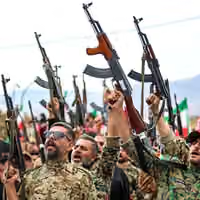
A member of Hashd al-Shaabi (paramilitary forces) holds a flag of Kataib Hezbollah militia group during a protest to condemn air strikes on their bases, outside the main gate of the US Embassy in Baghdad, Iraq December 31, 2019.

Conflicting reports from sources affiliated with Iran and its proxies have raised questions about their intentions, as a US base in Syria was targeted on Sunday for the first time in more than two months.

On January 30, following several months of sustained attacks against American troops in Iraq and Syria, the Shiite militia group Kataeb Hezbollah announced they would halt their strikes to “prevent embarrassment of the Iraqi government.” That announcement came after large US retaliatory air strikes targeting Iranian proxy forces in the region.

Sunday's attack was reportedly followed by at least one armed drone launched at the Ain al-Asad air base that hosting US troops in the western Iraqi province of Anbar, a US official told Reuters on Monday.

That January statement about halting attacks had withstood the test of time until Sunday night when five rockets were launched from Iraq's town of Zummar towards a US military base in northeastern Syria.

Shortly after the attack, a post appeared on the Telegram group affiliated with Kataeb Hezbollah, seemingly alluding to Sunday night’s rocket attacks, and stating that the armed groups’ in Iraq had decided to resume attacks because they felt the Iraqi government had failed to deliver a deal to end the US military presence in the country.

“Iraqi resistance gave Iraq’s prime minister three months to negotiate with the American forces to come up with a specific timetable for their removal from Iraq,” the post on the Kataeb-affiliated Telegram channel. “But now… It’s become clear that some political parties were lying: there is no foreign intention to leave Iraq.” Hence the decision “to resume military action.”

The “military action” (and the Telegram statement) came only one day after Iraq’s prime minister Mohammad Shia al-Sudani returned from Washington, where he had met President Joe Biden and other US officials to advance the plans for the Americans’ withdrawal from Iraq.

Not long after, Sabereen News, another popular Telegram group affiliated by Iran and its proxies, issued a statement denying that Kataeb Hezbollah had released a statement. Another Iran-affiliated outlet, Al Mayadeen, seconded the denial.

“The news attributed to the Islamic Resistance in Iraq regarding the resumption of its operations against US forces is false,” Al Mayadeen quoted its Baghdad correspondent. ”Iraqi Kataib Hezbollah Brigades has not issued any statement regarding this matter.” In another statement issued on the Telegram messaging app, the group said the resumption of attacks is "fabricated news".

It’s hard to tell with certainty which statement is true. Perhaps both. The difference could be intentional to create confusion, or it could be a sign of real clash within the groups’ rank and file.

Iran may also have a hand in all this: nudging its proxies to resume attacks on American forces in Iraq and Syria in order to pressure President Biden to dissuade the Israeli government from targeting Iran-backed militias in Syria and Iraq.

On Saturday –less than a day after the Israeli airstrike against Iran’s S-300 defense system near Isfahan– another round of airstrikes hit the headquarters and a major base of Iran-backed militias Hashd al-Shaabi (Popular Mobilization Forces) in Babylon, south of Baghdad.

No one claimed responsibility for the overnight attack on Hashd al-Shaabi US military rejected claims that it had a part in the operation. Citing an unnamed Israeli official, CNN reported that Israel also denied involvement in the incident.

Not enough is known about the incident to help draw definite conclusions about its source. One thing can be said with a reasonable degree of certainty, however: that “a vast network of hybrid warfare is currently underway between Israel and Iran and its proxies in the region,” according to UAE-based analyst Masoud Aflak.

Updated at 15:00 GMT, April 22

Most Viewed

Iran negotiators ordered to return after internal rift over Islamabad talks
1
EXCLUSIVE

Iran negotiators ordered to return after internal rift over Islamabad talks

2
ANALYSIS

US blockade enters murky phase as tankers spoof signals and buyers hesitate

3
ANALYSIS

Why the $100 billion Hormuz toll revenue is a myth

4

US tightens financial squeeze on Iran, warns banks over oil money flows

5
ANALYSIS

US blockade targets Iran oil boom amid regional disruption

Banner
Banner

Spotlight

  • Hardliners push Hormuz ‘red line’ as US blockade tests Iran’s leverage
    INSIGHT

    Hardliners push Hormuz ‘red line’ as US blockade tests Iran’s leverage

  • Ideology may be fading in Iran, but not in Kashmir's ‘Mini Iran'
    INSIGHT

    Ideology may be fading in Iran, but not in Kashmir's ‘Mini Iran'

  • War damage amounts to $3,000 per Iranian, with blockade set to add to losses
    INSIGHT

    War damage amounts to $3,000 per Iranian, with blockade set to add to losses

  • Why the $100 billion Hormuz toll revenue is a myth
    ANALYSIS

    Why the $100 billion Hormuz toll revenue is a myth

  • US blockade targets Iran oil boom amid regional disruption
    ANALYSIS

    US blockade targets Iran oil boom amid regional disruption

  • Iran's digital economy battered by prolonged blackout
    INSIGHT

    Iran's digital economy battered by prolonged blackout

•
•
•

More Stories

Food Prices Soar In Iran Amid Rial Devaluation And Israel Tensions

Apr 22, 2024, 09:09 GMT+1
•
Iran International Newsroom

Iran is grappling with soaring food prices amidst economic turmoil and the devaluation of the rial compounded by Iran-Israel tensions.

According to reports from Iran's state-run Khorasan newspaper, the cost of essential food items has skyrocketed since the beginning of the Iranian New Year in March 2024, coinciding with the month of Ramadan. Beans have seen a staggering 30% increase in price, while red meat prices have surged by 25%. Additionally, summer foods have seen a remarkable 50% hike, with rice and several other items following suit with increases ranging from 10% to 15%.

Earlier in April, in an interview with so-called reformist news site Entekhab, Reza Kangari, the head of the Tehran Provincial Union of Food Banks, also highlighted the recent significant rise in food prices. Kangari stated that “some food items have seen a 30% rise" and attributed the rise to the depreciation of the rial, supply shortages, and subsequent price gouging.

The root cause of this alarming price surge lies in Iran's faltering economy, exacerbated by the continuous devaluation of the Iranian rial. The rial has continuously fallen since the inception of the Islamic Republic in 1979, but it turned into a steep fall in 2018 when the United States withdrew from the JCPOA nuclear deal, demanding its revision. Oil export sanctions and international banking restrictions imposed by the Trump administration badly hurt Iran’s oil-dependent economy.

The Iranian rial has witnessed a sharp decline, losing over 30% of its value against major currencies since the onset of January this year. Additionally, following Iran's military and drone attack on Israel on April 13, the rial experienced an unprecedented downfall, with the dollar surpassing the 700,000-rial threshold.

Furthermore, Iran's economy has been besieged by a prolonged period of high inflation, with rates surpassing 40% for the past five years. Additionally, Iran's substantial state debt and liquidity challenges contributed to the devaluation of the rial. This devaluation has had a cascading effect on the prices of essential food items. Since President Ebrahim Raisi assumed office in August 2021, Iran's liquidity has almost doubled, fueling rampant inflation that surged to 47% in the last fiscal year.

Despite the government's recent announcement of being committed to addressing the issue of food security, the relentless upward trajectory of food prices has only served to compound the economic woes faced by ordinary Iranians, pushing many further into financial precarity.

In the lead-up to Norouz, Iranian New Year on 20 March, according to messages received by Iran International Iranians lamented a sharp decline in their purchasing power, with essentials like rice, red meat, and dairy vanishing from household budgets.

While external factors such as US sanctions undoubtedly play a significant role in Iran's economic challenges, domestic policies and priorities also come under scrutiny.

For instance, sanctions resulted in a significant decrease in Iran-India trade, plummeting by as much as a third. Rice, which constitutes the primary export from India to Iran, saw a sharp decline of 34%, falling from $2 billion in 2022 to $723 million in 2023.

The consistent reluctance of Iran's leadership, Supreme Leader Ayatollah Ali Khamenei, to address fundamental problems such as the nuclear issue has exacerbated the country's economic isolation and hindered efforts to alleviate the plight of its citizens.

As economic woes deepen with soaring food prices, Iranian citizens face dwindling options and rising prices, painting a bleak picture ahead.


Rockets Fired From Iraq At US Military Base In Syria, Sources say

Apr 22, 2024, 01:00 GMT+1
•
Iran International Newsroom

At least five rockets were launched from Iraq's town of Zummar towards a US military base in northeastern Syria on Sunday, two Iraqi security sources told Reuters.

The attack against US forces is the first since early February when Iranian-backed groups in Iraq stopped their attacks against US troops.

The attack comes one day after Iraqi Prime Minister Mohammed Shia al-Sudani returned from a visit to the United States and met with President Joe Biden at the White House.

Two security sources and a senior army officer said a rocket launcher fixed on the back of a small truck had been parked in Zummar border town with Syria.

The military official said the truck caught fire with an explosion from unfired rockets at the same time as warplanes were in the sky.

"We can't confirm that the truck was bombed by US warplanes unless we investigate it," said a military official on condition of anonymity because of the sensitivity of the incident.

Iraqi security forces were deployed in the area and launched a hunt for the perpetrators who fled the area using another vehicle, said a security official who is based in the town of Zummar.

The Iraqi Security Medica Cell, an official body responsible for disseminating security information, said in a statement that Iraqi forces had launched "a wide-ranging search and inspection operation" targeting the perpetrators near the Syrian border, pledging to bring them to justice.

An army officer said the truck was seized for further investigation and initial investigation shows that it was destroyed by an air strike.

"We are communicating with the coalition forces in Iraq to share information on this attack," the officer added.

A day earlier an apparent air strike hit a base of the pro-Iran Hashd al-Shaabi armed militia group causing major explosion.

Iran's Leader Downplays Missile Accuracy In Strikes On Israel

Apr 21, 2024, 21:13 GMT+1

Iran's Supreme Leader Ali Khamenei says the low success rate of missiles launched at Israel in the April 13 attacks is a "secondary issue," downplayingthe failure of the attack.

In a meeting with high-ranking military commanders on Sunday, he discussed the recent military clashes between Iran and Israel, making his first public remarks since the escalation of hostilities.

During his speech, Khamenei referred to the large-scale attack by the Revolutionary Guards, in which the Guards fired 185 drones, 36 cruise missiles, and 110 ground-to-ground basilic missiles at a military base in southern Israel. Despite the extensive assault, Israeli officials have reported only limited damage, claiming that 99 percent of the projectiles were intercepted.

"The issue of the number of missiles fired or that hit the target, which the other side is focused on, is a secondary matter. The main issue is the demonstration of the will of the Iranian nation and the armed forces on the international stage," Khamenei stated. His remarks can be seen as an implicit admission of the limited effectiveness of the strikes.

According to the Iranian regime, the April 13 assault was in retaliation for an attack on Iran's consulate in Damascus, an act for which Israel has not claimed responsibility. After Iran’s attack, Israel targeted the radar system and the S-300 air defense system at the Eighth Shekari Air Base in Isfahan on Friday, as confirmed by satellite images.

In his address, Khamenei also highlighted the need for innovation in military tactics and weaponry, urging the generals to understand enemy strategies. His comments come as the US and the UK have imposed new sanctions against Iran's drone program and military figures, reflecting ongoing international concerns.

Moreover, during a recent summit in Capri, Italy, the G7 foreign ministers expressed their readiness to further sanction Tehran to mitigate its destabilizing activities in the region.

Iranian Media Warn Regime's War With Israel Will Affect Citizens

Apr 21, 2024, 11:05 GMT+1
•
Iran International Newsroom

Following an alleged operation by Israel on Friday on targets in Esfahan, local media fears the fallout of the ongoing tit for tat attacks between Israel and Iran will have severe outcomes for the Iranian people.

In an editorial for Setareh-e Sobh newspaper on Saturday, Ali Saleh Abadi criticized the regime for the “incorrect assessment of the consequences of their actions for the economy and people’s daily lives.”

He wrote, “Any form of conflict, including verbal threats, has a detrimental effect on the economy,” he continued. “We need to ask why Arab countries that went to war with Israel before are now defending it against Iran’s attack.”

The Iranian attack on Israel last weekend involved over 350 missiles and drones, almost all of which were intercepted by Israel and a US-led coalition of allies. In contrast, the operation on Friday involved three missiles fired by fighter aircraft outside of Iran, according to a senior US official speaking with ABC News.

Although Israel has not claimed responsibility for the attack, ABC News and CNN, citing US officials, have attributed it to Israel. According to the former, the air defense radar site in Isfahan was the target of the attacks.

Isfahan is a critical province due to its military bases, and the underground Natanz enrichment facility, which suspected Israeli sabotage attacks have repeatedly targeted.

An Iranian missile is launched during a military exercise in Isfahan, central Iran, in 2023
100%
An Iranian missile is launched during a military exercise in Isfahan, central Iran, in 2023

In Tehran's leading reformist daily Etemad, former minister and long-time intelligence official Ali Rabiei wrote that Israel has not responded proportionally to Iran's barrage of missiles and drones while they seek an international coalition against Tehran with potentially harsh consequences.

Iran claims the bombardment was an act of self-defense after Israel allegedly conducted an air strike on the Iranian consulate compound in Damascus, killing one of the most senior Quds Force commanders and multiple IRGC personnel earlier this month.

In the same paper, Mostafa Zahrani, a former director general of strategic affairs in the foreign ministry, said the new strategy of IRGC’s direct conflict with Israel would "escalate war rather than [act as] deterrence."

In his view, the use of Iran's proxies across the region offers a more effective deterrent than direct conflict against Israel, Zahrani adding that while things are at present relatively calm, “there is a possibility that miscalculations by both sides could result in war.”

In Saturday's Jahan Sanat, Nader Karimi challenged the Iranian authorities' claim of robust defense systems by asking, “Why are these anti-aircraft systems waiting until the micro-birds are flying inside the country and over the nuclear facilities to strike them? They should have been spotted long before by radars. This is not in accordance with the stated security and deterrence strategies." He warned the conflict "will not end soon".

Last week, legal proceedings were brought against Jahan Sanat newspaper, accusing it of "compromising national security" for its coverage of Saturday's operation against Israel. It is the latest legal action to be taken against publications and journalists amidst ongoing crackdowns.

Shargh Daily, a reformist and relatively independent newspaper, speculated if news of the EU and US “yielding to Israeli demands” for tougher sanctions and the Friday attack on Iranian soil signals and ending of the current crisis between the two archenemies.

An ex-parliament member claimed that if Israel was behind the latest attack, “it was a controlled operation that was not intended to provoke international reactions” as powers such as the US call for calm following last weekend's aerial bombardment.

“Sanctions alone are not enough, and Israel had to attack because of balancing geopolitical equations,” Mohammad Javad Jamali Nobandegani said, adding that further Israeli attacks cannot be ruled out.

Iran’s Air Defense System Hit, New Satellite Image Shows

Apr 21, 2024, 07:19 GMT+1
•
Iran International Newsroom

Analysis on satellite imagery obtained by Iran International confirms media reports that a central part of an air defense system at an Iranian air base in Isfahan was hit by an Israeli attack on Friday.

The overnight attack has been a subject of intense speculation and debate, fueled partly at least by Israel’s customary silence in such instances. Confirmation has come from unnamed US officials who say missiles were fired from Israeli fighter jets over Iraqi airspace and “hit” their intended target. This has been disputed by Iranian officials who say the explosions heard in Isfahan early Friday local time were caused by Iran’s defense systems hitting three “quadcopters”.

Iranian Foreign Minister Hossein Amir-Abdollahian told NBC News the drones took off from inside Iran and flew for a few hundred meters before being downed. "They're ... more like toys that our children play with, not drones," Amir-Abdollahian said.

The image –taken by SkyWatch on 20 April 2024– shows an air defense system in Eighth Shekari Air Base, about 20 km northeast of Isfahan and 150 km south of the nuclear facility at Natanz, the central part of which seems to have been hit.

Satellite images before and after the strike

“The image shows clearly that the system’s engagement radar, which guides the surface-to-air missiles, has been destroyed,” Farzin Nadimi, a Senior Fellow at the Washington Institute, told Iran International after analyzing the image. “Destruction on this scale can’t be caused by “toy quadcopters”, as Iranian officials suggest.”

The imagery of the Iranian S-300 air defense system shows some significant damage to its fire control radar, while the missile launchers were apparently left intact.

The damage could have been caused by the impact of a precision-guided projectile similar to the Sparrow/Rocks family of standoff air-to-ground missiles believed to have been used by Israel in its latest strike, Nadimi said.

A similar assessment was offered by New York Times earlier. Analyzing satellite imagery, the paper concluded that “the precision attack at the Eighth Shekari Air Base damaged or destroyed the “flap-lid” radar, which is used in S-300 air defense systems to track incoming targets.”

This was also suggested by Chris Biggers, a former U.S. government imagery analyst, who published on X an image taken within a few hours after explosions were heard in Isfahan.

“Imagery acquired 0648Z 19APR2024 showed evidence of damage to the Iranian S-300PMU2 strategic surface-to-air missile battery in Isfahan,” Biggers wrote. “Other battery system components however have been withdrawn from the site. Their status and location is currently unclear.”

It may be impossible to say what exactly happened in Isfahan early Friday local time without detailed disclosures from Iran and Israel. But there’s growing evidence –and growing consensus among experts– that the target of the attack was Iran’s S-300 air defense system, and it was hit.

The S-300 is a Russian long-range surface-to-air missile defense system that can track objects 300 km afar, including ballistic missiles. It has four components: surveillance radar (tracks), command vehicle (identifies target and orders launch), engagement radar (guides missiles), and six launch vehicles that surround the engagement radar, and each fires two missiles. The system can therefore target up to 6 targets with 12 missiles at once.

Russia completed the delivery of S-300 to Iran in October 2016, after years of negotiation and several postponements, mainly due to pressure from western countries and Israel –which has long claimed Islamic Republic of Iran to be an “existential threat” for Israel.

Tension has increased between Iran and Israel in recent weeks following a presumed Israeli airstrike on April 1, which destroyed a building in Iran's embassy compound in Damascus and killed several Iranian officers.

Tehran retaliated by firing hundreds of missiles and drones at Israel on April 13, marking the first-ever direct attack on Israel by the Islamic Republic, although no casualties were reported.