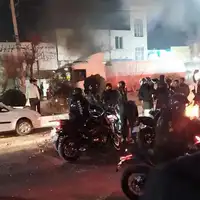
People gathered to watch a public execution in Iran
Eighty-two Iranian and international human rights groups are urging the UN agency on drugs and crime to suspend its cooperation with the regime in Iran, until it halts drug-related executions.
Mahmood Amiry-Moghaddam, one of the organizers of the call who heads Iran Human Rights, says the UN Office on Drug and Crime has remained silent about the sharp hike in drug-related executions in the country – while it cooperates with Tehran on combating drug trafficking.
“In addition to legitimizing the state’s use of the death penalty, this cooperation also leads to more executions through financial aid and equipment. A UN entity must not be complicit in drug executions in Iran,” Amiry-Moghaddam said.
“This joint action is to raise awareness and sensitise the international community and public about drug-related executions in Iran and increase the political cost of these executions for the authorities. The execution of more than one person per day under the pretext of drug offences should become intolerable for the people and the international community.”
Amnesty International’s latest report this month says at least 481 executions – more than half of the total 853 executions recorded in 2023 – were carried out for drug-related offenses.
“The number of executions in 2023 is the highest recorded since 2015 and marks a 48% increase from 2022 and a 172% increase from 2021. Iran’s killing spree is continuing into 2024, with at least 95 recorded executions by 20 March,” the Amnesty report read.
“Aimed at instilling fear and preventing more protests, the Islamic Republic executed at least 471 people for drug-charged in 2023, without any political cost and consequences,” Amiry-Moghaddam highlighted.
Execution numbers recorded by human rights groups are often the minimum figures and organizations like Amnesty International have often said that it believes the real number is higher.
“We are concerned that hundreds more will be executed in the coming months if we do not increase the political cost of these executions for the Islamic Republic. We call on all human rights organizations and activists to take part in a special global campaign to stop drug-related executions in Iran,” the statement read.
The signatories noted that the international community's muted response and limited media coverage for drug-related executions have led to these daily executions to take place with minimal public scrutiny. "On the other hand, the United Nations Office on Drug and Crime (UNODC) which cooperates with Iran in combating drug trafficking, has not only remained silent about the sharp hike in drug executions, but signed a new agreement with the Islamic Republic in May 2023."
Iran's top Sunni cleric Mowlavi Abdolhamid said in October that a lot of people are hanged In Iran for petty crimes involving only a few dollars. Abdolhamid told his congregation in Zahedan, capital of southeastern Sistan-Baluchestan Province, that lack of jobs in his province and some other impoverished areas is the prime reason people are driven to smuggling fuel, minor drug-related offences, or drug trafficking. "Many of these individuals end up in prison or are even executed for committing crimes that involve profiting as little as 5 million rials ($10)."
While on the surface, Iran has some of the world’s harshest drug laws – many of the regime’s own members are known to run parts of the drug business inside the country, including officials and high-ranking members of Iran’s Supreme National Security Council, managers from Tehran’s Municipality and members of parliament.