Iran To Expand Revolution Day Events Globally Amid Security Concerns
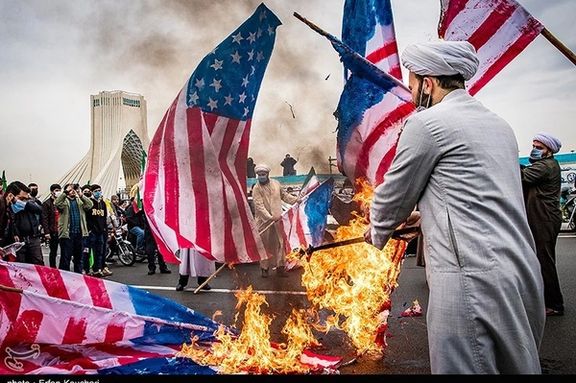
An Iranian official has announced that this year's revolution celebrations will extend to 140 international locations, with the focus on solidarity with Palestine.

An Iranian official has announced that this year's revolution celebrations will extend to 140 international locations, with the focus on solidarity with Palestine.
Traditionally, February sees the Iranian regime compelling its supporters and civil servants to participate in the 1979 revolution anniversary parades. The ten-day period from February 1st marks the arrival of Ayatollah Ruhollah Khomeini, the revolution's leader, in Tehran from Paris in 1979, culminating in the victory of the revolution on February 11th.
Abdollah Sohrabi, the head of the International Committee of the Islamic Revolution's celebrations, underscored on Sunday the importance of involving Iranians residing abroad in observing the 45th anniversary of the Islamic revolution. He stated, "This committee has prepared various programs for Iranians living outside the country."
Notably, every year the Iranian regime organizes global rallies on the anniversary to demonstrate its influence and convey a sense of strength.
This year's plans gain prominence in light of reports from The Times, suggesting Iranian agents were involved in fueling unrest in the UK through Gaza protests in recent months.
Direct Iranian regime involvement has been observed through the physical presence of operatives at protests and online disinformation campaigns. At a pro-Palestinian rally in London, British-Iranian activist Vahid Beheshti, staging a sit-in protest outside Westminster and calling for the designation of the IRGC as a terrorist organization, was assaulted by pro-Palestinian demonstrators. Beheshti, 46, reported a threat to cut his throat from a Hamas supporter.
An investigation by The Times of London revealed over six UK-based groups with ties to the Iranian regime actively participating in pro-Hamas rallies.


Iran will continue to support the Palestinians and “resistance groups”, President Ebrahim Raisi stated in Tehran on Sunday, emphasizing that compromise is not feasible.
“We have repeatedly stated without hesitation that supporting Palestine and resistance groups is on the agenda of the Islamic Republic's policies,” Raisi stated on Sunday.
Raisi’s speech in an Islamic gathering appeared to be the only response to President Joe Biden’s remarks on Saturday where he said Washington had delivered a private warning to Iran about its Houthi allies in Yemen responsible for attacking commercial shipping in the Red Sea.
"We delivered it privately and we're confident we're well-prepared," Biden told reporters at the White House before departing to the Camp David presidential retreat for the weekend.
On Friday, after American and British planes and ships attacked dozens of Houthi targets in Yemen, Biden told reporters that the US had delivered a message to Tehran.
Reactions from the Iranian government, the Revolutionary Guard and a web of hardliner media and politicians remained muted to Biden’s remarks. Overall, reactions even to the bombings in Yemen were low-key by officials and state media.
Biden, whose administration removed the Houthis from a State Department list of "foreign terrorist organizations" immediately after assuming office in 2021, was asked by reporters on Friday whether he felt the term "terrorist" described the movement now. "I think they are," Biden said.
Critics in Washington and elsewhere have expressed frustration that the Biden administration after pursuing a policy of accommodation with Iran and the Houthis for three years, still has not taken more decisive steps to establish deterrence against Tehran.
In 2023, Washington greenlit the release of up to $16 billion of frozen funds to Tehran, in an apparent de-escalation deal, while Hamas, another Iranian militant proxy, was preparing the October 7 attack on Israel. Even after the attack and the outbreak of the Gaza war the administration has not re-frozen the funds kept in Qatar and Oman.
Iran’s exiled Prince Reza Pahlavi issued a statement on Saturday harshly criticizing the Biden administration.
“While the Islamic Republic is financing and training its Houthi proxies, the American administration is facilitating this terror group’s continued access to capital,” he stated, in a reference to the released funds.
Critics also say that President Biden has allowed Iran to increase its oil exports to China, relaxing stringent sanctions imposed by his predecessor. Tehran’s oil revenues have increased from less than $10 billion in 2019 to nearly $30 billion in 2023.
“When he took office, President Biden made two critical mistakes: delisting the Houthis and refusing to implement oil sanctions on the dictatorship in Tehran.,” Pahlavi said in his statement. He went on to blame Biden’s policies for the current situation in the Middle East and urged the previous ‘maximum pressure policy to be restored. “This capitulation has brought about the latest regional conflagration by legitimizing this terror group and doubling the oil exports of their patron in Tehran— which has sold more than $100 billion worth since this administration took office.”

In a united effort, 80 political groups and parties, joined by more than 600 Iranian and non-Iranian activists, have initiated a week-long campaign against executions in Iran.
The campaign, scheduled from January 13-20, includes protests in 9 countries and 30 cities worldwide, where activists aim to engage with officials from various nations on the pressing issue.
A statement issued by activists emphasizes the diverse programs and protests planned across different cities globally throughout the week, urging individuals to "Join us to stop the execution and suppression machine in Iran through global unity and solidarity."
On Saturday, rallies opposing executions took place in several cities, accompanied by social media campaigns against the death penalty.
Particularly concerning were posts related to six prisoners sentenced to execution, featuring the hashtag "No to Execution." Additionally, users announced plans to initiate a X (Twitter) storm on Sunday evening.
Over the past four decades, Iran has consistently held a notorious reputation for having one of the highest per capita execution rates globally. The issuance of death sentences has witnessed a significant upswing following nationwide protests.
Human rights organizations, including the HRANA website, report that in 2023, at least 746 individuals were executed in Iran, marking a 32% increase compared to the previous year. During the same period, the issuance of death sentences was 68% higher than the preceding year.

Interim Friday Prayer Imam of Tehran, Hassan Aboutorabi-Fard, stated that the government has not returned $100 billion it withdrew from Iran’s National Development Fund (NDF).
This is tantamount to two-thirds of Iran’s aggregate reserve fund which was estimated to be as high as $150 billion.
“Even the resources granted by the NDF to the private sector have not been reimbursed,” added Aboutorabi-Fard, who holds a considerable sway in Iran as he is a member of the inner circle of Supreme Leader Ali Khamenei.
The NDF was established in early 2000s to save part of oil revenues for future generations and Iran’s development.
He criticized Iran’s oil-based economy in which prices of goods are fixed by the state. He emphasized that the country’s economy needs to move away from its dependency on oil and fossil fuels revenues towards knowledge and technology.
“The share of research in Iranian companies should be four percent today, whereas it is less than one percent,” Aboutorabi-Fard warned.
According to a report by the Iranian parliament’s research center released in August, as stringent international sanctions struck Iran during 2011-2013, the administration of former president Mahmoud Ahmadinejad initiated withdrawals from the NDF.
Despite the end of sanctions in 2015 after a nuclear agreement, withdrawals from the NDF persisted throughout President Hassan Rouhani’s two terms (2013-2021). In his initial presidential tenure, $30 billion was withdrawn. However, as former US President Donald Trump abandoned the JCPOA and re-imposed sanctions, the Islamic Republic increasingly relied on its reserves, resulting in a negative cash flow in the NDF.
The pace of withdrawals accelerated further under the hardliner president Ebrahim Raisi.

Media reports have highlighted Iran's renewed interest in pursuing FATF membership, and recently, the Ministry of Economy sent a protest letter to the financial watchdog.
The ministry argued that Iran’s 2015 JCPOA nuclear deal with world powers removed all sanctions, and Iran should not be economically penalized by the FATF.
The Financial Action Task Force (FATF) is a global body combating money laundering, terrorist financing, and proliferation of weapons of mass destruction. FATF Recommendations set international standards for anti-money laundering (AML) and counter-terrorist financing (CFT). The Convention against the Financing of Terrorism (CFT) targets terrorism financing, and the Palermo Convention (UNTOC) addresses transnational organized crime, including money laundering and human trafficking. These measures enhance transparency, traceability, and accountability in financial transactions to prevent illicit use of financial systems.
President Raisi administration is skeptical about Iran joining the FATF, as it has kept Iran on the organization's blacklist since February 2018. Raisi contends that focusing on relationships with "neighbors and friendly" nations is a better course of action than the previous administration's “obsession” with membership in the FATF.
The Rouhani administration in 2017 proposed a series of bills to parliament to enact legislation that would bring Iran’s financial regulations in line with those of FATF. However, hardliners prevented final adoption of those laws and Iran remained on the watchdog’s blacklist.

Considering the Raisi administration's shift in approach and the acknowledgment by Mohammad Sadr, a regime insider that there is potential for progress in addressing the FATF issue, especially with the current economic challenges facing the government.,
The letter from the Minister of Economy of Iran was sent at a time when some economists in Iran express skepticism about the efficacy of such correspondence in resolving the FATF issue. To address the problem, it is crucial to first clarify Iran’s position toward the CFT (Counter Financing of Terrorism) and Palermo conventions. Economist Vahid Shaghaghi speaking to media in Tehran emphasized that without approving the Palermo and CFT bills, Iran's request will not be taken seriously. Only after the approval of these two bills can Tehran proceed to write a letter requesting the removal of Iran's name from the blacklist. Even in that case, it may take 2 to 3 years for Iran to be added to the gray list.
Whether these bills are approved or not is a complex matter, because there is a disagreement over the essence of words and terms. Iranian hardliners are concerned that adhering to international standards against money laundering and terrorism financing will interfere with the regime’s efforts to support its militant proxies in the region. The Lebanese Hezbollah, Hamas and others are either officially labeled terrorist or are under severe surveillance as terror operatives.
The core of the Iranian regime is reluctant to join the FATF and follow international financial standards and conventions, even after the government submitted four proposals in 2017 to incorporate FATF criteria—two of which were rejected by the hardline Guardian Council. While opponents claim that compliance limits support to recognized terrorist groups and exacerbates political tensions, Iranian officials realize the economic difficulties linked to non-adherence. Some argue that these steps must be taken immediately, pointing out that Iran cannot conduct international banking or trade without FATF clearance, even if sanctions are repealed.

Iranian police officers violently detained a woman in Tehran on Saturday for non-compliance with mandatory hijab regulations.
The officers singled out the woman, physically assaulted her, and forced her into a police van.
According to videos released on social media, police forces in Shahrak-e Gharb, northwest of the capital Tehran, took the woman out of her vehicle because she was not covering herself in the car.
In recent years, security forces of the regime have detained numerous women and girls across the country for failing to adhere to compulsory hijab, subjecting them to physical abuse and harassment.
On January 3, Iranian woman Roya Heshmati received 74 lashes for defying the Islamic Republic’s mandatory hijab. The execution of the sentence sparked widespread condemnation on social media.
Despite restrictive legislation and the Islamic Republic's efforts to suppress opponents of mandatory hijab, the struggle for women in Iran to secure the right to choose their attire continues.
Since the killing of 22-year-old Mahsa Amini in police custody in September 2022, which ignited the Women, Life, Freedom protests, the act of civil disobedience has become increasingly difficult for the regime to control. Daily images of women without compulsory hijab continue to circulate online.
According to the annual report by HRANA, a human rights organization, in 2023, 44 women were detained for women's rights activism. At least 20 activists have been sentenced to 182 months of imprisonment in addition to fines. Two individuals have also received a sentence of 222 lashes.